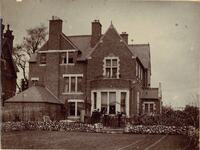
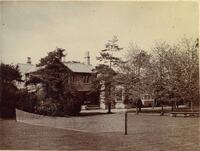
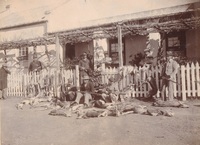
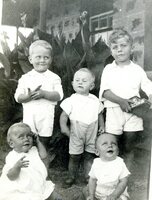
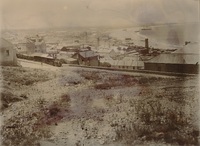
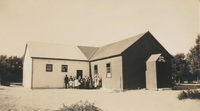
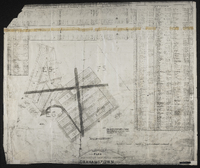
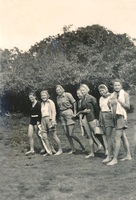
A series of photographs showing views of forced removal of communities from Klipfontein farm, near Kenton-on-sea, and other areas, to Glenmore in 1979. These photographs were accumulated by Ben Maclennan when he worked as a journalist for Eastern Province Herald, covering the move, and when he wrote the book "Glenmore : the story of a forced removal
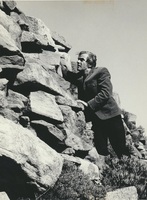
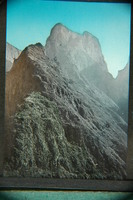
Norman Coombs and an example of the dry-stone packing which Bain used to build his many passes. The picture was taken in Pluto's Vale, one of Bains' contraptions in the Eastern Cape.
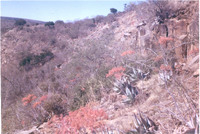
Coral Aloes Aloe striata. Much of this hillside was covered with them but the dryness of the grass hides their redness in the picture. Many sunbirds were active at the time the photo was taken.
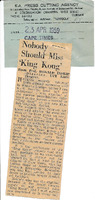
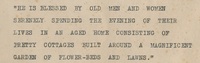
Transcript: "He is blessed by old men and women serenely spending the evening of their lives in an aged home consisting of pretty cottages built around a magnificent garden of flower-beds and lawns."
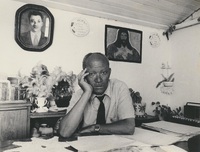
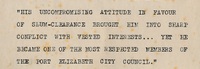
Transcript: "His uncompromising attitude in favour of slum-clearence brought him into sharp conflict with vested interests... yet he became on of the most respected members of the Port Elizabeth city council."
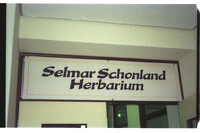
The new name was given in honour of Dr. Selmar Schonland, former Director of the Museum and Keeper of the Herbarium, when Rhodes University Herbarium was merged with the Albany Museum Herbarium in 1990's.
From the Preface: This volume presents a critically compiled and historically grounded narrative of Ntsikana, widely regarded as one of the earliest African Christian converts and hymn composers among the amaXhosa. Prepared originally in 1878–79 and revised for publication in 1914, the work represents the first sustained attempt to render Ntsikana’s life and religious influence into a coherent English narrative. The account is based on a triangulation of sources, including oral testimony from elders who personally knew Ntsikana or his family, family memory preserved through the author’s grandparents, early missionary periodicals, and archival documents. Central among the written sources are articles published in Isigidimi Samaxosa (1875–1888) and the rediscovered 1845 issues of Ikwezi, the earliest Kafir–English missionary periodical, printed at the Chumie Mission Press.
The volume also preserves four hymns attributed to Ntsikana, transmitted through oral tradition and here recorded with both words and melodies, underscoring his role in the indigenisation of Christian worship in southern Africa. Supplementary appendices include contemporaneous writings by Ntsikana’s close companions—later known as Charles Henry (Matshaya) and Robert Balfour (Noyi)—as well as extracts from Charles Brownlee’s authoritative nineteenth-century reflections on Xhosa society. Together, these materials situate Ntsikana within the broader historical context of early missionary encounter, African religious agency, and the beginnings of Christianity among the amaXhosa. The work argues for the essential reliability of the narrative, noting that subsequent references and critiques have largely confirmed, rather than contradicted, its central claims.