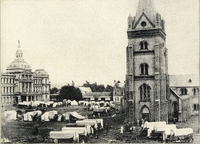
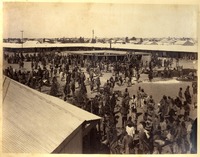
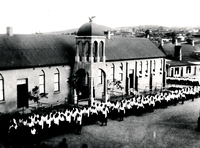
Nachtmaal on Church Square in Pretoria (probably in the 1890s) showing Afrikaner gathering with tents and ox wagons.,'Nachtmaal', a quarterly scene on the Church Square, Pretoria, when the Boer Farmers and their families come to Sacrament, Confirmation, Marriage and Christening Ceremonies. They 'camp out' in the middle of the town and their vrouws (wives) carry on their household duties, cooking, etc., 'right there'
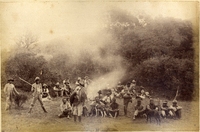
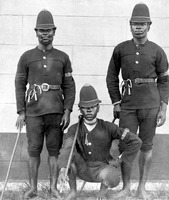
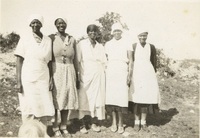
Taken from the description on the Origins 22 - Genealogy & History Facebook page (dated 29 January 2026): "In addition to maintaining order within their own communities, Black Africans also served alongside British forces during the South African War. Estimates suggest that between 15000 and 30000 Black Africans were employed in armed support roles, such as scouts and sentries, while a much larger number, approximately 100000, were engaged in essential non-combatant work. These roles included labour, transport driving, blacksmithing, wheelwrighting, farriery, and construction. Their contributions played a significant part in sustaining British military operations during the conflict."
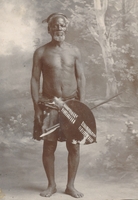
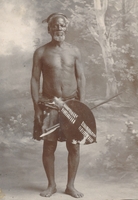
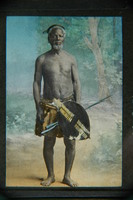
Note on back reads: “This is a photograph of Ndogeni, the Zulu who accompanied Dick King on his famous ride in 1842. The Boers at this time laid claim to Port Natal. It was, however, because England was determined to protect the rights of her subjects that Capt. Smith and a couple of hundred men were forthwith sent to Durban. On the 25th of May (same year), the situation having become extremely critical, it was imperative to send for help and over a distance of not less than 500 miles of the wildest country. Dick King volunteered at once for this service. As Ndogeni, then 15 or 16 years of age, was his servant and knew how to ride, King selected him as his companion, other persons, for some reason or another, being unavailable. Ndogeni was not, at the outset, told the true objective of the journey, no doubt on account of his youth as well as his nationality. The two were rowed across the Bay in a boat at night by George and Joseph Cato, their two horses being swum at the stern. Ndogeni accompanied King for nearly 250 miles and over what was undoubtedly the most perilous part of the journey. He would have gone further, only, owing to an omission, he became incapacitated because obliged to ride this great distance without stirrups. He proved of considerable assistance to his master, indeed it is not too much to say that without some such help as he was able to afford, the mission might not have been quite as successful as it was. Natal was saved. It is partly because his account of the journey throws fresh lustre on King’s magnificent achievement, that Ndogeni’s narrative has been specially translated, and the accompanying photograph taken.”
Note on back reads: “This is a photograph of Ndogeni, the Zulu who accompanied Dick King on his famous ride in 1842. The Boers at this time laid claim to Port Natal. It was, however, because England was determined to protect the rights of her subjects that Capt. Smith and a couple of hundred men were forthwith sent to Durban. On the 25th of May (same year), the situation having become extremely critical, it was imperative to send for help and over a distance of not less than 500 miles of the wildest country. Dick King volunteered at once for this service. As Ndogeni, then 15 or 16 years of age, was his servant and knew how to ride, King selected him as his companion, other persons, for some reason or another, being unavailable. Ndogeni was not, at the outset, told the true objective of the journey, no doubt on account of his youth as well as his nationality. The two were rowed across the Bay in a boat at night by George and Joseph Cato, their two horses being swum at the stern. Ndogeni accompanied King for nearly 250 miles and over what was undoubtedly the most perilous part of the journey. He would have gone further, only, owing to an omission, he became incapacitated because obliged to ride this great distance without stirrups. He proved of considerable assistance to his master, indeed it is not too much to say that without some such help as he was able to afford, the mission might not have been quite as successful as it was. Natal was saved. It is partly because his account of the journey throws fresh lustre on King’s magnificent achievement, that Ndogeni’s narrative has been specially translated, and the accompanying photograph taken.”
Accompanied his master Dick King on his famous ride to Grahamstown in 1842 to summon assistance for a besieged British army in Natal. Although Ndongeni (about sixteen at the time) did not complete the journey to Grahamstown his assistance was considered vital to Dick King's success. Original photograph by "The Rembrandt" Studio, Durban.