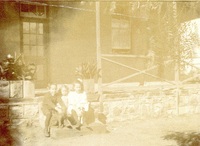
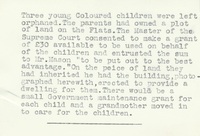
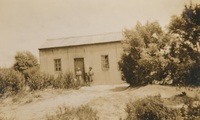
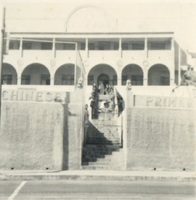
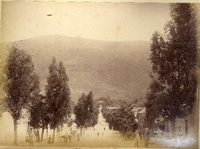
Transcription: "Three young Coloured children were left orphaned. The parents had owned a [plot of land on the Flats. The Master of the Supreme Court consented to make a grant of £30 available to be used on behalf of the children and entrusted the sum to Mr. Mason "to be put out to the best advantage." On the piece of land of land they had inherited he had the building, photographed herewith, erected to provide a dwelling for them. There would be a small Government maintenance grant for each child and a grandmother moved in to care for the children".
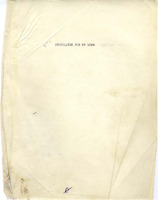
Typed inscription on the back of the photo: "Three young Coloured children were left orphaned. The parents had owned a [plot of land on the Flats. The Master of the Supreme Court consented to make a grant of £30 available to be used on behalf of the children and entrusted the sum to Mr. Mason "to be put out to the best advantage." On the piece of land of land they had inherited he had the building, photographed herewith, erected to provide a dwelling for them. There would be a small Government maintenance grant for each child and a grandmother moved in to care for the children".
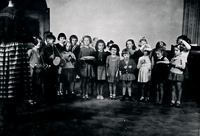
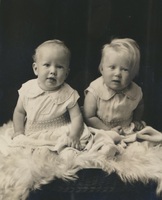
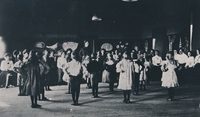
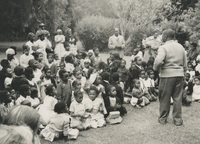
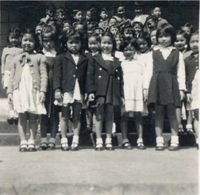
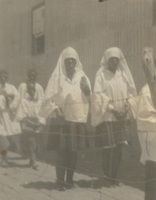
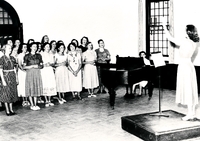
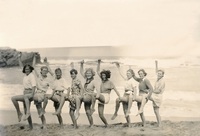
A photograph album compiled by Mary Butler, containing photographs of Wayfarers, Sunbeams and Pathfinders, mostly in Cradock. Two newspaper clippings and a handwritten concert programme included. There are three photographs of Rev. James Arthur Calata's young daughters, and he himself is included in two photographs. This photograph showing a choir consisting of young African girls at St James Mission in Cradock, Eastern Cape. Rev James Arthur Calata was the priest-in-charge of St James Anglican Mission Church and also school mananager of the St James Mission School. He had deep interest in the education of an African child. Amongst the things he did for the mission school was to re-create it into a social sphere of transformation, and established a church choir
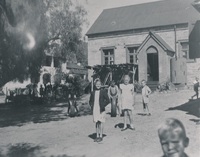
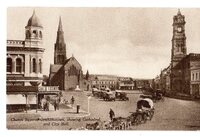
A sepia-toned postcard or print depicting Church Square in Grahamstown. The scene shows the Anglican Cathedral of St. Michael and St. George in the center and the City Hall clock tower on the right. The foreground captures a transition in transport, featuring both motorised vehicles parked in a row and a traditional donkey or ox-drawn wagon in the lower right. The "Bon Marche" building is visible on the far left.