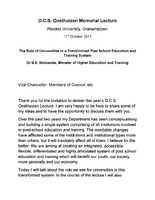
Minister Blade Nzimande outlines the government's vision for an integrated and differentiated post-school education system. He addresses the tension between academic freedom and the developmental needs of the state, arguing that while the government does not seek to "muzzle" universities, academic freedom must not be used as a shield to avoid social accountability or to hide corruption. He specifically critiques the "hysterical" opposition to the State Information Bill.
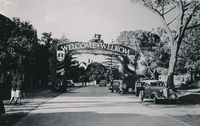
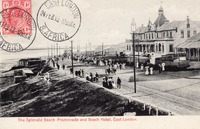
"The Splendid Beach Promenade and Beach Hotel, East London." Postcard published by the East London branch of J.C. Juta & Co. Posted to Dresden in Germany via Southampton on the 24th February 1913 with the stamp on the front of the card, which was often the preference of collectors from continental Europe at the time. An added bonus with this card is the interprovincial use of a Transvaal stamp in the Cape Province.
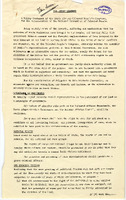
This item consists of the formal indictment issued by the Attorney-General of the Transvaal Province against Abram Fischer, charging him with multiple offences including sabotage under the General Law Amendment Act (Act No. 76 of 1962), contraventions of the Suppression of Communism Act (Act No. 44 of 1950, as amended), and charges of fraud, forgery, and uttering under South African statutory law. The document forms part of the prosecution record in one of the most significant political trials of the apartheid era, reflecting the use of security legislation against anti-apartheid activists and legal practitioners.
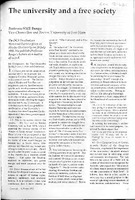
Delivered by the Vice-Chancellor of the University of Fort Hare after 14 years in exile, this lecture focuses on the relationship between higher education and the quest for a free society. Bengu emphasizes the need for universities to be relevant to their regional communities and argues that academic freedom is inseparable from the broader democratic struggle of the people.
An exploration of the university's social responsibility toward those marginalized by apartheid policies. It defines "new foreigners" as Africans stripped of South African citizenship and Section 10 urban residency rights through the Bantustan system and resettlement programs. The lecture calls for universities to adopt multi-disciplinary approaches to address poverty, malnutrition, and legal injustices in the "periphery" or reserves.
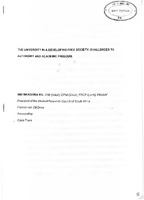
Makgoba discusses the shift from the classical British model of university autonomy to a "co-operative governance model" suited for a developing South Africa. He argues that universities must be developmental instruments for the nation and suggests that a "high-trust syndrome" between the state and the university is necessary to protect academic freedom in the new millennium.