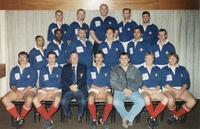
Albany Rugby Voetbal Klub Tweede Span 1998, Tweede span - 1998, Team photograph with rugby/football players, in rugby uniform (blue jersey, white shorts, red socks), Group photograph, Colour photograph, Indoor photograph, Players standing have arms in front of themselves, by their sides or behind their back while those sitting have their hands in their laps, Agter (van links na regs): D. Potgieter, G. Dyson, G. Petser, M. Sweeny, D. Crous, Middel (van links na regs): A. Estruis, S. Thompson, J. Botha, H. Warrington, N. van Vuuren, J. Lourens, Voor (van links na regs): F. Zeelie, P. Demmers, G. Sawyer (President), N. van Vuuren (Kaptein), Joos Vos (Afrigter), I Dorfling, T. Pretorius.
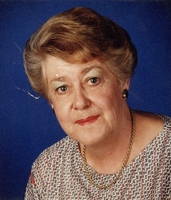
Albany Sports Club President Gail Boy, Albany Sports Club, Albany Sports Club President Gail Boy, President. 1990-1992, 1993-1996, 1997-1999, Portrait photograph, Colour photograph, Blue background.
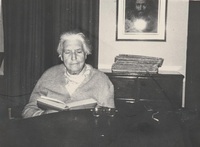
Alice Eyre Butler (Stringer) was the wife of Ernest Collett Butler. They were the parents of Guy Butler, Joan Butler, Dorothy Butler, Christine Moys Butler and Jeffrey Butler.
This introductory text (Intshayelelo) to Incwadi yeBali neNtlalo yama-Mpondo, authored by Victor Poto Ndamase, articulates a deliberate intellectual and cultural project aimed at preserving the historical memory, social organisation, customs, and genealogies of the amaMpondo people. Written in isiMpondo, the introduction frames history (imbali) and social custom (intlalo) as essential safeguards against cultural erosion, moral disorientation, and uncritical assimilation of foreign practices. Ndamase emphasises the importance of documenting indigenous knowledge from within the community itself, arguing that written records enable comparison, discussion, and intergenerational transmission. Central to the work is the preservation of genealogies (imilibo), envisioned as a living “tree” whose branches connect present and future generations to their ancestral origins. Linguistic reflection further underscores the distinctiveness of isiMpondo in relation to isiXhosa, justifying the use of the former as the primary medium of narration. The introduction also situates the text within a broader emerging African-authored historiography, acknowledging parallel efforts by other Black intellectuals and stressing collaboration rather than competition in the pursuit of historical truth. Finally, the text documents the crucial role of informants—most notably Mangala—whose life history is carefully recorded as a guarantor of authority, continuity, and credibility. As such, Intshayelelo stands as both a methodological statement and a manifesto for indigenous historical writing in early twentieth-century Southern Africa.