Martin Plaut Collection
Item set
- Title
- Martin Plaut Collection
- Description
- Martin Plaut Photographic Collection: In May 2015, Martin Plaut donated digital copies of six photographs he had purchased at a photographic fair in London to the Cory Library. He had recognised them as being taken in Grahamstown. Of the six, five are in fact related to the laying of the foundation stone of the chancel of the Cathedral of St Michael and St George on 29 January 1890, with the accompanying visit of the Governor of the Cape Colony, Sir Henry Loch. The sixth is of an imposing house, seemingly unrelated to the other five photographs. He later donated seven additional digital images of Grahamstown, King William's Town and Eastern Cape relevance, which he had purchased on eBay. Unfortunately, they therefore lack provenance, but research has provided contextual information wherever possible.
Items
-
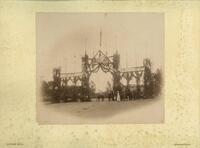 A decorative arch, part of the town decorations to welcome the Governor on the occasion of the laying of the foundation stone of the chancel of the Cathedral of St Michael and St George, reads in Latin "Praetorem Andreae pueri Aidanique salutant, omnes Patronum te clamant urbis alumni." (St Andrew's and St Aidan's boys greet the Governor, and all the scholars of the city schools hail their patron) Smaller shields read "Religio" and "Scientia". (Religion and knowledge)
 -
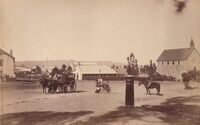 A late 19th-century sepia photograph capturing daily life in Grahamstown (now Makhanda). The scene features a horse-drawn carriage on the left, a woman with a child in a pram in the centre, and a mounted rider on the right. A prominent Victorian-style pillar postbox stands in the foreground. In the background, colonial buildings and a church with a bell cote are visible against the local hills.
 -
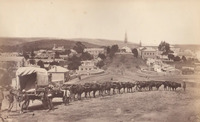 A wide-angle landscape photograph looking down a dirt-paved High Street in Grahamstown. In the foreground, a large span of oxen is harnessed to a covered transport wagon with several attendants standing nearby. The background features the spire of the Cathedral of St. Michael and St. George and various colonial-era buildings against the hills.
 -
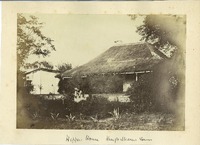 View of a man seated on the step of a thatched house in an overgrown garden, reading a newspaper. An inscription on the mount reads: 'Hepper's house, King William's Town'.
 -
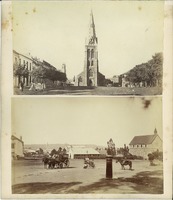 Two photographs stuck on card, of: (a) View of High Street, Grahamstown, showing the Cathedral of St Michael and St George with the spire, completed in 1878. The Settlers Memorial Tower, completed in 1870, can be seen to the left. (b) View of the intersection of Worcester and Somerset Streets, Grahamstown, with a Victorian fluted pillar box ca. 1859-60 in the foreground, reputed to be the oldest official letter box in South Africa. The house of the Headmaster of St Andrew's College is visible behind it, with Christchurch, built in 1876, in the distance. The latter photograph was taken by Aldham and Aldham, photographers active in Grahamstown from1879-1905.
 -
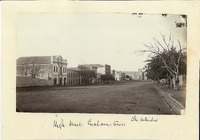 View of an almost deserted High Street, looking eastwards towards the Cathedral of St Michael and St George. The photograph is mounted on card which bears the inscription 'The Cathedral High Street Grahamstown'. It predates the building of the Cathedral spire, completed in 1878.
 -
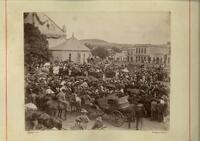 Laying of the foundation stone of the chancel of Cathedral of St Michael and St George, Grahamstown.View from south side of Church Square of the laying of the foundation stone of the chancel of the Cathedral of St Michael and St George by the Governor, Sir Henry Loch, on 29 January 1890. A photographer from Barraud Brothers is visible in the background.
 -
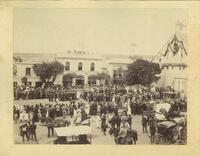 A note on the verso reads ' The laying of the foundation stone of the chancel of the Cathedral of St Michael and St George, Grahamstown, by His Excellency, Sir Henry Loch, GCMG KCB, Wednesday, 29th January 1890'. It shows a view from the north side of Church Square.
 -
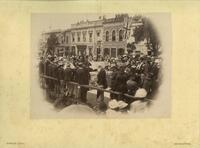 View from the north side of Church Square showing the laying of the foundation stone of the chancel of the Cathedral of St Michael and St George by the Governor, Sir Henry Loch, on 29 January 1890. The camera of F. W. Hepburn is visible in the upper left window of 'T.H. Parker', a stone building in the background.,Donated by Martin Plaut, 2015
 -
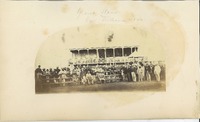 Although an inscription on the mount describes this as 'Grand stand, King William's Town', the building in question is however identical to that in a photograph by F.W. Hepburn of a race meeting in Grahamstown, taken in 1864, and held in the van der Riet collection at Cory Library.
 -
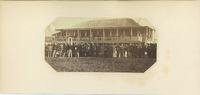 Spectators at a race course, possibly in King William's Town, standing in front of the grandstand.
 -
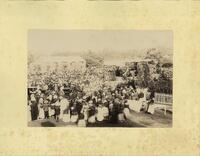 The verso of the photograph has a note which reads: 'Reception of Sir Henry Loch, KCB GCMG at the Drostdy, Grahamstown, Eastern Cape, South Africa, Tuesday 28th January 1890.' He was in Grahamstown for the laying of the chancel foundation stone of the Cathedral of St Michael and St George.
 -
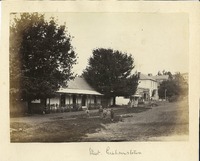 Although only inscribed 'Street. Grahamstown' on the mount, this is in fact a photograph of The Oaks, a cottage in Somerset Street, taken by Dr. W.G. Atherstone. It shows six little boys playing in the foreground, with Renfrew House to the extreme right.
 -
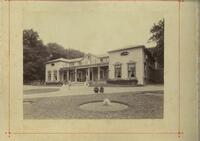 Unidentified house with flagpole on balcony above front porch.
 -
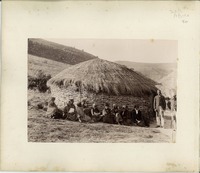 View of a thatched hut, showing clearly the wattle and daub construction. Two men in western dress are shown with ten seated women, all in traditional headscarves and blankets. The card mount has an inscription in the upper right corner: 'South Africa. 30'.