Grahamstown, Eastern Cape, South Africa
Item set
- Alternative Title
- Grahamstown, Cape Colony
- Creator
-
Cory Library for Humanities Research
- Role Relationship - Role
- en compiler
- Description
- A curated digital collection documenting the history of Grahamstown (Makhanda). This set includes historical photographs, maps, architectural plans, and civic records. Key themes include the 1820 Settler heritage, Victorian-era development, local religious institutions, and the socio-political evolution of the town within the Eastern Cape.
- Type
- Collection
- Subject
- Grahamstown (South Africa) -- History
- Makhanda (South Africa) -- History
- Architecture -- South Africa -- Grahamstown
- Eastern Cape -- Local History
- Temporal Coverage
- 19th Century to 20th Century
Items
-
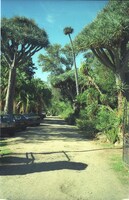 Array of alien palms and indigenous aloes. etc. The gardens were established in 1853.
 -
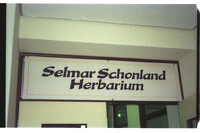 The new name was given in honour of Dr. Selmar Schonland, former Director of the Museum and Keeper of the Herbarium, when Rhodes University Herbarium was merged with the Albany Museum Herbarium in 1990's.
 -
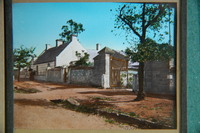
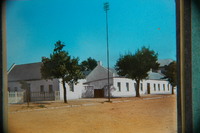 View of the Old Deanery and the Diocesan office in High Street, on the site of the current St. George's Chambers.
 -
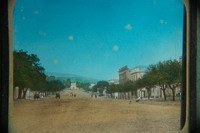 Eastern Districts court.
 -
-
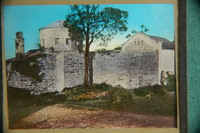
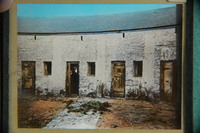
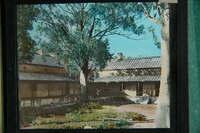 The courtyard within the old Military Hospital and part of the verandah surrounding it. This building was known for many years as the Schonland Botanical Laboratory and today still forms part of the Botany Department of Rhodes University.
 -
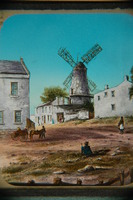 Painting showing the Old Mill on the corner of George and Market Streets, and on the left corner, the home of Mr George Wood, first Mayor of Grahamstown. The small cart was used to carry Miss Josie Wood (founder of the South African Library for the Blind) to school.
 -
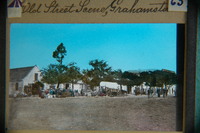 View showing the south side of upper High Street, from "Charles Pote's Auction Rooms" on the corner of Hill Street, as far as Hayton's Building. Trees, an ox wagon and people obscure the buildings.
 -
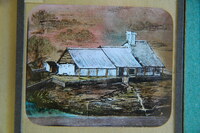 View showing the south side of upper High Street, from "Charles Pote's Auction Rooms" on the corner of Hill Street, as far as Hayton's Building. Trees, an ox wagon and people obscure the buildings.
 -
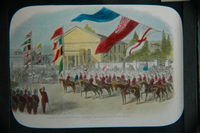 Showing the opening of the only Parliamentary session ever held away from Cape Town.
 -
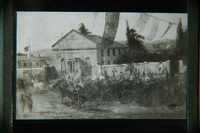 Showing the opening of the only Parliamentary session ever held away from Cape Town.
 -
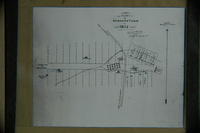 Copy made by Sir George Cory in 1904 of a plan of Grahamstown dated 1814.
 -
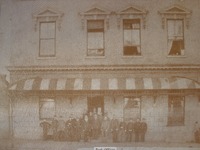 A sepia-toned group portrait of postal workers standing in front of the Grahamstown Post Office. The building features four prominent windows with decorative pediments on the upper floor and a large, striped corrugated-iron awning (veranda) over the ground-floor entrance. A diverse group of men in period attire, likely including postmen and administrative staff, are posed for the photograph.
 -
-
-
-
-
-
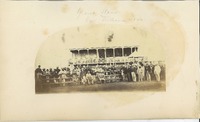 Although an inscription on the mount describes this as 'Grand stand, King William's Town', the building in question is however identical to that in a photograph by F.W. Hepburn of a race meeting in Grahamstown, taken in 1864, and held in the van der Riet collection at Cory Library.
 -
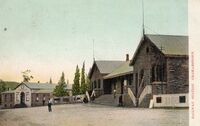 Post from Mark Finnigan in Grahamstown History Facebook group: "Grahamstown Railway Station. Postcard by J. C. Juta & Co. of Grahamstown. Posted to Krom River Siding in 1908."
 -
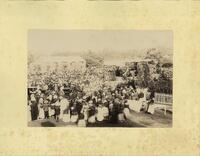 The verso of the photograph has a note which reads: 'Reception of Sir Henry Loch, KCB GCMG at the Drostdy, Grahamstown, Eastern Cape, South Africa, Tuesday 28th January 1890.' He was in Grahamstown for the laying of the chancel foundation stone of the Cathedral of St Michael and St George.
 -
-
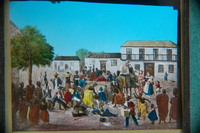 This painting by Frederick I’Ons is sometimes called ‘The Pump scene’, and shows the well which used to be sited at the junction of High and Bathurst Street – not Market Square as mentioned in the title. The double storey building in the background made way for the Commemoration Church in later years.
 -
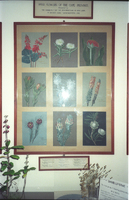 Display Sister Jeannie's flower paintings in foyer. A gift from Sisters of the Community of the Resurrection, per kind favour, the Curator, Tony Dold. (the white spot is a light reflection).
 -
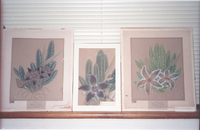 Three examples of Mary Elizabeth Barber's flower paintings. All stapelias. By kind permission the Curator, Mr. T. Dold