The Development of Settler Towns
Item set
- Alternative Title
- Eastern Cape Settler Towns Historical Collection
- Description
- The Development of Settler Towns is a major digitised archival collection from the Cory Library and Historical Archives at Rhodes University, forming part of The Frontier Collection. It brings together nearly 468 digitised resources documenting the historical emergence, expansion, and material culture of settler towns across the Eastern Cape, South Africa during the colonial and frontier period. The collection includes sub-sets on towns such as Alice, Bathurst, Bedford, Cathcart, Cradock, East London, Grahamstown, King William’s Town, Port Alfred, Port Elizabeth, Queenstown and others, illustrating a range of urban development patterns, community activities, built environments, maps, plans, and visual materials that reflect the social, economic, and geographic histories of these settlements. As an overarching thematic grouping within the Cory Library’s frontier history holdings, this item set supports comparative and place-based research into settler town origins, colonial infrastructure, demographic change, and regional interactions in the Eastern Cape.
- Language
- English
- Type
- Collection
- Spatial Coverage
- Eastern Cape, South Africa (multiple towns)
- Temporal Coverage
- Primarily 19th – early 20th century
- Format
- Digital images
- Maps
Items
-
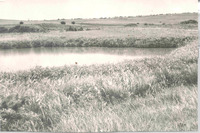 Dense Typha beds surrounding a vlei, used annually as a nesting site by Red Bishop birds.
 -
-
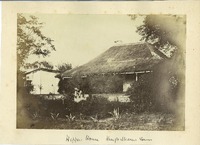 View of a man seated on the step of a thatched house in an overgrown garden, reading a newspaper. An inscription on the mount reads: 'Hepper's house, King William's Town'.
 -
-
-
-
-
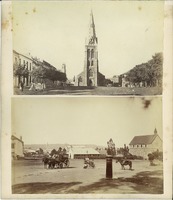 Two photographs stuck on card, of: (a) View of High Street, Grahamstown, showing the Cathedral of St Michael and St George with the spire, completed in 1878. The Settlers Memorial Tower, completed in 1870, can be seen to the left. (b) View of the intersection of Worcester and Somerset Streets, Grahamstown, with a Victorian fluted pillar box ca. 1859-60 in the foreground, reputed to be the oldest official letter box in South Africa. The house of the Headmaster of St Andrew's College is visible behind it, with Christchurch, built in 1876, in the distance. The latter photograph was taken by Aldham and Aldham, photographers active in Grahamstown from1879-1905.
 -
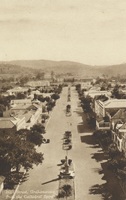
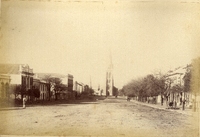
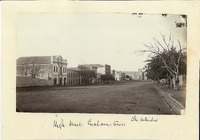 View of an almost deserted High Street, looking eastwards towards the Cathedral of St Michael and St George. The photograph is mounted on card which bears the inscription 'The Cathedral High Street Grahamstown'. It predates the building of the Cathedral spire, completed in 1878.
 -
-
-
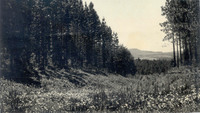 Spread of Zantedeschia aethiopica in damp hollow between pine plantations. Buttresses of southern Hogsback peak in distance.
 -
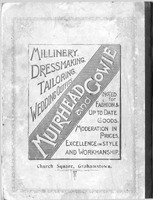 This publication, dated 1899, serves as souvenir publication of the industrial and arts exhibition held at Grahamstown, Cape Colony, between December 1898 and January 1899.
 -
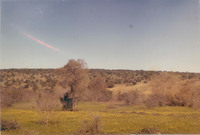 Field of forbs (Asteracae), scattered Combretum trees surrounding.
 -
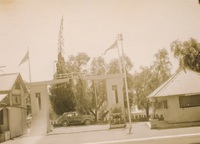
-
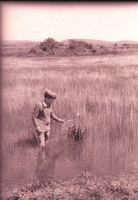 First flowering Vlei Lilies, Crinum campanulatum. The lilies were brought there from another vlei on the Burntkraal flats, by Mrs. Lou Mullins in 1960's.
 -
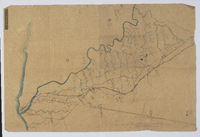 Inspection of telegraph line - G. McKay, East London to Potsdam - C. Brownlee, King Williams Town to Potsdam; [comp. by G. McKay?].Scale not stated. 1 sheet 14½" x 22". Manuscript; may be dated "1868".
 -
-
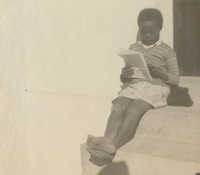 A photograph album compiled by Mary Butler, containing photographs of Wayfarers, Sunbeams and Pathfinders, mostly in Cradock. Two newspaper clippings and a handwritten concert programme included. There are three photographs of Rev. James Arthur Calata's young daughters, and he himself is included in two photographs. This photograph showing one of James Arthur Calata's daughters sitting on the stoep reading a book
 -
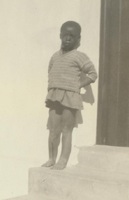 A photograph album compiled by Mary Butler, containing photographs of Wayfarers, Sunbeams and Pathfinders, mostly in Cradock. Two newspaper clippings and a handwritten concert programme included. There are three photographs of Rev. James Arthur Calata's young daughters, and he himself is included in two photographs. This photograph showing one of James Arthur Calata's daughters standing on the stoep. J.A. Calata had three daughters, namely, Nontsikelelo, Noluthando and Vuyiseka (born in 1922)
 -
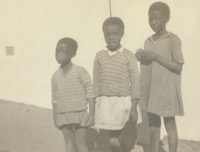 A photograph album compiled by Mary Butler, containing photographs of Wayfarers, Sunbeams and Pathfinders, mostly in Cradock. Two newspaper clippings and a handwritten concert programme included. There are three photographs of Rev. James Arthur Calata's young daughters, and he himself is included in two photographs. This photograph showing James Arthur Calata's three daughters standing next to a house. J.A. Calata had three daughters, namely, Nontsikelelo, Noluthando and Vuyiseka (born in 1922)
 -
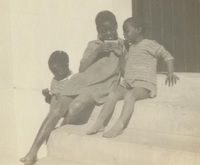 A photograph album compiled by Mary Butler, containing photographs of Wayfarers, Sunbeams and Pathfinders, mostly in Cradock. Two newspaper clippings and a handwritten concert programme included. There are three photographs of Rev. James Arthur Calata's young daughters, and he himself is included in two photographs. This photograph showing James Arthur Calata's three daughters sitting on the stoep, probably their house. They are probably looking at photographs or reading letters. J.A. Calata had three daughters, namely, Nontsikelelo, Noluthando and Vuyiseka (born in 1922)
 -
-
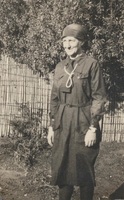 A photograph album compiled by Mary Butler, containing photographs of Wayfarers, Sunbeams and Pathfinders, mostly in Cradock. Two newspaper clippings and a handwritten concert programme included. There are three photographs of Rev. James Arthur Calata's young daughters, and he himself is included in two photographs. This photograph showing Joyce Brown, a Wayfarer Officer wearing her uniform, 1929
 -
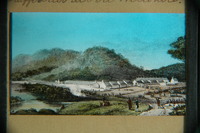 Fort Willshire was built by the Royal Engineers under Lieutenant Colonel Thomas Willshire of the 38th Regiment, on the orders of Lord Charles Somerset, in 1819.,From 1824 – 1830 weekly trade fairs were held at the Fort, where licensed British Settlers could trade in ivory, hides etc with Xhosa. At first cattle could not be traded, and trade in fire-arms and liquor was forbidden.