The Development of Settler Towns
Item set
- Alternative Title
- Eastern Cape Settler Towns Historical Collection
- Description
- The Development of Settler Towns is a major digitised archival collection from the Cory Library and Historical Archives at Rhodes University, forming part of The Frontier Collection. It brings together nearly 468 digitised resources documenting the historical emergence, expansion, and material culture of settler towns across the Eastern Cape, South Africa during the colonial and frontier period. The collection includes sub-sets on towns such as Alice, Bathurst, Bedford, Cathcart, Cradock, East London, Grahamstown, King William’s Town, Port Alfred, Port Elizabeth, Queenstown and others, illustrating a range of urban development patterns, community activities, built environments, maps, plans, and visual materials that reflect the social, economic, and geographic histories of these settlements. As an overarching thematic grouping within the Cory Library’s frontier history holdings, this item set supports comparative and place-based research into settler town origins, colonial infrastructure, demographic change, and regional interactions in the Eastern Cape.
- Language
- English
- Type
- Collection
- Spatial Coverage
- Eastern Cape, South Africa (multiple towns)
- Temporal Coverage
- Primarily 19th – early 20th century
- Format
- Digital images
- Maps
Items
-
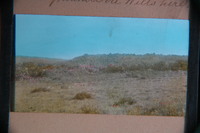 Fort Willshire was built by the Royal Engineers under Lieutenant Colonel Thomas Willshire of the 38th Regiment, on the orders of Lord Charles Somerset, in 1819.
 -
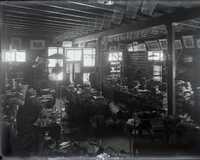 Glass negative : Views of the interior of Butler Bros., booksellers, stationers and importers, Cradock, possibly showing flood damage as the pictures show great confusion and mess.
 -
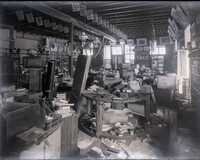 Glass negative : Views of the interior of Butler Bros., booksellers, stationers and importers, Cradock, possibly showing flood damage as the pictures show great confusion and mess.
 -
-
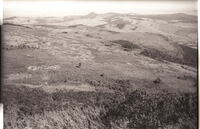 Looking westwards from top of Hoho Peak (Pirie West Peak) over Protea thickets in immediate foreground to the mid-picture ridge covered in Cliffortia fynbos and which might once have held dense Protea subvestita and /or Protea multibracteata thickets. Some of the latter still growing below the subvestita thickets there. iNtaba knNdoda Peak in distance.
 -
-
-
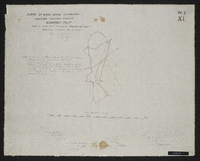 "Fine pasture country uninhabited and considered neutral ground". Title 29th January 1944. Copied by Walter P. Jones, 21st July 1873.
 -
-
-
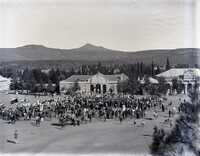 Glass negative : View of the celebration of Mafeking Day in Cradock, after the lifting of the Siege of Mafeking on 17 May 1900. Original holding envelope marked "Taken from G. B.'s roof".
 -
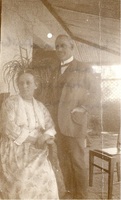
-
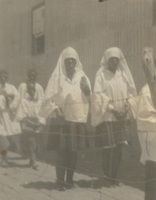 A photograph album compiled by Mary Butler, containing photographs of Wayfarers, Sunbeams and Pathfinders, mostly in Cradock. Two newspaper clippings and a handwritten concert programme included. There are three photographs of Rev. James Arthur Calata's young daughters, and he himself is included in two photographs. This photograph showing a choir consisting of young African girls at St James Mission in Cradock, Eastern Cape. Rev James Arthur Calata was the priest-in-charge of St James Anglican Mission Church and also school mananager of the St James Mission School. He had deep interest in the education of an African child. Amongst the things he did for the mission school was to re-create it into a social sphere of transformation, and established a church choir
 -
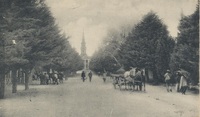
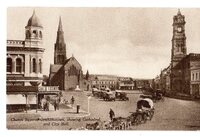 A sepia-toned postcard or print depicting Church Square in Grahamstown. The scene shows the Anglican Cathedral of St. Michael and St. George in the center and the City Hall clock tower on the right. The foreground captures a transition in transport, featuring both motorised vehicles parked in a row and a traditional donkey or ox-drawn wagon in the lower right. The "Bon Marche" building is visible on the far left.
 -
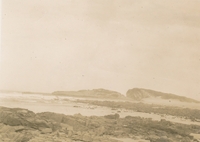 A photograph of Cove Rock, East London.
 -
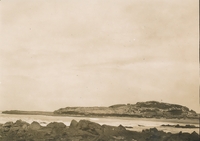 Photograph of Cove Rock, East London.
 -
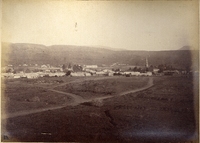 Album of "Photographs of South Africa", compiler and photographer not stated. Photos covering Easter and Western Cape, Natal, Free State, Rivers, Transport, Ostriches and Black people. [1880-1883],Gold Fields of South Africa Ltd. (donor)
 -
-
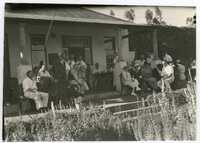 Glass negative : Views of the Cradock Bowling Green showing people seated outside the club house, taken in 1944.
 -
-
-
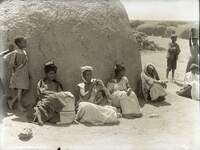 Glass negative : View of four women, one holding a baby, seated in front of a dome-shaped mud hut in Cradock location, 1900.
 -
-
-