Gold Fields : South Africa: Souvenir Album (1898)
Item set
- Description
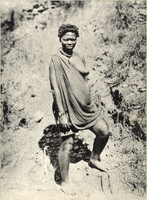
- The fifty-two platinotypes--prints made from a photographic process using ferric oxalate in combination with platinum salts deposited directly on the paper (rather than in an emulsion like the silver print process)--are arranged by the photographer following the itinerary of a route proceeding clockwise from Capetown up the eastern coast of South Africa, through Port Elizabeth, Grahamstown, and East London, to Durban, and Pietermaritzburg, and provide views of the churches, parks, harbors, and main streets of these cities. Also included is a portrait of a local "cabby," a Zulu boy, wearing animal horns on his head, with his rickshaw. Continuing up the coast into what is now Mozambique, Middlebrook photographs Delagoa Bay, and the towns of Inhambane, Beira, Chinde, at the mouth of the Zambezi River, and Quelimane. As he crosses west into the Matoppo Hills towards Bulawayo, he records "Mr. Rhodes' Farm Buildings," with a photo of "C.J.R."--Cecil Rhodes--in the entrance of one of his conical "huts". Shots of Kimberley include a bird's eye view of the city from the De Beers Floors, and the Kimberley Sanitorium built by Rhodes. In Johannesburg, Middlebrook records a bird's eye view of the city, the imposing new post office, Commissioner and Pritchard Streets, Joubert Park, the vast produce market, and processing buildings of the Randt Gold Mining Companies. There are also views of Pretoria--including a scene of "Naachtmaal," when Boer farmers and families come to town for church services, and camp out in the town square--and the hills near Barberton, where Sheba G.M. Company mines quartz. Seven of the photographs portray native people, such as Chief Khama of the Batlapins, well-known for his friendship with Livingstone; Zulu men wearing head gear of rickshaw pullers in Durban; Zulu families in front of their homes in Natal, Zululand; an Amaxosa family in Cape Colony (Cape of Good Hope); a Matabele cane seller; a woman from Swaziland in native garb; and an east coast man, known as a Zanzibaree. The final two photographs are steamships: U[nion] S[steam] S[hip] Company's "Briton"; and C[astle] M[ail] P[ackets] Company's "Carisbrook Castle." Late 19th-century South African photographer. The flourishing diamond mines in Kimberley brought hundreds of workers and photographers to the area beginning in 1867. J.E. Middlebrook followed soon thereafter in the early 1870s, and set up his photography studio, The Premier Studio, on West Street West ; he had a second studio in Durban, "Opposite the Club." Middlebrook photographed the landscape, farms, cities, and people of South Africa.
Items
-
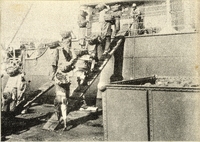 Coaling a steamer by means of the basket system, Durban harbour.
 -
 View of Johannesburg.
 -
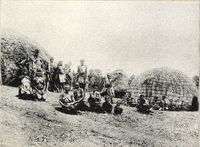 Zulu family in Zululand, South Africa.
 -
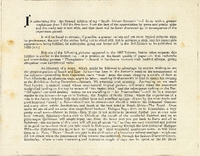 South African souvenir by J.E. Middlebrook, Introduction page. 2.
 -
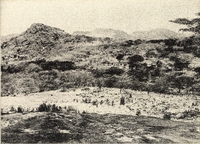 Kershaws Kopji (showing spot where Major Frederick Kershaw was killed in 1896 during the Matabele War), in the Matopos
 -
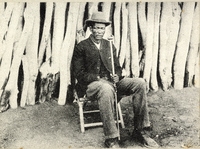 Originally titled "Chief Khama of the Batlapins, well known for his friendship with Livingstone also his Temperance principles."
 -
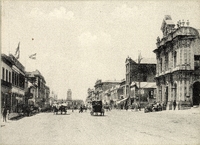 Main Street, Port Elizabeth showing buildings and town hall.
 -
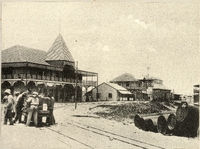 Main Street Beira shwoing railway offices.
 -
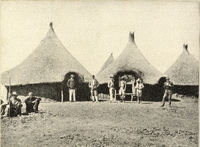 Cecil Rhodes' farm buildings with Rhodes at the entrance to his 'hut' in the Matopas.
 -
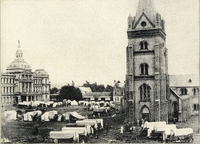 Nachtmaal on Church Square in Pretoria (probably in the 1890s) showing Afrikaner gathering with tents and ox wagons.,'Nachtmaal', a quarterly scene on the Church Square, Pretoria, when the Boer Farmers and their families come to Sacrament, Confirmation, Marriage and Christening Ceremonies. They 'camp out' in the middle of the town and their vrouws (wives) carry on their household duties, cooking, etc., 'right there'
 -
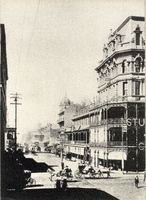 Pritchard Street (up to date), shewing Thorne Stuttaford's new six-storied Stockhouse, the ground on which this building is erected, 50ft by 50ft., cost £35,000.
 -
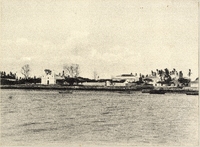 Quelimane from the river showing the Roman Catholic Church.
 -
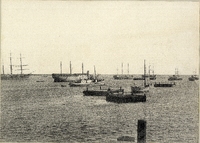 Ships and boats in Delagoa Bay.
 -
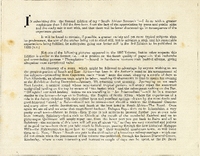 South African souvenir by J.E. Middlebrook, Introduction page 1.
 -
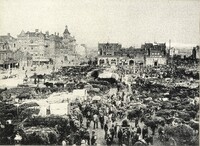 The early morning produce market, showing the enormous number of wagons and oxen used to convey 'supplies' to the important centre, Johannesburg.
 -
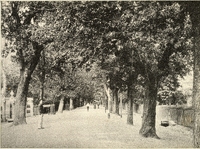 Gardens Avenue, Cape Town.
 -
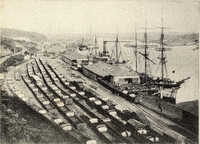 Harbour entrance, East London, South Africa. Showing ships and railway wagons.
 -
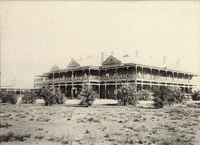 The Kimberley Sanitorium recently erected mainly by Cecil John Rhodes as a tribute to the climate for pulmonary complaints. Now the McGregor Museum.
 -
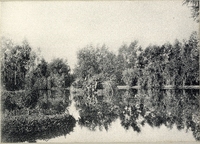 The Lake, a view in Joubert Park, Johannesburg.
 -
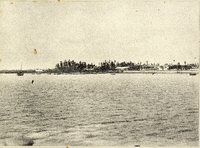 The Main Street (Rua Arugo), Lourenço Marques (Central Hotel on Left).
 -
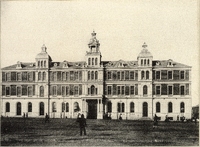 The Post Office in Rissik Street, Johannesburg, built in 1897.
 -
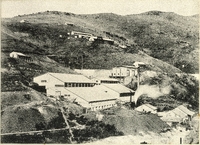 The Sheba G M Company's new quartz Crushing Mill, 120 head of stamps - and some of the employees quarters on the hill side, Barberton District.
 -
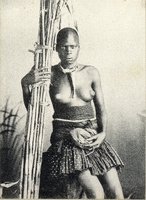 An Ndebele woman cane seller probably in Southern Rhodesia.
 -
-
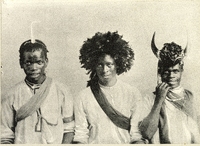 A photo of three Zulu rickshaw men wearing their ornamented headgear.