Gold Fields : Rand Rebellion 1922
Item set
- Alternative Title
- Rand Rebellion, 1922
- Rand Revolt, 1922
- Second Rand Revolt, 1922
- Creator
- Various creators
- Description
-
The Rand Rebellion, 1922 (also known as the Rand Revolt or Second Rand Revolt) refers to an armed uprising by white mineworkers in the Witwatersrand region of South Africa in March 1922. The rebellion arose from industrial conflict within the gold-mining industry, as mining companies sought to reduce costs in response to declining gold prices by restructuring labour practices, including the replacement of higher-paid white workers with lower-paid black labour. Following unsuccessful negotiations between mine owners, workers, and the state in February 1922, sections of the white mining workforce organised armed commandos and engaged in violent resistance to government authority.
The uprising escalated into widespread clashes between strikers, police, and state forces in areas including Johannesburg, Benoni, Brakpan, Springs, Fordsburg, and Brixton. The Union government, led by Prime Minister General Jan Smuts, declared martial law and deployed the Union Defence Force, artillery, and aircraft of the South African Air Force to suppress the revolt. By mid-March 1922, government forces had regained control, resulting in significant loss of life, mass arrests, and the imprisonment or death of several rebel leaders.
The Rand Rebellion had lasting political and social consequences, influencing labour relations, racialised employment policies in the mining sector, and the development of state security responses in South Africa. Materials in this item set document the events, participants, and contexts associated with the rebellion and its suppression. - Date Issued
- 1922-03
- Language
- English
- Genre
- Photographs
- Subject
- Rand Rebellion, 1922
- Labor disputes — South Africa — Witwatersrand
- Mine workers — South Africa — History — 20th century
- Gold mines and mining — South Africa — Labor disputes
- Trade unions — South Africa — History
- South Africa — Politics and government — 1910–1948
- Martial law — South Africa — History
- Communism — South Africa — History
- Temporal Coverage
- 1922
- Format
- image/jpeg
- Spatial Coverage
- Witwatersrand (South Africa)
- Johannesburg (South Africa)
- Benoni (South Africa)
- Brakpan (South Africa)
- Fordsburg (South Africa)
- Brixton (Johannesburg, South Africa)
- Extent
- Multiple items
- Medium
- Photographic materials
Items
-
 Newspaper clipping of a photograph heading: "Rival detachments meeting on Tuesday morning, March 7, in the middle of Joubert Street - Johannesburg's narrowest thoroughfare".
 -
 Newspaper clipping of an article heading which reads: "Monday and Tuesday in Johannesburg.".
 -
 Newspaper clipping of an article heading: "In the heart of the shopping centre".
 -
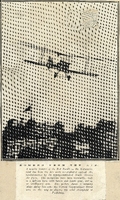 Newspaper clipping showing a scouting plane flying low over the Central Commissioner Street area on the way to observe the rebel stronghold at Fordsburg. The caption below the photograph reads: "Bombed from the air: A notable feature of the Red Revolt on the Witwatersrand has been the fine work accomplished against the revolutionaries by the newly-established South African Air Force. The aeroplanes have been invaluable, both on a fighting force with bombs and Lewis guns, and as an intelligence arm. The picture shows a scouting 'plane flying low over the Central Commissioner Street area on the way to observe the rebel stronghold at Fordsburg.".
 -
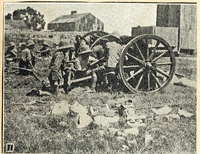 Newspaper clipping showing one of the guns that bombarded Fordsburg, Johannesburg in South Africa during the Rand Rebellion, from 11 o'clock till 10 minutes past noon on Tuesday (possibly 14 March 1922).
 -
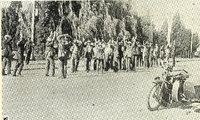 Newspaper clipping showing Rand Rebellion rebels surrendering outside John Ware Park, Fordsburg in Johannesburg, South Africa.
 -
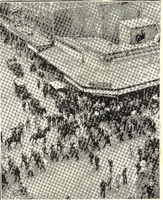 Newspaper clipping showing rival detachments meeting on Tuesday morning March 7, in the middle of Joubert Street, Johannesburg's narrowest throughfare.
 -
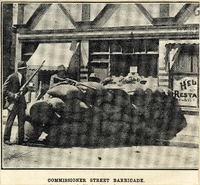 Newspaper clipping titled: "Commissioner Street barricade" showing armed men behind a sandbag fortification.
 -
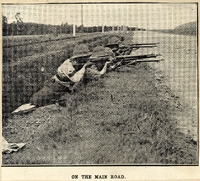 Newspaper clipping titled: "On the Main Road" showing armed men lying in a trench beside a road.
 -
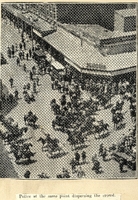 Newspaper clipping titled: "Police at the same point dispersing the crowd", showing police dispersing rival detachments meeting on Tuesday morning, March 7, in the middle of Joubert Street, Johannesburg's narrowest throughfare.
 -
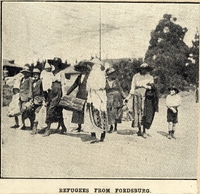 Newspaper clipping titled: "Refugees from Fordsburg". The photograph shows a group of men, women and children carrying their possessions.
 -
 Newspaper clipping titled: "Routing the Reds from their nests: Fordsburg rebels rounded up on Tuesday afternoon". The caption desbribes photographs found in PIC/A 2715-117 to PIC/A 2715-120, and reads: "1. One of the guns that bombarded Fordsburg from 11 o'clock till 10 minutes past noon on Tuesday. 2. Rebels surrendering outside John Ware Park, Fordsburg. 3 and 4. Bringing in the prisoners. Photos for S.A. Pictorial".
 -
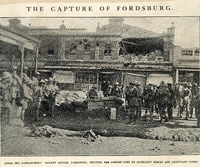 Newspaper clipping titled: "The capture of Fordsburg" showing a group of soldiers in front of a damaged building on Market Square, Fordsburg after a bombardment. The caption below the photograph reads: "After the bombardment: Market Square, Fordsburg, showing the damage done by artillery shells and aeroplane bombs".
 -
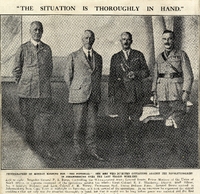 Newspaper clipping titled: "The situation is thoroughly in hand" with a photograph of four men, (from left to right) Brigadier-General P.S. Beves, General Smuts, Lieut.-Colonel E.F. Thackeray, and Lieut.-Colonel J.H. Blaney. The caption below the photograph reads: "Photographed on Monday morning for "The Pictorial": the men who directed operations against the revolutionaries in Johannesburg over the last tragic week-end. Left to right: Brigadier-General P.S. Beves, controlling the Witwatersrand area; General Smuts, Prime Minister of the Union of South Africa, in supreme command of the operations against the rebels; Lieut.-Colonel E.F. Thackeray, District Staff Officer, No. 8 Military District; and Lieut.-Colonel J.H. Blaney, Permanent staff, Union Defence Force. General Smuts arrived in Johannesburg from Cape Town at midnight on Saturday, and took control of the operations. In an interview he expressed the utmost confidence that not only was the situation thoroughly in hand, but that it would not be long before peace was restored and the Red Rebellion completely curshed!".
 -
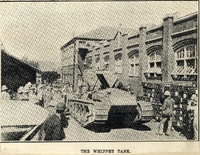 Newspaper clipping titled: "The Whippet tank", showing a military tank also known as "The Medium Mark A Whippet" which was a British tank intended for fast mobile assaults.
 -
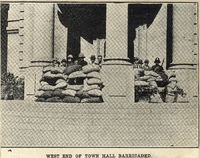 Newspaper clipping titled: "West End of Town Hall Barricaded" showing a group of men behind a sandbag fortification.
 -
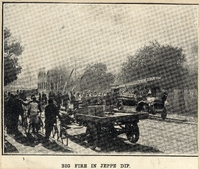 Newspaper clipping titled "Big fire in Jeppe Dip". The photograph shows a fire engine and several people in front of a burning building.
 -
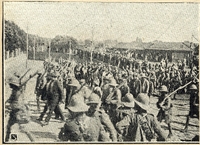 Newspaper clipping titled "Bringing in the prisoners". The photograph is of armed men bringing in the prisoners captured after the Rand Rebellion in 1922.
 -
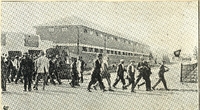 Newspaper clipping titled "Bringing in the prisoners". The photograph is of armed men bringing in the prisoners captured after the Rand Rebellion in 1922.
 -
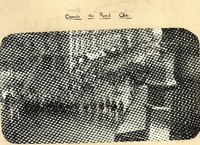 Photograph titled: "Outside the Rand Club", showing a group of armed men on horseback facing a crowd of people outside the Rand Club in Johannesburg. The club was one of the targets of the striking miners during the Rand Rebellion of 1922 and was briefly barricaded during the disturbances.
 -
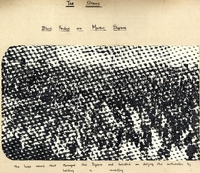 Photograph titled: "The Strike. Black Friday on Market Square". The caption below the photograph reads: "The huge crowd that thronged the Square and insisted on defying the authorities by holding a meeting. Black Friday, as it became known, took place in Johannesburg on 9 March 1922.