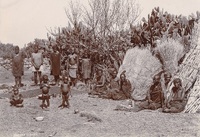
Images of Africans Collections
Item set
- Description
-
The 'Images of Africans Collection' brings together photographs and visual materials drawn from a range of collections held at the Cory Library. These collections provide the foundation for researchers to investigate themes of cultural memory, identity and representation, as the images depict African people across different periods, places, and social contexts. Many of these images and materials were originally created within colonial or Western frameworks, and inevitably by context, the intent behind their production was shaped by ethnographic, administrative, or exhibitionary purposes that may carry negative or objectifying connotations.
This collection, as a project, in its intention to redefine past constructions, is curated with reflection, inquiry, and critical engagement in mind. The dynamic un-obscuration of those past histories, allows these images and materials to be recontextualised, acknowledging the circumstances of their creation while using them as sources through which African presence, lived experience, and historical reality, can be more fully recognised. By bringing these materials together, the collection highlights Africans as individuals and African communities situated within their own cultural, social, and historical contexts.
Through this reframing, the 'Images of Africans Collection' aims to foreground the dignity, resilience, and beauty of African people. It positions the images as part of broader processes of identity formation, heritage preservation, and collective memory, inviting critical engagement with the past while affirming African histories and experiences as central to the curative, preservative role of the Cory archive. - Type
- Collection
- Subject
- AfricansSee all item sets with this value
- African people
- Africa--Social life and customsSee all item sets with this value
- Africa--HistorySee all item sets with this value
- Ethnology--Africa, SouthernSee all item sets with this value
- Indigenous peoples--Africa
- Cultural identity--Africa
- Collective memory--Africa
- Heritage--Africa
Items
-
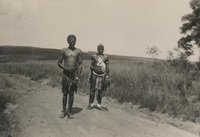 Photo of two Zulu men on road near KwaMagwaza, 1934.
 -
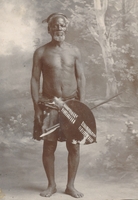 Note on back reads: “This is a photograph of Ndogeni, the Zulu who accompanied Dick King on his famous ride in 1842. The Boers at this time laid claim to Port Natal. It was, however, because England was determined to protect the rights of her subjects that Capt. Smith and a couple of hundred men were forthwith sent to Durban. On the 25th of May (same year), the situation having become extremely critical, it was imperative to send for help and over a distance of not less than 500 miles of the wildest country. Dick King volunteered at once for this service. As Ndogeni, then 15 or 16 years of age, was his servant and knew how to ride, King selected him as his companion, other persons, for some reason or another, being unavailable. Ndogeni was not, at the outset, told the true objective of the journey, no doubt on account of his youth as well as his nationality. The two were rowed across the Bay in a boat at night by George and Joseph Cato, their two horses being swum at the stern. Ndogeni accompanied King for nearly 250 miles and over what was undoubtedly the most perilous part of the journey. He would have gone further, only, owing to an omission, he became incapacitated because obliged to ride this great distance without stirrups. He proved of considerable assistance to his master, indeed it is not too much to say that without some such help as he was able to afford, the mission might not have been quite as successful as it was. Natal was saved. It is partly because his account of the journey throws fresh lustre on King’s magnificent achievement, that Ndogeni’s narrative has been specially translated, and the accompanying photograph taken.”
 -
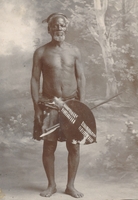 Note on back reads: “This is a photograph of Ndogeni, the Zulu who accompanied Dick King on his famous ride in 1842. The Boers at this time laid claim to Port Natal. It was, however, because England was determined to protect the rights of her subjects that Capt. Smith and a couple of hundred men were forthwith sent to Durban. On the 25th of May (same year), the situation having become extremely critical, it was imperative to send for help and over a distance of not less than 500 miles of the wildest country. Dick King volunteered at once for this service. As Ndogeni, then 15 or 16 years of age, was his servant and knew how to ride, King selected him as his companion, other persons, for some reason or another, being unavailable. Ndogeni was not, at the outset, told the true objective of the journey, no doubt on account of his youth as well as his nationality. The two were rowed across the Bay in a boat at night by George and Joseph Cato, their two horses being swum at the stern. Ndogeni accompanied King for nearly 250 miles and over what was undoubtedly the most perilous part of the journey. He would have gone further, only, owing to an omission, he became incapacitated because obliged to ride this great distance without stirrups. He proved of considerable assistance to his master, indeed it is not too much to say that without some such help as he was able to afford, the mission might not have been quite as successful as it was. Natal was saved. It is partly because his account of the journey throws fresh lustre on King’s magnificent achievement, that Ndogeni’s narrative has been specially translated, and the accompanying photograph taken.”
 -
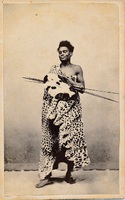 Full-length portrait of a young man dressed in a leopard skin kaross, carrying a small ornamented ox-hide shield, assegais and a kierie. The portrait is annotated in pencil, "Prince Kekolokowina in full dress".
 -
-
-
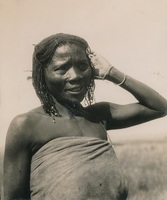 Woman holding a hand to her ear
 -
-
-
-
-
-
-
-
-
-
-
-
-
-
-
-
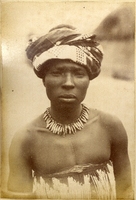
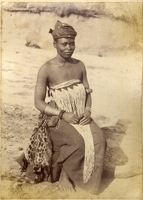
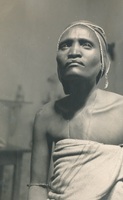 A photograph of an African woman wearing traditional dress with headscarf
 -
-