Daantjie Oosthuizen Memorial Lectures
Item set
- Alternative Title
- D.C.S. Oosthuizen Memorial Lectures
- Description
- An annual lecture series established in memory of Daniel Charl Stephanus "Daantjie" Oosthuizen (1926–1969), Professor of Philosophy at Rhodes University. The lectures focus on philosophy, ethics, and liberal thought in South Africa.
- Language
- English
- Type
- Collection
- Text
- Publisher
- Rhodes University
- Place
- Grahamstown, South Africa
Items
-
 Federici examines the "global enclosure of knowledge," where education is increasingly commodified and access is restricted to a wealthy few. Drawing on her experiences in Africa and the United States, she argues that academic freedom is under siege by corporate interests and the "logic of profitability." She calls for a resistance that involves rethinking grading systems, demystifying the hierarchy between teachers and "non-academic" staff, and rooting knowledge in the pursuit of a just society.
 -
 The then-Minister of Education explores the role of universities in a "developmental state." She argues that universities cannot exist in a vacuum or seek "insulation" from social forces like poverty and underdevelopment. Pandor emphasizes that higher education must produce skilled graduates and responsive research to support the political and economic integration of Africa.
 -
 Albie Sachs explores the cultural dimensions of a post-apartheid society. He envisions a "rainbow culture" that moves beyond the "Baas and Klaas" dynamic toward a shared humanity. The lecture includes a "personal fantasy" of 21 points for cultural renewal, including the restoration of national patrimony, the promotion of multilingualism, and the establishment of community arts centres.
 -
 This lecture was delivered after being initially prohibited by a government ban on political meetings. Bozzoli discusses the necessity of social and educational change in South Africa, arguing that while change is inherently "inconvenient" for those in power, it is essential for survival. He advocates for tolerance, the acceptance of full citizenship rights for all, and the role of education in shifting national attitudes.
 -
 An inaugural memorial lecture for Professor D.C.S. "Daantjie" Oosthuizen (1926–1969), former Head of the Department of Philosophy at Rhodes University. The lecture discusses themes of truth, justice, the "secluded church" versus the church active in the world, and the responsibilities of the individual in the face of state injustice.
 -
 Professor Janz challenges the "pieties" often associated with academic freedom, moving beyond the legal definitions found in the South African Constitution. He introduces the concept of "free space" as a necessary condition for genuine intellectual growth and "epistemic justice." The lecture explores how internal institutional cultures, social identities, and power dynamics can create "little murders of the soul" that stifle inquiry even when formal academic freedom is protected by law.
 -
 Set against the backdrop of global instability following 9/11, Alexander examines the "symbolic power" of language in South African education. He argues that the post-apartheid university has a democratic responsibility to promote multilingualism to prevent the marginalization of the majority and to decolonize the South African mind.
 -
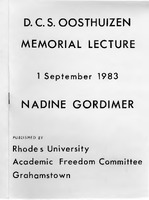 In this influential address, Nobel Laureate Nadine Gordimer reflects on the "interregnum"—the period between the dying of the old apartheid order and the birth of a new, yet-to-be-defined society. She examines the role of the white writer and intellectual in a revolutionary context, the "ugly creation" of institutionalized racism, and the urgent need for a new South African identity beyond race and class.
 -
 Using Antjie Krog’s Country of My Skull as a philosophical departure point, the speaker explores the "multiplicity of levels" of freedom in South Africa. The lecture critiques contemporary political populism (referencing Julius Malema) and argues that the future of the country depends on "fearless critical thought," scholarly excellence, and an environment of institutional accountability.
 -
 n analysis of the principles of academic freedom, university autonomy, and institutional neutrality within the socio-political context of apartheid-era South Africa. The lecture specifically addresses the "Extension of University Education Act of 1959" and the university's relationship with the State.
 -
 Returning to the series during the transition period of the "New South Africa," Slabbert argues that academic freedom is not a static ritual but a continuous battle. He analyzes the concepts of university autonomy and neutrality, warning that the end of Apartheid does not mean the end of the struggle for intellectual inquiry; rather, the challenges to academic freedom simply acquire new meanings in a democratic state.
 -
 Minister Blade Nzimande outlines the government's vision for an integrated and differentiated post-school education system. He addresses the tension between academic freedom and the developmental needs of the state, arguing that while the government does not seek to "muzzle" universities, academic freedom must not be used as a shield to avoid social accountability or to hide corruption. He specifically critiques the "hysterical" opposition to the State Information Bill.
 -
 Delivered by the Vice-Chancellor of the University of Fort Hare after 14 years in exile, this lecture focuses on the relationship between higher education and the quest for a free society. Bengu emphasizes the need for universities to be relevant to their regional communities and argues that academic freedom is inseparable from the broader democratic struggle of the people.
 -
 An exploration of the university's social responsibility toward those marginalized by apartheid policies. It defines "new foreigners" as Africans stripped of South African citizenship and Section 10 urban residency rights through the Bantustan system and resettlement programs. The lecture calls for universities to adopt multi-disciplinary approaches to address poverty, malnutrition, and legal injustices in the "periphery" or reserves.
 -
 Makgoba discusses the shift from the classical British model of university autonomy to a "co-operative governance model" suited for a developing South Africa. He argues that universities must be developmental instruments for the nation and suggests that a "high-trust syndrome" between the state and the university is necessary to protect academic freedom in the new millennium.
 -
 Utilizing the philosophical frameworks of Hannah Arendt and Pierre Bourdieu, Dr. Lange explores academic freedom not just as a legal right, but as a "political, public and plural exercise of thinking." She critiques the "instrumentalisation" of research and teaching by market forces and suggests that the university’s true autonomy resides in the critical capability of its academics to objectify their own practices and offer counter-narratives to the prevailing political economy of innovation.
 -
 Mamdani reflects on the "crisis" of African universities by comparing South African struggles with those in Ethiopia and Uganda. He argues against "institutional reform" that merely changes the skin color of the faculty without changing the orientation of research. He calls for "rooting African universities in African soil" to serve the actual needs of the public.