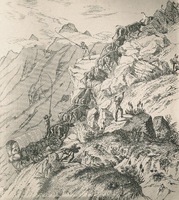
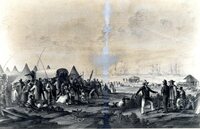
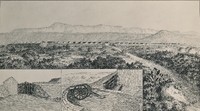
An iconic engraving by Charles Michell of an ox-wagon ascending Cradock Pass, Outeniqua Mountains, Cape. 1840. Michell, a Surveyor and Road Builder used this image to illustrate the dangerous ascent. This image has captured the imagination of South Africans for many generations
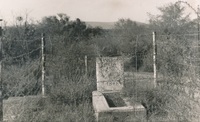
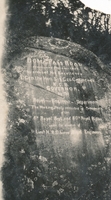
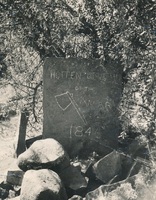
Gravestone with the words “Hottentot victim of the [drawing of an axe] war 1846” engraved on it. Note on the back: “A Hottentot victim of the war of the axe 1846 45".
The inscription reads: “Boma Pass Road constructed December 1853 by order of His Excellency L’Gen. the Hon. Sir Geo. Cathcart K.C.B. Governor, by the Royal – Engineer Department. The working party consisted of Detachments of the 8th Regt. And the 60th Royal Rifles. Under the direction of Lieut HR Siborne Royal Engineers.
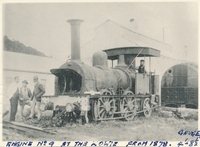
Note at the bottom: “Engine no9 at the Kowie from 1878. Gauge 4’-81/2”. Note on the back: “c. 1883 aka “Blackie” and “Frontier” This in Engine no 9 for 4-8 ½ inch Gauge. A series of this type of locomotive were sent out to Cape Town from Sept. 1859 is April 1860 – Engine no9 was sent to the “Kowie” Harbour Works during 1879. With the Compliments of Theo J Espitolies. PO Box 1006 Pretoria.”,Engine no. 9 at the Kowie from 1878.
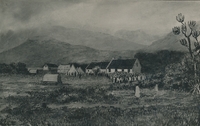
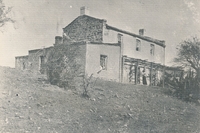
The note on the back reads (there is also and Afrikaans translation): “Farmhouse at Klu Klu near Fort Beaufort, originally built by British Settler Joseph Mildenhall (1801-1875).
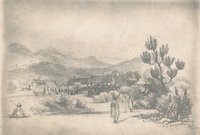
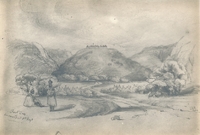
Photographic copies of two drawings of Fort Cox in ca 1850 by C E A, one showing the encampment of a regiment with a Xhosa man, woman and baby and the other showing buildings, tents, Xhosa people and wagons.
Photographic copies of two drawings of Fort Cox in ca 1850 by C E A, one showing the encampment of a regiment with a Xhosa man, woman and baby and the other showing buildings, tents, Xhosa people and wagons.
The gravestone is engraved: “Hottentot Victim of the [picture of an axe] war 1846”. On the back of the image is a note reading: “T Mackenzie Kingston House SMT”.
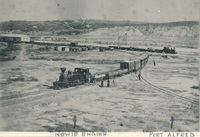
Note on the bottom: “Kowie Engine” and “Port Alfred”. d. Note on the back: “The first two engines for 3’-6” gauge working between Port Alfred and Grahamstown Landed by SS Rothsay May 20th 1882 – Ran first trial trip from Port Alfred for 16 miles pn the 25th July 1882. Engine made my the Hunsletics & Leeds. The Kowie Engine was the passing engine [illegible] 22 Tom “Grahamstown” “Port Alfred” engine for Goods working washing 25 Tom or “Kowie”".,Kowie engine at Port Alfred.
Head-and-shoulders portrait of Langalibalele, Hlubi chief. Langalibalele, commonly known as Langalibalele I, was also known as Dlomo II and later Mthethwa.
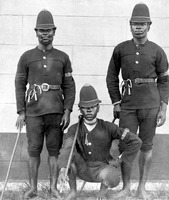
Taken from the description on the Origins 22 - Genealogy & History Facebook page (dated 29 January 2026): "In addition to maintaining order within their own communities, Black Africans also served alongside British forces during the South African War. Estimates suggest that between 15000 and 30000 Black Africans were employed in armed support roles, such as scouts and sentries, while a much larger number, approximately 100000, were engaged in essential non-combatant work. These roles included labour, transport driving, blacksmithing, wheelwrighting, farriery, and construction. Their contributions played a significant part in sustaining British military operations during the conflict."