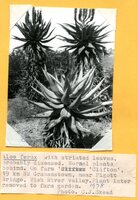
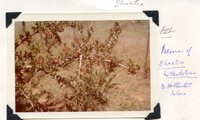
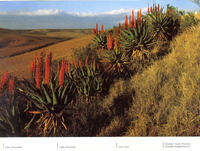
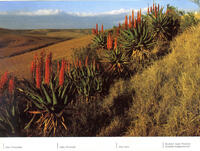
Caption: "Aloe ferox with striated leaves, probably diseased. Normal plants behind. On farm 'Clifton', 19 km NW Grahamstown, near Pigott Bridge, Fish River valley. Plant later removed to farm garden. 1978."
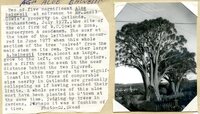
Caption: "Two of five magnificent Aloe Bainesii at entrance to Mr. Basil Gowie's property in Oatlands, Grahamstown, July 1977, the site of the old firm of W.C. Gowie & Sons, nurserymen & seedsmen."The scar at the base of the lefthand tree occurred in June 1977 when this whole section of the tree 'calved' from the main stem on its own. Two other large A.bainesii trees, almost as large grow to the left, out of the picture, and a fifth can be seen in the near distance behind the two figured. These pictures may prove to be significant in that trees of comparable size nearby in Oatlands are gradually collapsing as if having reached their limits."
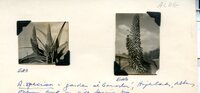
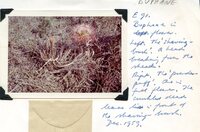
Caption: "Buphane in flower. Left: The 'shaving-bush', a head breaking from the stealth. Right: The 'powder-puff', one in full flower. The crinkles dead leaves lies in front of the shaving-bush. Dec. 1959."
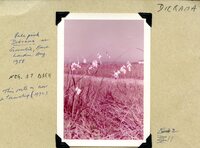
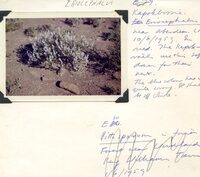
Caption: "Kapokbossie, Eriocephalus near Aberdeen, C.P. 10/06/1955. The kapok-voels use this for their nest. The blue colour here is quite wrong. It should be off white. "
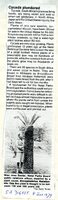
Newspaper article: "Cycads, South Africa's precious living fossils, are being stolen and sold to smart-set gardeners in South Africa, Japan and the United States reports The Daily News. Plants of one rare species, Encephelatus Woodii, have been offered for sale in the United States for R5 000. Botanists say cycads sell for R26 a centimeter overseas, so that a waist-high plant fetches about R2 500. Cycads are very slow-growing. Plants germinated 12 years ago at the Natal Botanical Gardens have a stem the size of a small football. Hence plants of a reasonable size may be hundreds of years old, while the rootstock from which the plants grow may be thousands of years old. There are 28 species in South Africa and seven occur in Natal. They are known in Afrikaans as Broodboom (bread tree) because Hottentots were said to make bread from the pith, after it had been left to rot for two months. A spokesman for the Natal Parks Board said the authorities could not prevent exploitation. Convictions for removing protected plants were difficult to obtain as it was almost impossible to prove where the plants came from unless the culprits were caught red-handed. When found to be in illegal possession, plants ere confiscated and planted out.Miss Jane Baxter, Natal Parks Board public relations officer, dwarfed by a giant cycad, Encephelatus Natalensis. This fine plant is thought to be between 150 and 200 years old. The Daily News. S. A. Digest. 8 June 1979."