C.J. Skead Photograph Collection
Item set
- Title
- C.J. Skead Photograph Collection
- Creator
- Skead, C. J. (Cuthbert John)
- Description
-
The Jack (Cuthbert John) Skead Collection comprises a substantial body of photographic material that documents the natural environments, vegetation types, and ecological habitats of the Eastern Cape and the wider southern African region. The photographs—taken over several decades—capture landscapes, plant communities, wetlands, forests, grasslands, and other habitat formations that were central to Skead’s extensive research interests. Many images also document environmental change, land use patterns, and field sites associated with his ornithological and botanical studies.
The collection provides a valuable visual record for researchers working in the fields of environmental history, ecology, biogeography, conservation, and Eastern Cape natural heritage. The photographs complement Skead’s published and unpublished work held at Cory Library, including field notes, correspondence, and research manuscripts. - Language
- English
- Provenance
- Materials received from the Skead Family.
- Type
- Collection
- Genre
- Photographs
- Subject
- South Africa--Addo Elephant National Park
- Addo Elephant National Park (South Africa)
- Natual history -- South Africa -- Eastern Cape
- Vegetation -- South Africa -- Eastern Cape
- Habitats -- South Africa -- Eastern Cape
- Ecology -- South Africa -- Eastern Cape
- Landscape photography -- South Africa
- Photograph collections
- Environmental change -- South Africa -- Eastern Cape
- Biogeography -- South Africa
- Eastern Cape (South Africa) -- Photographs
- Albany District (South Africa) -- Photographs
- Skead, C. J. (Cuthbert John), 1912–2006
Items
-
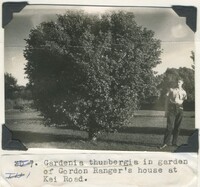 Caption "Gardenia thunbergia in garden of Gordon Ranger's house at Kei Road."
 -
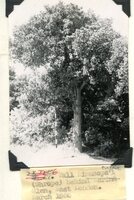 Caption "Tall Mimusops caffra (shrope) behind Marina Glen, East London. March 1960."
 -
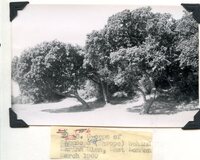 Caption "Groups Mimusops caffra (shrope) behind Marina Glen, East London. March 1960."
 -
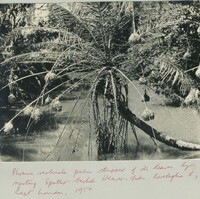 Caption "Phoenix reclinata palm stripped of its leaves by nesting Spotted-backed Weaver-bird. Kwelera R., East London. 1950."
 -
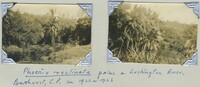 Caption "Phoenix reclinata palms on Lushington River, Bathurst, C. P. ca. 1922 or 1923."
 -
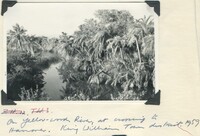 Caption "On Yellow-wood River, at crossing. King Williams Town district. 1959."
 -
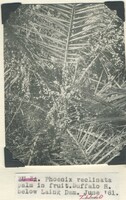 Caption "Phoenix reclinata palm in fruit. Buffalo R. below Laing Dam. June '61."
 -
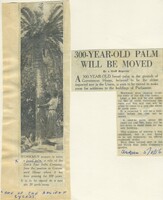 Caption "300-Year-Old Palm will be moved. Workmen prepare to move a relic of the East Dutch India Company, from the position in Government House where it has been growing for 300 years. It is to be moved to a new site 20 yards away. Argus 05-08-56."
 -
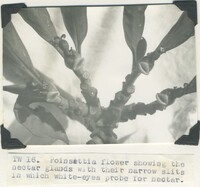 Caption "Poinsettia flower showing the nectoar glands with their narrow slits in which white-eyes probe for nectar."
 -
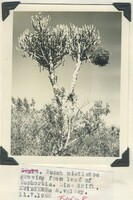 Caption "Bunch mistletoe growing from leaf of Euphorbia. Line drift. Keiskamma R. valley. 11-07-1960."
 -
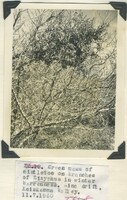 Caption "Green mass of mistletoe on branches of Zizyphus in winter barrenness. Line drift, Keiskamma Valley. 11-07-1960."
 -
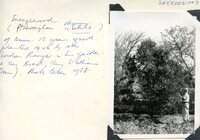 Caption "Sneezewood P. obliquum of known 12 years growth, planted 1946 by Mr Gordon Ranger, (in his garden at Kei Road, King Williams Town). Photo taken 1958."
 -
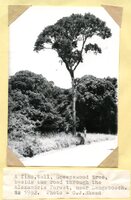 Caption "Fine, tall Sneezewood tree, beside the road through the Alexandria Forest, near Langebosch. 1982."
 -
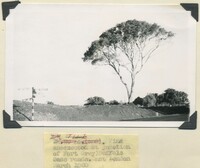 Caption "Fine sneezewood at junction of Fort Grey. Buffalo Pass roads. East London. March 1960."
 -
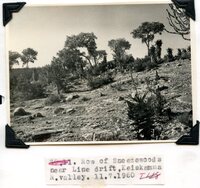 Caption "Row of Sneezewood's near Line drift, Keiskamma R. valley. 11.07.1960."
 -
 Transcript: "1822 Thomas Pringle, 1835 April. In The Koonap River Valley, Adelaide, E.Cape. p.126. "Among the mimosa trees (i.e. thorntrees) sprinkled over the meadows, or lower bottoms, the traces of their (i.e. elephant) operations were not less apparent. Immense numbers of these trees had been torn out of the ground and placed in an inverted position in order to enable the animals to browse at their ease on their juicy roots which form a favourite part of their food. I observed that, in numerous instances, when the trees were of considerable size, The elephant had employed one of his tusks, exactly as he would use a crowbar, thrusting it under The roots to loosen their hold on The earth before he attempted to tear them up with his proboscis, many of the larger mimosas had resisted all their efforts, and, indeed, it is only after rains that they can successfully attempt the operation."
 -
 Transcript: "Acacia karroo 01. 11. 1959. At Bashee Bridge, between Idutywa and Umtata, Transkei, trees just beginning to flower. One fairly advanced. At Kei bridge on the Transkei-Komga border only a few yellow dots of flower appearing; also as King William's Town. The winter and spring had been good this year. Last-week in May and into June. Autumnal tints fine. Trees change to a rich gold, made lovelier by the fern-like nature of the foliage. Colour varies from yellow to gold. July. Branches now bare August. Branches mostly bare still but where a tree is growing in a damp area, new shoots are staring 28.12.1958. Travelling between Grahamstown and King William's Town. Acacias in the Great Fish River valley were well out in flower, far in advance of those near Grahamstown, in the Keiskamma River valley, and at King William's Town. Always some trees in an area flower in advance of the rest and, always, certain trees surpass all others Sept.1960. Trees burst into leaf in about second week despite severe drought. Rather irregular as between tree and tree with some trees still in their old dark foliage and some still leafless after the winter, 16.10.1960. A few puffs of flower coming out. Otherwise only rough, unopened flower buds 1 June 1961. In the King William's Town bushveld many of the Acacia trees, now almost leafless or only sparsely leaved, have appearance of spume-like scum spread over them, a dirty off- white mass. But this is an illusion; it is caused by the fuzzy, wispy seed-covers of Clematis now in full seed."
 -
 Transcript: "from PRINGLES OF THE VALLEYS ,1957, by Eric, Mark and John Pringle. p.29. (On the farm now known as Clifton). "The next day, July 2nd (1820) was our first Sunday on our own grounds. Feeling deeply the importance of maintaining the suitable observance of this day of sacred rest, it was unanimously resolved that we should strictly abstain from an secular employment not sanctioned by absolute necessity; and at the same time commence such a system of religious services as might be with propriety maintained in the absence of a clergyman or minister. The whole party were accordingly assembled after breakfast under a venerable acacia tree, on the margin of a little stream which murmured around our camp. It was, indeed, an affecting sight to look round on our little band of Scottish emigrants, thus congregated for the first time to worship God in the wild glen allotted for their future home and the heritage of their offspring". An inspection in 1956 established this spot with some certainty is just south of the present Craig Rennie homestead".
 -
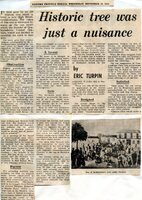 Newspaper article: "Historic tree was just a nuicance" discussion the removal of the mimosa tree in High Street, Grahamstown. This tree is believed to be the tree that Colonel Graham was resting under, when he decided to establish the town in the vicinity.
 -
 Transcript: "Acacia caffra. Flowers November to January with occasional extensions to March. The scent differs from Accia karroo in being not so sickly -is sharper to the nose but nonetheless attractive. The fine thorns are not readily visible. The softness of the foliage can lead one into grabbing at branches only to be be well pricked. The tree is very common along the Buffalo river at King William's Town often growing at the water's edge. In the veld, Acacia karroo often grows among Acacia caffra, the two making an interesting contrast. 30.10.1959. Coming into flower at Kei Bridge on the Komga-Transkei border, At Bashee Bridge between Idutywa and Umtata, and in the Umzimkhulu valley on the Natal border of Transkei. 21.11.1959. Coming into good flower at King William's Town. July 1960. Trees mostly bare but some have straggly leaves adhering. August 1960. Bare. September 1960. Began shooting on trees along rivers early in the month. But leaves began bursting from their buds on trees in dry veld on about the 15th of the month despite lack of rain to stimulate spring growth October 27th 1960. First flowers appearing."
 -
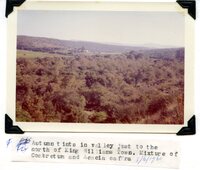 Caption: "Autunm tints in valley just to the north of King William's Town. Mixture of Combretum and Acacia caffra. 3/6/1960."
 -
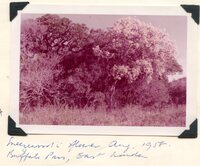 Caption "Sneezewood flower. Aug. 1958. Buffels Pan, East London."
 -
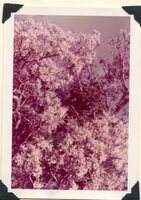 Caption "Sneezewood flower. Aug. 1958. Buffels Pan, East London."
 -
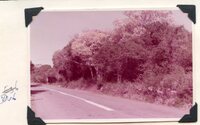 Caption "Sneezewood tree in flower in Buffalo Pan, East London. Aug. 1958."
 -
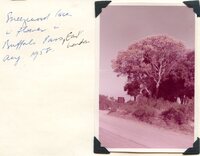 Caption "Sneezewood tree in flower in Buffalo Pan, East London. Aug. 1958."