C.J. Skead Photograph Collection
Item set
- Title
- C.J. Skead Photograph Collection
- Creator
- Skead, C. J. (Cuthbert John)
- Description
-
The Jack (Cuthbert John) Skead Collection comprises a substantial body of photographic material that documents the natural environments, vegetation types, and ecological habitats of the Eastern Cape and the wider southern African region. The photographs—taken over several decades—capture landscapes, plant communities, wetlands, forests, grasslands, and other habitat formations that were central to Skead’s extensive research interests. Many images also document environmental change, land use patterns, and field sites associated with his ornithological and botanical studies.
The collection provides a valuable visual record for researchers working in the fields of environmental history, ecology, biogeography, conservation, and Eastern Cape natural heritage. The photographs complement Skead’s published and unpublished work held at Cory Library, including field notes, correspondence, and research manuscripts. - Language
- English
- Provenance
- Materials received from the Skead Family.
- Type
- Collection
- Genre
- Photographs
- Subject
- South Africa--Addo Elephant National Park
- Addo Elephant National Park (South Africa)
- Natual history -- South Africa -- Eastern Cape
- Vegetation -- South Africa -- Eastern Cape
- Habitats -- South Africa -- Eastern Cape
- Ecology -- South Africa -- Eastern Cape
- Landscape photography -- South Africa
- Photograph collections
- Environmental change -- South Africa -- Eastern Cape
- Biogeography -- South Africa
- Eastern Cape (South Africa) -- Photographs
- Albany District (South Africa) -- Photographs
- Skead, C. J. (Cuthbert John), 1912–2006
Items
-
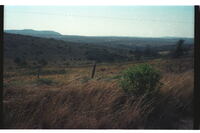 The small patch of bush-forest against the hill in mid-distance might have been the 'hanging forest' after which Assegaaibosch Outspan got its name. The Assegaaihout tree, Curtisia dentata, still grows there.
 -
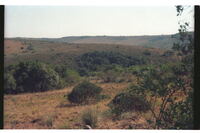 Origionally an outspan in the early 1770's. The dark green patch of bush-forest on slope in the mid-distance hill may well be the origin of the name Assegaaibosch as recorded in 1797. Assegaaihout trees, Curtisia dentata. Assegaaihout trees still occur in that small patch. Kariega Rand in far distance to the north.
 -
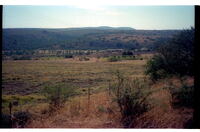 Site of original Assegaaibosch outspan used from early 1770's by elephant-hunters heading to ciskei etc., also by later early travellers. Farmhouse in valley on extreme right of middle-picture. Highlands Mountain (on Carl's Rust farm), the former Rietberg, in far distance with Kariega Road forming the line of horizon in front.
 -
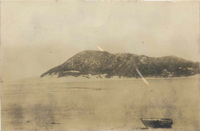 Vegetated dune-hill showing mature vegetation there in 1926 before Kenton-on-Sea was built up. Taken by C.J.Skead in 1926 when a schoolboy at St. Andrews College. He and a party of friends walked stark naked from here along the beach to Bushman's River Mount without fear of being seen by a soul.
 -
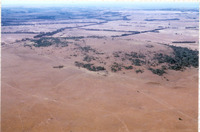 Surrounded by Bathurst suurveld. Taken from western side.
 -
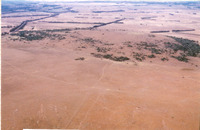 Surrounded by Bathurst suurveld. Taken from north facing towards the coast.
 -
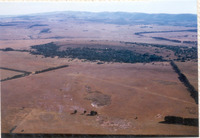 Aerial view of Bathurst suurveld, the old Zuure Veldt, looking north to Kap River Hills with the dome of Round Hill centrally.
 -
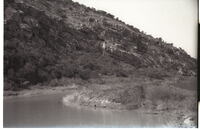 On the krans in the background are at least 32 nests of black-headed Herons yet, on top of the krans is a thicket of tall Euphorbias on which the birds could have built comfortably more in conformity with their usual habit of nesting in trees.
 -
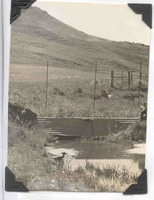 Hamerkop in a stream below Gaika's Kop.
 -
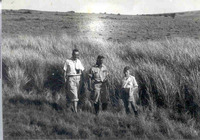 Reed-beds in swamps on farm, a place much favoured by Ethiopian Snipe, Especially for nesting. Figures are Tim Gillitt, Gordan Ranger and Walter Skead (the boy).
 -
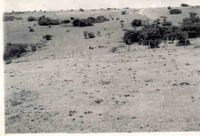 Masses of dry cowpats covering a grassy cattle-sleeping-place on farm. Hoopoes fed here in nesting season with nests in the vicinity.
 -
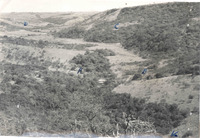 "Where Lesser, Greater and Scaly-throated Honeyguides had regular call-sites for 20 years and more. 'A' is field workers' camp-site. 'B' was main call-site of Lesser Honeyguide; 'C' was a minor call-site of Lessers; 'D' was the main call-site of Greater Honeyguide. The Scaly-throated's call-site was in the forest valley just off the bottom of the photograph."
 -
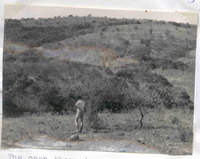 The open thorn-tree scattered hillside across the bushy valley contain the favourate Acacia karroo tree used successively for many years by Lesser Honeyguides as their call-site.
 -
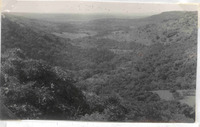 The Scaly-throated Honeyguides call-site was in the dense tall patch in the stream bed.
 -
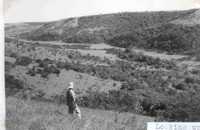 The Scaly-throated Honeyguide ranged over the whole area but mostly in the forests and along bushy streams.
 -
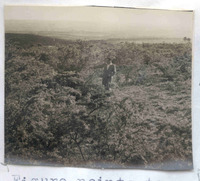 Figure points to bush where nest was built.
 -
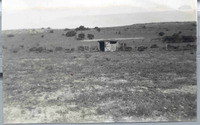 Small isolated bull-box under roof of which Greater Striped Swallows nested annually.
 -
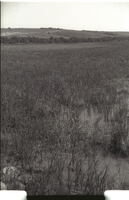 When this grass invaded the newly-deposited mudflats at Hamburg, Cisticola juncidis moved in despite tidal water beneath
 -
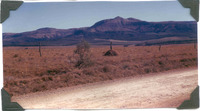 This whole range could well have been covered in both Protea subvestita and Protea multibracteata before being heavily overstocked with cattle. Even on the flats in the foreground relict patches of multibracteata occurred until the 1970's. Good populations of sugarbirds could therefore have existed.
 -
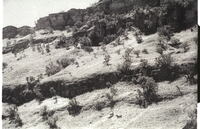 Hillside with Protea rouppelliae and Protea multibracteata. Typical Gurney's Sugarbird country. Two eland stand on face of hill near bottom of picture.
 -
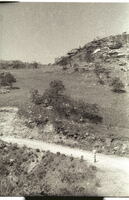 Gurney's Sugarbirds nested in the Protea rouppelliae in the foreground. D.M. Skead in picture when a ranger there.
 -
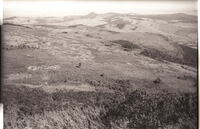 Looking westwards from top of Hoho Peak (Pirie West Peak) over Protea thickets in immediate foreground to the mid-picture ridge covered in Cliffortia fynbos and which might once have held dense Protea subvestita and /or Protea multibracteata thickets. Some of the latter still growing below the subvestita thickets there. iNtaba knNdoda Peak in distance.
 -
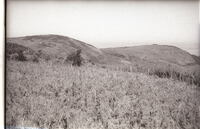 Cape and Gurney Sugerbird Promerops cafer & Gurneyi country. The left-hand dome is Hoho Peak, or Pirie West Peak, on the western slopes of which both species where found occupying and nesting in a thicket of tall, dense Protea subvestita, almost the last patch of any size on these mountains. The dark areas on the slopes are protea trees. Those on top had been burned out. Such thickets would have been more widespread in the past. Below are some Protea multibracteata plants. The thickets of subvestita were burnt out in the late 1960's to make way for stock grazing.
 -
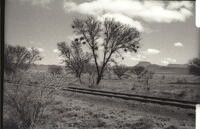 White-browed Sparrow-weaver colony beside railway line.
 -
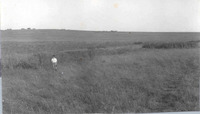 "Two photos of Red Bishop nesting area in swamps. Nesting site was in the dark mass at right; small clumps of Typha & Phragmites held a few nests."