
Items
Subject is exactly
Labour unions -- South Africa
-
 This document outlines the Socio-economic Programme of the Congress of South African Trade Unions (COSATU). It articulates a strategic shift toward a coordinated policy framework intended to align the federation’s collective bargaining efforts with broader macroeconomic restructuring. The programme asserts that the success of the "Living Wage Campaign" is contingent upon fundamental changes to the South African economy. It advocates for a transition towards a productive and equitable economic system, the redistribution of wealth, and the establishment of a democratic state where the working class holds significant political influence.
-
 This document outlines the Socio-economic Programme of the Congress of South African Trade Unions (COSATU). It articulates a strategic shift toward a coordinated policy framework intended to align the federation’s collective bargaining efforts with broader macroeconomic restructuring. The programme asserts that the success of the "Living Wage Campaign" is contingent upon fundamental changes to the South African economy. It advocates for a transition towards a productive and equitable economic system, the redistribution of wealth, and the establishment of a democratic state where the working class holds significant political influence.
-
 This document is a Gender Policy Discussion Document issued by the Congress of South African Trade Unions (COSATU) for a session held between 27 and 29 March 2012. It serves to consolidate historical resolutions into a unified policy framework designed to address gender inequality within the workplace, the economy, the trade union movement, and broader society. The text acknowledges that while gender equality has been a foundational objective since COSATU's inception, progress across different union affiliates has been inconsistent. The policy outlines a vision for a society free from sexism, racism, and class exploitation, specifically seeking the emancipation of women from oppression within both domestic and professional spheres. Originally debated at the National Gender Conference in July 2000, this version was tabled for formal adoption to ensure all affiliates implement these principles within their own internal structures.
-
 This document is a Socio-economic Discussion Paper produced by the Congress of South African Trade Unions (COSATU) for a session held between 27 and 29 March 2012. It argues for the decriminalisation of sex work in South Africa, framing the issue as a matter of human rights, labour protection, and social justice. The text critiques the continued use of the apartheid-era Sexual Offences Act of 1957, asserting that criminalisation exacerbates the "miserable conditions" of the poor and the working class—specifically black women—who are disproportionately driven into the industry by unemployment and the "feminisation of poverty." COSATU advocates for a rights-based approach that recognises sex work as work, thereby allowing individuals to access the protection of national labour laws and occupational health and safety regulations.
-
 This document is a Maternity Protection Discussion Document produced by the Congress of South African Trade Unions (COSATU) for a session held between 27 and 29 March 2012. Developed in collaboration with the Solidarity Centre (AFL-CIO), the booklet serves as a comprehensive policy resource intended to strengthen the rights of pregnant and nursing workers in South Africa. The text acknowledges a wide-ranging partnership of contributors, including statutory bodies such as the Commission for Gender Equality (CGE), legal advocacy groups like the Legal Resources Centre (LRC), and international bodies like the International Labour Organisation (ILO). It specifically highlights the inclusion of vulnerable sectors through the involvement of the African Diaspora Women Workers Network and the South African Self-Employed Women’s Association (SASEWA).
-
 This document is a Socioeconomic Discussion Paper produced by the Congress of South African Trade Unions (COSATU) for a session held from 27 to 29 March 2012. It focuses on the strategic organisation and protection of domestic workers, following mandates established at the 5th COSATU Congress and the 2011 Domestic Workers' Summit. The paper evaluates the feasibility of establishing advice centres to assist domestic workers and explores the creation of a "viable home" or dedicated union structure for these employees within the federation. A central theme is the alignment of South African labour practices with international standards, specifically the ILO Convention 189 (C189) on Decent Work for Domestic Workers. The document represents a collaborative effort between COSATU, the South African Domestic Service and Allied Workers Union (SADSAWU), and the National Labour and Economic Development Institute (NALEDI).
-
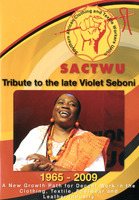 Violet Seboni was born on 18 September 1965. It was to be a turbulent start to life for this young girl who never got to know her father, in a story that started in sadness. And shortly after her birth, it was her mother too that she lost in circumstances that no one should experience. She knew pain and later in life she stood up for those in pain. Young Violet was raised by her grandmother for the first few years of her life, and when her grandmother died, it was her granny's friend - in a culture where ubuntu requires that we reach out to others - who took on the responsibility to rear the young girl and to become her comforter, her provider, her mother. Violet went to primary school and later to Madibane High School in Diepkloof, where she developed a love for netball and a passion for activism. After high school, she became pregnant and her beloved daughter Lesego was born. She looked for work, and like generations of young, working- class women before her, she turned to the clothing industry, to use her hands, her dexterity and her skill to earn a living to feed her young family. The role the industry plays, to give work, bread and life to those in need, is in itself a reason not to let the industry die simply due to the cold, harsh winds of global competition and indifference or inaction from those who have the power to intervene, to use trade measures and to use industrial policy tools to save jobs and absorb our people into decent work opportunities. The industry that young Violet chose is one whose factories in Joburg grew with the discovery of minerals and the rapid growth of an urban population that needed to be clothed. Violet's predecessors in the industry were white women sewing machinists, mainly Afrikaners, often the wives and daughters of the Afrikaner mineworkers who as 'by-woners', were like their black brethren, driven off the land and into the cities hungry for labour. Trade unionism took root among the male mineworkers - Die Mynwerkers Unie was their vehicle - and among female garment workers - through the Garment Workers Union.,A new growth path for decent work in the clothing, textile, footwear and leather industry
-
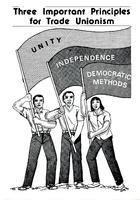 The first principle of trade unionism is unity: the unity of workers, or put another way, solidarity, “one for all, all for one. With solid unity, many things can be achieved by the workers. Without unity, nothing of significance can be achieved by an individual worker. What this means in practice is: the organizational objective of a union is 100 percent membership.The strength and influence of a trade union in its relationship to employers depend on the extent the employees of the company concerned are unionized. The higher the proportion of unionized workers to non-unionized workers, the greater the strength. Apart from numbers, strength also come from organizing the key, skilled workers in the enterprise. Depending on what the basis of organization of the union is—whether it be craft occupation, a specific industry, an undertaking, a common employer or general labor —all workers should be united into one union, irrespective of race, religion, creed, sex, skill, etc. All are equal in the eyes of the organization. Trade unions should also operate nationally because local or regional unions cannot develop sufficient bargaining power or competence over a whole range of issues to adequately safeguard the interest of workers. Trade unions should not be considered as closed societies. They should not be an instrument of privileged or elite workers, jealously guarding member's privileges against nonmember workers who receive lower wages and are unorganized. They should be open to all workers, otherwise, these same underprivileged workers could be used as scabs against organized workers in the event of a serious conflict. If an organization is to serve the needs of its members, it must be controlled by the members themselves, for who but they themselves can best define and guard their own interests? If a union intends to truly achieve the principles and objectives upon which it was founded, it should not allow itself to be dominated or controlled by external interests, be it government, employers, political parties, religious, communal or fraternal organizations, or individual persons. A government may or may not be well disposed to trade unions, but in general, it is very responsive to the interests of the powerful groups in society, usually the employers. Moreover, if a government can control the operation and policies of a trade union, it becomes an instrument of the government rather than of the workers for whom it was originally set up. There are cases where a so-called “union†is organized by the employer for the employees. This kind of union is a “yellow union†(company dominated union). It is dominated by the management or its stooges. It is usually a local union (or a one-shop union), which means that only employees of that undertaking are allowed to join it. Needless to say, this kind of union is totally useless because its basic purpose is not to promote the workers' interest but to prevent them from setting up a genuine one. When management starts to pressure employees to join a local union, the signals are clear: it is a yellow union. Equally, the union should resist any attempt by any political party to control and dominate it. The interests of the political party are not necessarily the same as those of the union. Even if there are some areas of shared interests, the ultimate aim of a trade union is to serve its members. This aim may be distorted under the domination of a political party whose basic aim is to obtain support from all sectors to secure power.
-
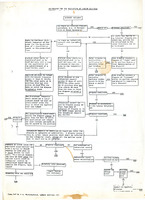 A four-phase historical review authored by R.M. Godsell (Chairman of SACCOLA) detailing the organisation's engagement with labour law reform from 1983 to August 1988. The report tracks SACCOLA's evolution from its expulsion from the International Organisation of Employers to its role as a primary negotiator during the crisis surrounding the 1988 Labour Relations Amendment Bill. It documents high-stakes meetings with COSATU and NACTU, the 1988 three-day national stay-away, and employer attempts to reach consensus on "Unfair Labour Practice" definitions to prevent industrial conflict.
-
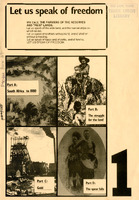 The struggle reaches back to the days of the first white settlement in our country. In this chapter we will look at some of these traditions of our struggle. We will learn more about the people who were in South Africa when the settlers came, and how they fought bravely to live in peace on their land. We will also read about the many changes that happened, particularly after diamonds and gold were discovered and how people continued to struggle against the new conditions that made their lives even harder.,“We call the farmers of the reserves and trust lands. Let us speak of the wide land, and the narrow strips on which we toil. Let us speak of brothers without land, and of children without schooling. Let us speak of taxes and of cattle, and of famine. LET US SPEAK OF FREEDOM.â€