
Items
Subject is exactly
Congress of South African Trade Unions (COSATU)
-
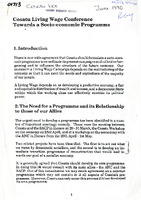 This document outlines the Socio-economic Programme of the Congress of South African Trade Unions (COSATU). It articulates a strategic shift toward a coordinated policy framework intended to align the federation’s collective bargaining efforts with broader macroeconomic restructuring. The programme asserts that the success of the "Living Wage Campaign" is contingent upon fundamental changes to the South African economy. It advocates for a transition towards a productive and equitable economic system, the redistribution of wealth, and the establishment of a democratic state where the working class holds significant political influence.
-
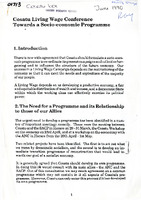 This document outlines the Socio-economic Programme of the Congress of South African Trade Unions (COSATU). It articulates a strategic shift toward a coordinated policy framework intended to align the federation’s collective bargaining efforts with broader macroeconomic restructuring. The programme asserts that the success of the "Living Wage Campaign" is contingent upon fundamental changes to the South African economy. It advocates for a transition towards a productive and equitable economic system, the redistribution of wealth, and the establishment of a democratic state where the working class holds significant political influence.
-
 This document is a Gender Policy Discussion Document issued by the Congress of South African Trade Unions (COSATU) for a session held between 27 and 29 March 2012. It serves to consolidate historical resolutions into a unified policy framework designed to address gender inequality within the workplace, the economy, the trade union movement, and broader society. The text acknowledges that while gender equality has been a foundational objective since COSATU's inception, progress across different union affiliates has been inconsistent. The policy outlines a vision for a society free from sexism, racism, and class exploitation, specifically seeking the emancipation of women from oppression within both domestic and professional spheres. Originally debated at the National Gender Conference in July 2000, this version was tabled for formal adoption to ensure all affiliates implement these principles within their own internal structures.
-
 This document is a Socio-economic Discussion Paper produced by the Congress of South African Trade Unions (COSATU) for a session held between 27 and 29 March 2012. It argues for the decriminalisation of sex work in South Africa, framing the issue as a matter of human rights, labour protection, and social justice. The text critiques the continued use of the apartheid-era Sexual Offences Act of 1957, asserting that criminalisation exacerbates the "miserable conditions" of the poor and the working class—specifically black women—who are disproportionately driven into the industry by unemployment and the "feminisation of poverty." COSATU advocates for a rights-based approach that recognises sex work as work, thereby allowing individuals to access the protection of national labour laws and occupational health and safety regulations.
-
 This document is a Maternity Protection Discussion Document produced by the Congress of South African Trade Unions (COSATU) for a session held between 27 and 29 March 2012. Developed in collaboration with the Solidarity Centre (AFL-CIO), the booklet serves as a comprehensive policy resource intended to strengthen the rights of pregnant and nursing workers in South Africa. The text acknowledges a wide-ranging partnership of contributors, including statutory bodies such as the Commission for Gender Equality (CGE), legal advocacy groups like the Legal Resources Centre (LRC), and international bodies like the International Labour Organisation (ILO). It specifically highlights the inclusion of vulnerable sectors through the involvement of the African Diaspora Women Workers Network and the South African Self-Employed Women’s Association (SASEWA).
-
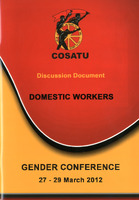 This document is a Socioeconomic Discussion Paper produced by the Congress of South African Trade Unions (COSATU) for a session held from 27 to 29 March 2012. It focuses on the strategic organisation and protection of domestic workers, following mandates established at the 5th COSATU Congress and the 2011 Domestic Workers' Summit. The paper evaluates the feasibility of establishing advice centres to assist domestic workers and explores the creation of a "viable home" or dedicated union structure for these employees within the federation. A central theme is the alignment of South African labour practices with international standards, specifically the ILO Convention 189 (C189) on Decent Work for Domestic Workers. The document represents a collaborative effort between COSATU, the South African Domestic Service and Allied Workers Union (SADSAWU), and the National Labour and Economic Development Institute (NALEDI).