
Items
Subject is exactly
CheckCat
-
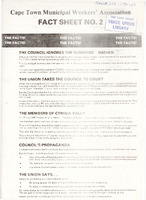 Members have shown tremendous interest in the Industrial Court Hearing relating to the Wage Dispute with the City Council. In addition to personal enquiries, we have received hundreds of telephone calls asking for progress reports. The calls are still coming in. It is in response to this clamour for information, as well as the Union's commitment to keep members informed, that it was decided to bring out this SPECIAL ISSUE of WORKER NEWS. We hope that members will now be better informed on the latest developments.
-
 In every workplace there is a struggle. On the one side is the employer who seeks to make as much profit as possible, and on the other side are the workers who want a living wage and decent working conditions. For the employer's pockets to be full, the workers must suffer. For workers to get what they deserve, profits would fall. The interests of bosses and workers are different. This struggle is the spirit of capitalism. It fills the walls of every factory, the shaft of every mine, and the fields of every farm. But this struggle between bosses and workers is not like a soccer match between two equal teams. The employer has much more power than the worker : The employer owns the company. The employer has a big store of wealth from profit making to rest on. The employer has the power to hire and fire workers. The employer has the power to make decisions and give orders. The employer has easy access to lawyers, politicians and technical resources. Workers have one thing that bosses want. Their ability to work. But although employers need labour, this does not give an individual worker much bargaining power. Bosses and workers do not meet as equals in the market place, as many capitalist economists would like us to believe.
-
-
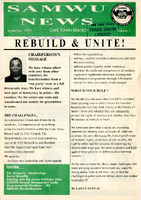 As a democratic Union and driven by its members, it is imperative for us to bring about the transformation within the Cape Town Branch and the City Council. The Shopstewards, our elected representatives, cannot do it by themselves and therefore need the support and input from their members they represent. We need to: develope new leadership and build capacity within the organisation, seriously address workplace democracy and joint decision-making address gender equality at the workplace, develope the skills and competencies of workers, vigorously implement education, training and development programmes through Affirmative Action for those previously disadvantaged. WHAT IS YOUR ROLE ? We should also dissuade other SAMWU members from crossing over to other Unions for material benefits but that they look closely at the history of these Unions and whether they can adequately protect the rights of workers and whether they have the interest of workers at heart. We have seen how other Unions are recruiting members by offering them all kinds of elaborate schemes, but not addressing the fundamental issues of workers' rights, protection of job security, the right to strike and the question of narrowing the discriminate wage gap. We need to protect and fight against these policies of differentiation between workers. As we can see from the above, many challenges and work are lying ahead of us to build and unite the strong union. Now is the time - let us face the challenges together to build strong union and worker leadership.
-
-
-
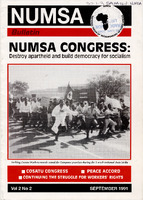 In this Bulletin we focus on the NUMSA and COSATU Congresses which were held in June and July this year. We also cover the National Peace Accord in some detail. In covering NUMSA's Third National Congress we focus on the major points discussed and contributions from guest speakers. We report on NUMSA's current membership and who the new Office Bearers are. We also produce in full the Resolutions that were adopted at the Congress. We report briefly on the discussions, debates and the resolutions that were finally passed at COSATU's Fourth National Congress. Unfortunately for reasons of space, we have not been able to print the resolutions adopted at this Congress. Shop stewards are therefore advised to contact their NUMSA Regional Office for a copy of the Minutes, Speeches and Resolutions of the Congress, or to contact COSATU Head Office which is due to produce a resolutions booklet soon. Much has been achieved in the negotiations around a Peace Accord between the ANC Alliance, Inkatha Freedom Party and the National Party. The Accord is pages long and is very detailed. We have tried in this Bulletin to give an overview of its basic features. We hope the chart that goes with the article will help people understand the detail and complexity of it and why it goes much, much further than all previous Accords. The Accord has now been signed by most of the major parties on September 14. Watch the press for details of a new Act which is due to be passed within 30 days outlawing
-
 COSATU and UDF say, A climate for creating peace is slowly being established. But at the same time, a number of anti-peace forces are working to undermine our efforts. For years the police have been fanning the violence in Natal. In 1987 when peace talks with Inkatha were taking place they detained our leaders - thus sabotaging the peace talks. Throughout South Africa, the state has created and supported vigilante groups aimed at destroying progressive organisations. Now, after all the harm they have caused, they are trying to take credit for the peace that has recently been established in Tshongweni. In Mpumalanga, members of the Special Branch are attempting to hold peace talks with members of our organisations. We say that the police cannot be the agent of lasting peace. Peace will only come about when the organisations which are most affected come together and decide how peace can be enforced. The recent police shootings at Natal University, Cape Town, Pietermaritzburg and other areas remind us thgt the police are prepared to kill to save apartheid.
-
 The idea of developing Research Groups in NUMSA was agreed to within the Education Programme for 1989. The areas of research emerged from the organising sectors of the union. This link between research, education and organisation was seen to be very important. The experiment has been very successful and could point the way to a successful research method for many other projects. The research groups have effectively combined academic researchers, service organisations and worker leaders. This has proved a powerful combination. The basic idea was that a small group of between 10-15 people from within NUMSA would work with outside researchers on certain key areas. The task of the group was to identify problems and a framework of proposals for how NUMSA could deal with the issues. These recommendations then went to the organisational structures for discussion and endorsement. Once endorsed it became the task of: organisational structures to carry out the implementation of the proposals through collective bargaining and campaigns. Education to educate and train people within the unions on these issues. Education would work with the research groups in doing this. the research groups to continue research if necessary. It is also our aim to link these research groups to study tours to other countries so that we can make comparisons.
-
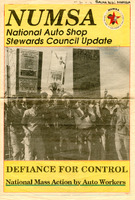 During July and August this year, the united mass action of 25 OOO auto workers forced the bosses to negotiate nationally. Large demonstrations of workers demanding national negotiations marched and toyi-toyied through the plants. But auto workers also gave their bosses another strong message. United and strong, marching with large banners and replica AKs, workers were unbanning the ANC and flying high the red flag. Workers demanded the release of Nelson Mandela and all political prisoners. They said all hangings and political trials must stop. Workers demonstrated against the LRA and all other apartheid laws. Workers wanted their bosses to be clear. The bosses must know that the mass defiance campaign in the factory is part i of the struggle of the oppressed and exploited masses. When we are demanding better working conditions today, when we are unbanning our organisations through mass action today, we are demanding at one and the same time, control over every aspect of our lives in the factory and in the townships where we live. Our struggle for freedom is one struggle.
-
-
-
 This survey was carried out in November 1973. My grateful thanks are due to the Grahamstown officials of the Cape Midlands Bantu Administration Board for permission to use the records of the Labour Office, and for the assistance given me during the survey. In particular I should like to thank the Area Manager, Mr. Bush, Mr. Freeman, the Manager, Mr. Hall, the Labour Officer, and the Clerks in the Labour Office who gave their help when needed. The aim of the survey was to provide up-to-date information on the basic rates being paid to African employees registered at the Labour Office in Grahamstown. The survey was intended to provide an overall view of wages paid in Grahamstown by various groups of employers, and to give some information on differing wage rates for males and females, and for Africans recruited in Grahamstown and working in other centres.
-
-
 This was the first time I attended any Gender workshop or seminar. I can truly say that this was a real eyeopener to me. I would recommend this course or any other similar course to all women and not only to trade unionist , because we must empower ourselves.
-
 The implementation of our previous resolutions on socialism has always created misunderstanding amongst our members. Believing that an effective, achievable education programme for our members will ensure understanding amongst our members. SAMWU's continued commitment to socialism requires that it develops a counter to the ideological war against socialism. Socialism is the only system which can solve the social and economic problems of working people across the globe and any attempts to reform capitalism will merely lead to greater levels of poverty, unemployment, homelessness, disease, starvation, crime and civil war. Resolves that SAMWU, with COSATU, shall mount a counter-offensive campaign against ' capitalism aimed at proving the superiority of socialism by: Engaging in relentless public criticism of capitalism By conducting, throughout the Federation, ongoing education on the fundamental ideas of socialism and nurturing a working class consciousness and outlook. Fostering a climate of free and fraternal debate on how socialism is to be achieved. SAMWU should forge links with other working class formations internationally as part of the international fight against neo-liberal globalisation.
-
 One of the biggest threats to RDP delivery in the municipal sector is that of privatisation. The Conference re-affirmed the long standing anti-privatisation position of SAMWU. In order to advance this position, the following proposals are made: That the Union develops a clear campaign to promote our opposition to privatisation and our support for the retention of basic services under public control and ownership through the “turning around†of local government services. That Regions discuss the elements of this campaign and that this is finalised in the next NEC. That for the campaign to succeed, it must be mass based. We should focus on getting worker and community support for our fight to retain services in public hands. An essential element of the campaign would be to ensure implementation of the last COSATU CEC resolution which calls for basic services like water, electricity, housing etc. to remain under public ownership and control. This includes identifying those services which should be brought under public ownership and control(nationalisation). Another important feature of the campaign should be the integration of the research findings(the joint ILRIG/SAMWU Research Project) into the programme. The research should both illustrate international and national consequences of past privatisation experiments as well as illustrating public sector superiority in the delivery of basic services(democratic alternatives to privatisation).
-
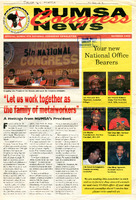 From the 25 to the 29 September, NUMSA held its Fifth National Congress. Seven hundred and sixty-two delegates came from all our locals. They had prepared well. We saw from the debate. I was afraid before the Congress. I was not happy. 80% j of the shop stewards you elected in 1996 were new. I thought the level of debate at the Congress was not going to be high. But I was wrong - the level of debate was high. We must be proud of ourselves. Thank you for mandating your representatives to Congress - that is what we mean by worker control and democracy. We are doing our work under different conditions compared to before April 27, 1994. We have a democratically elected government in place. It is not as hostile as its predecessor. But the reality of the situation is that as workers in the workplace, nothing has changed. Management is coming to us with new ideas like kaizen, team-work, etc. These are all about eliminating waste. They define waste as anything that is not absolutely essential to production. They want to get to the lowest levels of inputs, equipment, material and workers. This means more and more control over workers' time and activities, a faster workplace, longer and more irregular hours. They standardise jobs and make the workplace more regimented. So we have to focus our efforts collectively on our “core business†- to represent our members effectively. We have to fight for job security, training, technical skills and better increases. We have to do all these under difficult conditions, for example, reduction of tariffs to conform with the requirements of the World Trade Organisation. We do not want the country's economy to be cushioned forever but the drastic restructuring results in job loss and factory closures. We must have an alternative in place to ensure that people do not once more swell the swollen ranks of the unemployed. Work organisation is taking place in different forms in different workplaces. We are involved in these processes. I know that when shop stewards give report backs and persuade members to accept certain things in exchange for job security, members tend to regard them as management stooges. We mustn't think like that. It is causing division amongst us. Outside the workplace, the balance of forces is not in favour of the working class for reasons that we all know. We must work together as workers, shop stewards, administrators and organisers to build our Union into a coherent vehicle. Only a strong vehicle can play a leading role in freeing our people economically. Let us work together as the family of metalworkers!
-
 IN FEBRUARY 1995, Comrade Tito Mboweni published for comment and negotiations, a draft Labour Relations Bill, prepared by the Ministerial Task Team led by Halton Cheadle. The initial reactions of both business and labour were generally favourable to the Bill. We indicated that, at a glance, the Bill represented a major shift in industrial relations, an advance in our struggle and that its basic structure had many positive elements. We also indicated that some areas needed reworking and radical changes. By the end of April, labour was ready with its positions. These had been agreed upon by Cosatu's Central Executive Committee (CEC) and in further discussions with Fedsal and Nactu. These positions were published on May Day and presented to business and the government on 4 May. Business was either not ready by then, or had made a decision to delay the process. Throughout the negotiations process, they did not table any constructive proposals. Instead they labeled ours as unworkable and unreasonable. The same approach was adopted by most of the commercial media. By the end of May it was clear to all of us that, short of a massive programme of mass action, mobilisation of the international trade union movement and a new approach to the negotiations, we were not going to have the Bill ready by this year. The result was massive marches and stay aways on 6 and 19 June. Business responded with an advertisement in all major newspapers' claiming to have accepted the Bill. They even misrepresented Tito's speech at the launch of the Bill. This was a sign of desperation on their part. A new round of negotiations started again on 21 June 1995 with a series of trilateral negotiations culminating in the Nedlac Agreement of 19 July. While labour was satisfied with most of the issues, we had reservations on the way some of the issues were resolved or captured. We nonetheless agreed that the process of drafting the agreements into law should begin, to ensure that the bill went through parliament before the end of the 1995 sitting, which was scheduled to rise on 15 September. We now have a new law, which, as 1 have indicated earlier, represents a victory for labour and brings in a new era of industrial relations. Most of the issues on which we had reservations, have been resolved either through drafting or the parliamentary process.
-
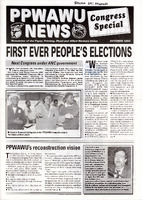 Congress understood well what Cde Nqakula was saying and how important it is to mobilise all our forces to come in with a huge ANC majority in the elections. Delegates made sure through a strong resolution on elections that PPWAWU will play its part: the union will send a fulltime PPWAWU person to COSATU for voter education. This person is Sipho Kubheka and he is already at COSATU head office. One shopsteward from each region will also be released to assist COSATU. Branches must run voter education workshops at once with the education co-ordinator's help. Shopstewards must get time off to train as voter educators, and all workers must give R1 towards voter education.
-
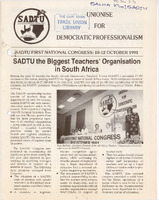 During the past 12 months the South African Democratic Teachers' Union (SADTU) recruited 37 947 teachers to the union, making SADTU the biggest union in South Africa today. With completed membership forms in excess of 15 000 still to be collected, SADTU can talk of an effective membership of 50 000 teachers, the SADTU president, Shepherd Mdladlana said during his address to Congress at Nasrec, Johannesburg. The SADTU membership further consists of teachers from all departments all over the country, making SADTU the only unitary, non-racial teachers' union in the country. In his report to Congress, SADTU General Secretary, Randall van den Heever, pointed out that the most progressive members of all erstwhile organisations - newly emergent as well as established - occupied leadership positions within the union's branch and regional structures, making SADTU the most well represented union of teachers from all sectors.
-
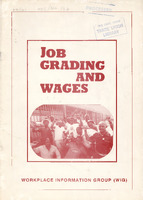 Job grading is a way of saying how important different jobs are for management. Job grading is a way of comparing different jobs, and saying that some jobs are very important, and other jobs are not so important. Most job grading systems say that managers and engineers are very important, and that labourers and operators are not important. Wages are paid according to the workers' grade in the job grading system. A worker with an important job will earn higher wages that a worker with a job that is not so important.
-
 Eskom increased the wages of general workers by 10% from 1 July- 1988, after the unions had rejected a 12% offer. The trade unions declared a dispute with Eskom, and have demanded a 20% wage increase (including the 10% increase implemented unilaterally), to be backdated to 1 July 1988. This document outlines the case for a higher wage increase than that granted by Eskom. All the wage calculations and projections assume that the increased wage will be back-dated to 1 July 1988. This report has been written by the Collective Bargaining Department of the National Union of Mineworkers in collaboration with the Labour Research Service in Cape Town.
-
-
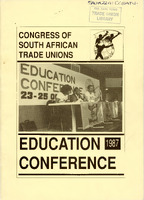 The education struggle has always had an important place in our liberation struggle. For as long as can be remembered, the oppressed and exploited have been fighting against bantu education and for control over our own education. As our struggles intensified, so our education demands became clearer. In the late 1980s the demand is for people's education which serves the needs of the oppressed. In the early 1980s the demand was for equal education. The growth of working class organisation in the factories and townships, coupled with the Frelimo and MPLA victories, encouraged deeper discussion of the role of education in the struggle for socialism. After the historic National Education Crisis Committee (NECC) conference, there came a clear and united call for people's education and for democratising all educational institutions so that students, teachers and parents could build joint control over education. In 1985 COSATU was launched with the words: "A giant has risen." COSATU has since grown very quickly, challenging the bosses and taking organised workers to the frontline of the struggle. The first National Congress in July 1987 showed that COSATU mergers and campaigns had made the federation much stronger. However, the conference noted that education structures in COSATU and within many affiliates remained weak. It was decided that an Education Conference be called to give direction and a new push to worker education in the federation. The conference looked at the main areas covered in our resolutions : COSATU Courses, Peoples Education, Media, Women and Culture. This booklet gives a record of the discussions and strong resolutions taken at the conference, where every union and every region of COSATU was represented. When we read this booklet, we must ask ourselves: Have we implemented the resolutions taken? How much progress has been made? We have a short time left until the next Education Conference (in October 1989) where we will assess what progress has been made. This booklet is for discussion and debate. It must be a tool that we use to build education in the unions. It must be a weapon for turning our resolutions into reality; our theory into practice; our commitment into struggle.