
Items
Creator is exactly
SAMWU
-
 As a democratic Union and driven by its members, it is imperative for us to bring about the transformation within the Cape Town Branch and the City Council. The Shopstewards, our elected representatives, cannot do it by themselves and therefore need the support and input from their members they represent. We need to: develope new leadership and build capacity within the organisation, seriously address workplace democracy and joint decision-making address gender equality at the workplace, develope the skills and competencies of workers, vigorously implement education, training and development programmes through Affirmative Action for those previously disadvantaged. WHAT IS YOUR ROLE ? We should also dissuade other SAMWU members from crossing over to other Unions for material benefits but that they look closely at the history of these Unions and whether they can adequately protect the rights of workers and whether they have the interest of workers at heart. We have seen how other Unions are recruiting members by offering them all kinds of elaborate schemes, but not addressing the fundamental issues of workers' rights, protection of job security, the right to strike and the question of narrowing the discriminate wage gap. We need to protect and fight against these policies of differentiation between workers. As we can see from the above, many challenges and work are lying ahead of us to build and unite the strong union. Now is the time - let us face the challenges together to build strong union and worker leadership.
-
 The implementation of our previous resolutions on socialism has always created misunderstanding amongst our members. Believing that an effective, achievable education programme for our members will ensure understanding amongst our members. SAMWU's continued commitment to socialism requires that it develops a counter to the ideological war against socialism. Socialism is the only system which can solve the social and economic problems of working people across the globe and any attempts to reform capitalism will merely lead to greater levels of poverty, unemployment, homelessness, disease, starvation, crime and civil war. Resolves that SAMWU, with COSATU, shall mount a counter-offensive campaign against ' capitalism aimed at proving the superiority of socialism by: Engaging in relentless public criticism of capitalism By conducting, throughout the Federation, ongoing education on the fundamental ideas of socialism and nurturing a working class consciousness and outlook. Fostering a climate of free and fraternal debate on how socialism is to be achieved. SAMWU should forge links with other working class formations internationally as part of the international fight against neo-liberal globalisation.
-
 One of the biggest threats to RDP delivery in the municipal sector is that of privatisation. The Conference re-affirmed the long standing anti-privatisation position of SAMWU. In order to advance this position, the following proposals are made: That the Union develops a clear campaign to promote our opposition to privatisation and our support for the retention of basic services under public control and ownership through the “turning around†of local government services. That Regions discuss the elements of this campaign and that this is finalised in the next NEC. That for the campaign to succeed, it must be mass based. We should focus on getting worker and community support for our fight to retain services in public hands. An essential element of the campaign would be to ensure implementation of the last COSATU CEC resolution which calls for basic services like water, electricity, housing etc. to remain under public ownership and control. This includes identifying those services which should be brought under public ownership and control(nationalisation). Another important feature of the campaign should be the integration of the research findings(the joint ILRIG/SAMWU Research Project) into the programme. The research should both illustrate international and national consequences of past privatisation experiments as well as illustrating public sector superiority in the delivery of basic services(democratic alternatives to privatisation).
-
 The SAMWU anti-privatisation campaign goes right to the heart of all members in their role as service providers to the community. Any privatisation of municipal services would mean that people in community not have access to basic services. It would also mean a loss of jobs through retrenchment and restructuring. This has already happened in other parts of the world. Internationally, public sector unions are fighting privatisation. For all these reasons, SAMWU calls on all members to intensify the anti-privatisation campaign! Experiences internationally have shown that privatisation results in increase in tariffs and a decline in quality services. Our communities have never received a quality service under apartheid. Now things will even be worse: under privatisation only those who can afford to pay, will get services. A major political responsibility that confronts SAMWU: we must ensure that we win the struggle against privatisation. We are confident that based on the democratic participation of 'our gold', SAMWU workers, COSATU and the community we can be victorious.
-
 The name of the union shall be the SOUTH AFRICAN MUNICIPAL WORKERS UNION. The union shall be a body corporate with perpetual succession capable of entering into contractual and other relations and of suing and being sued in its own name and shall be an organisation not for gain. It shall hold property separate from its members. The liability of members shall be limited to the amount of subscriptions or other monies due to the union at any time in terms of this constitution.
-
 We enclose our preliminary response to the report. This serves as our contribution to the agenda for the meeting currently scheduled for 22 March 1996 in Cape Town. Intended to commence early and continue until lunch time - if not beyond. We record that we have discussed the representation of different departments which need to be present from Governments side -including yourselves, Constitutional Development, Water Affairs, Finance, and Labour. We would further note that the participants need to understand that we are not impressed in general when we arrange meetings only to have details change at the last moment. From our side you can expect a delegation of between 12-14 persons including representatives of our 9 regions and national office bearers. SAMWU first became aware of the MIIF during the Portfolio Committee Public Hearing on local government legislation held in November 1995. A copy of the full document was received by our office in mid-January 1996. A covering letter indicated that a key issue in the MIIF was the " nature and extent of private sector involvement in extending service delivery". A meeting was held, on 21 February 1996, between the Minister without Portfolio, the Director General in the RDP Office and a delegation from SAMWU. It is necessary to note that this first formal contact was very belated and does not serve to engender trust in any process. We do not accept that any serious attempt was made to involve the union prior to the document being made public. It is our view that the attitude to unions , as reflected in the document, was one of “unions will have to be accommodated “ (our Italics). Implying more of a necessary evil than any concern for a partnership. “ Partnerships†being reserved for business, small entrepreneurs and big capital. We have been assured that the document remain a consultative document and that we can still make our input. The fact is that it is already taken to represent government policy and is being acted upon in such terms. A case in point being the planning already being done by the DBS A in respect to water and sanitation (Municipal Engineer - Jan 96 ). It is necessary that Government correct this impression if further consultation is to be taken seriously. It is our view that in its current form the document is being used as a means of mounting an attack on the direct provision of services by local government.
-
-
 It has been agreed that SAMWU will register under the PSLRA to allow the new union to be able to be registered under the Public and the Private sectors.This is called a piggy bag model. The NEC will be composed of the newly elected NOB's and Heads Of Departments together with one delegate from the. respective regions'..The NOB's will go around launching the regions after the merger congress.
-
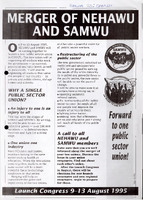 On 9 to 13 August 1995,NEHAWU and SAMWU will be coming together to launch a new public service union in COSATU. The new union will be organising all workers who work for government — at national, provincial and local levels as well as parastatals. It will also be Organising all workers that serve the people of our country — in private and public clinics, old age homes and schools.
-
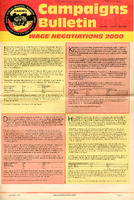 It is sad how the promises of a better life for all made by the government means so little for workers. Cosatu and Samwu mobilised our forces to ensure a victory for the ANC in the national and local government elections. Despite the fact that workers have put MPs into parliament and councillors into local government councils, we have yet to see any real benefit for workers. The 3rd and final round of negotiations delivered a big disappointment for Samwu. Once again we went into negotiations with high hopes of persuading Saiga to implement decent wage increases. Samwu's position of R250 or 10% for workers earning less than R6 700 per month was very reasonable. Because we said that those earning more than R13 700 should get a 7% increase, this meant that the total cost to councils was only 9%, which is very affordable. Saiga moved its position in negotiations by 1%. They also tried to get us to give up our demand for a R250 increase by offering a minimum wage of R1600. As we know, most workers are earning more than that. Workers earning R1600 Saiga's 5% will mean a R80 increase. This is less than councillor's get for attending one meeting! Although the negotiators tried everything to try to reach a settlement, Saiga frustrated us at every turn.
-
-
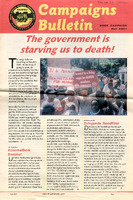 The wage talks are resuming on May 8th 2001. At the time of going to print, all provinces were holding marches all over the country to highlight our demands for a living wage. Currently on the table is a proposal by the conciliator that all parties should agree to accept an 8% across the board increase, and an increase in the minimum wage to R1900. Firstly this proposal has not yet been accepted by the employer. At the conciliation, the employer stuck to 5% only. Secondly this falls short of our demand. It means we will not get the R300 across the board. Any worker earning below R3800 per month is going to get an increase of less than R300. The hardest hit will be workers earning from R1700 - R3000 who will only get R136 - R240. There is nothing more we can get from conciliation or negotiations. It is now up to YOU the workers to decide if you will accept the 8% offer put on the table by the conciliator!
-
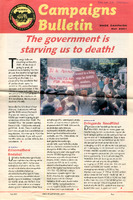 The wage talks are resuming on May 8th 2001. At the time of going to print, all provinces were holding marches all over the country to highlight our demands for a living wage. Currently on the table is a proposal by the conciliator that all parties should agree to accept an 8% across the board increase, and an increase in the minimum wage to R1900. Firstly this proposal has not yet been accepted by the employer. At the conciliation, the employer stuck to 5% only. Secondly this falls short of our demand. It means we will not get the R300 across the board. Any worker earning below R3800 per month is going to get an increase of less than R300. The hardest hit will be workers earning from R1700 - R3000 who will only get R136 - R240. There is nothing more we can get from conciliation or negotiations. It is now up to YOU the workers to decide if you will accept the 8% offer put on the table by the conciliator!
-
-
 Our National Executive Committee met on 20/21 February and, amongst others, deliberated on the latest developments around the proposed labour law amendments. After consideration of the document circulated at the recent COSATU CEC and the subsequent CEC resolution on the matter, our NEC resolved as follows: SAMWU expresses its concern at the manner in which negotiations on the amendments were conducted and more specifically the lack of a more thoroughgoing consultative process involving workers. Already it would appear, as cautioned previously, that the Millenium Labour Council has usurped NEDLAC as the site of engagement on matters of this nature with the latter simply assuming a rubber- stamping role. Of major concern to the Union is the proposed joint vision that serves as a preamble to the agreement concluded between the negotiators in the Millenium Labour Council. In the view of SAMWU, the vision constitutes the first formal embrace by COSATU, notwithstanding the Federation's vision of socialism, of neo-liberal globalisation viz. economic growth for redistribution. The COSATU view has always been the opposite - growth through redistribution. SAMWU cannot support any agreement with business that acknowledges their right to a 'competitive' profit and secure investments. Profits derive directly from the exploitation of workers. If any agreement between business, labour and government on the proposed amendments has to contain a preamble, then SAMWU is of the view that it should simply recognise that notwithstanding fundamental differences on an appropriate macro-economic strategy for the country, the parties have been able to reach agreement on various amendments to labour legislation.
-
 This document is as adopted by the SAMWU NEC in November 1994. It serves to define the wages and conditions of employment applicable to all SAMWU staff and is the only conditions of employment document of the union. Employees who were staff of a pre-existing trade union which merged with SAMWU who have conditions which were previously declared personal to holder ( in terms of merger agreements ) are required to examine this document and to individually register where they, consider that their terms differ from this document. No improved condition hereby introduced can be taken to apply to such employees as a matter of right . They have a choice of registering specific conditions as †personal to holder " or converting to the full set of conditions as contained herein. Where they register a condition as personal to holder the NEC will decide whether new conditions hereby introduced are also applicable to them. It is further recorded that whilst these conditions of service are open to be ammended from time to time ; as-the NEC may decide , any representations for amendments shall normally only be considered during the later part*of-each year.
-
 The headings of the clauses in this agreement are for the purpose of convenience and reference only and shall not be used in the interpretation of nor modify nor amplify the terms of this agreement for any clause hereof.
-
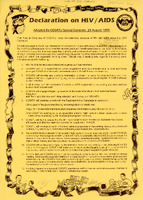 This Special Congress of COSATU notes the relentless advance of HIV and AIDS since the 1997 Congress. 3,5 million people in South are infected with the Human Immuno-deficiency Virus (HIV). Life expectant South Africa will reduce to 40-45 over the next ten years and health care costs will be beyond the cape of survivors to pay for. It is now clear that publicity and condom distribution, though important, are enough. This requires a new approach and strategy, based on a partnership between government and society in which the organised working class should play a leading role.
-
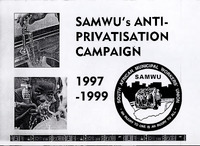 Last week, SAMWU held lunchtime demonstrations around the country to protest against the privatisation of municipal services. The demonstrations were well attended with reports from the regions indicating that thousands of workers turned out. SAMWU has received an overwhelming show of solidarity from the international community. The General Secretary of UNISON, Britain's largest public sector union with over 1 million members, wrote that “The UK experience of water privatisation has been huge windfall profits for the companies, record dividends for their shareholders, and massive pay rises for those at the top of these companies. At the same time, employees have suffered job losses, while consumers have had massive price rises. Drought restrictions are widespread and almost one third of all water leaks from old pipes.†The Community and Public Sector Union is Australia wrote that “the Victorian government has pursued similar policies since its election in 1992, and this has resulted in the loss of over 30 000 jobs. Despite the massive effort at privatisation, the state remains the highest taxed state in the nation!†The President of the Public Services Association in Trinidad and Tobago wrote “Our own experience is that Severn Trent of the UK has been granted a loan facility by our government to cover all operational losses for the three year period, thereby taking no risks and collecting management fees of millions of dollars. Water is the most essential commodity for humans and it should never be handed over to the private sector profiteers.†The Executive Committee of Algemene Onderwijsbond, Netherlands wrote: “the evil of privatisation of public holdings is a worldwide problem.. .be convinced of our solidarity and support with your struggle.†SINTAP, the Portuguese Union representing public administration personnel wrote: “We hope the Ministry of Constitutional Development will be able to accept your pilot projects for public sector alternatives to privatisation of water and waste services.†The International Secretary of the 1.3 million member AFSCME (American Federation of State, County and Municipal Employees) wrote: “given its central importance to sustaining life, water must remain in public hands. We applaud your actions to ensure working conditions for those employed in these critical public services and your leadership in educating the community of the danges associated with privatisation.†The President of the Lithuanian Trade Union Federation of Public Services faxed SAMWU's President a message saying that “in Lithuania, the capital city of Vilnius has been fighting French multinational Lyonnaise Des Eaux for four years. They want to buy our city's water system for 5 million US dollars and get 30% of the shares, which is valued at 660 000 US dollars. Its profit the company will get from our citizens pockets.â€