
Items
Creator is exactly
Congress of South African Trade Unions (COSATU)
-
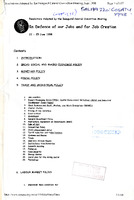 A consolidated policy document containing socio-economic resolutions delegated by the 6th National Congress. It integrates new resolutions from affiliates with established policies from previous conferences (1992–1997) covering Economic Policy, Health and Safety, and the Living Wage. As the inaugural meeting of the Central Committee, this document represents the highest policy-making authority on socio-economic issues between National Congresses.
-
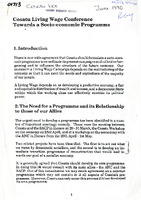 This document outlines the Socio-economic Programme of the Congress of South African Trade Unions (COSATU). It articulates a strategic shift toward a coordinated policy framework intended to align the federation’s collective bargaining efforts with broader macroeconomic restructuring. The programme asserts that the success of the "Living Wage Campaign" is contingent upon fundamental changes to the South African economy. It advocates for a transition towards a productive and equitable economic system, the redistribution of wealth, and the establishment of a democratic state where the working class holds significant political influence.
-
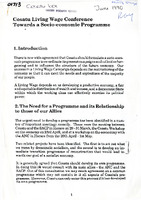 This document outlines the Socio-economic Programme of the Congress of South African Trade Unions (COSATU). It articulates a strategic shift toward a coordinated policy framework intended to align the federation’s collective bargaining efforts with broader macroeconomic restructuring. The programme asserts that the success of the "Living Wage Campaign" is contingent upon fundamental changes to the South African economy. It advocates for a transition towards a productive and equitable economic system, the redistribution of wealth, and the establishment of a democratic state where the working class holds significant political influence.
-
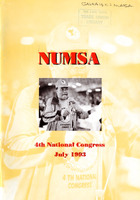 This document is a formal record of the Fourth National Congress of the National Union of Metalworkers of South Africa (NUMSA), which was held in Johannesburg from July 1 to 4, 1993. The congress served as a critical constitutional meeting, bringing together 773 delegates from across the union's eleven regions. The primary function of the congress was to determine the union's leadership and strategic direction for the following three-year term. It represents a significant historical snapshot of the metalworkers' movement during the final stages of South Africa's transition to democracy, highlighting the union's democratic processes and regional representation.
-
 This document is a Gender Policy Discussion Document issued by the Congress of South African Trade Unions (COSATU) for a session held between 27 and 29 March 2012. It serves to consolidate historical resolutions into a unified policy framework designed to address gender inequality within the workplace, the economy, the trade union movement, and broader society. The text acknowledges that while gender equality has been a foundational objective since COSATU's inception, progress across different union affiliates has been inconsistent. The policy outlines a vision for a society free from sexism, racism, and class exploitation, specifically seeking the emancipation of women from oppression within both domestic and professional spheres. Originally debated at the National Gender Conference in July 2000, this version was tabled for formal adoption to ensure all affiliates implement these principles within their own internal structures.
-
 This document is a Socio-economic Discussion Paper produced by the Congress of South African Trade Unions (COSATU) for a session held between 27 and 29 March 2012. It argues for the decriminalisation of sex work in South Africa, framing the issue as a matter of human rights, labour protection, and social justice. The text critiques the continued use of the apartheid-era Sexual Offences Act of 1957, asserting that criminalisation exacerbates the "miserable conditions" of the poor and the working class—specifically black women—who are disproportionately driven into the industry by unemployment and the "feminisation of poverty." COSATU advocates for a rights-based approach that recognises sex work as work, thereby allowing individuals to access the protection of national labour laws and occupational health and safety regulations.
-
 This document is a Maternity Protection Discussion Document produced by the Congress of South African Trade Unions (COSATU) for a session held between 27 and 29 March 2012. Developed in collaboration with the Solidarity Centre (AFL-CIO), the booklet serves as a comprehensive policy resource intended to strengthen the rights of pregnant and nursing workers in South Africa. The text acknowledges a wide-ranging partnership of contributors, including statutory bodies such as the Commission for Gender Equality (CGE), legal advocacy groups like the Legal Resources Centre (LRC), and international bodies like the International Labour Organisation (ILO). It specifically highlights the inclusion of vulnerable sectors through the involvement of the African Diaspora Women Workers Network and the South African Self-Employed Women’s Association (SASEWA).
-
 This document is a Socioeconomic Discussion Paper produced by the Congress of South African Trade Unions (COSATU) for a session held from 27 to 29 March 2012. It focuses on the strategic organisation and protection of domestic workers, following mandates established at the 5th COSATU Congress and the 2011 Domestic Workers' Summit. The paper evaluates the feasibility of establishing advice centres to assist domestic workers and explores the creation of a "viable home" or dedicated union structure for these employees within the federation. A central theme is the alignment of South African labour practices with international standards, specifically the ILO Convention 189 (C189) on Decent Work for Domestic Workers. The document represents a collaborative effort between COSATU, the South African Domestic Service and Allied Workers Union (SADSAWU), and the National Labour and Economic Development Institute (NALEDI).
-
 A 2001 issue of the COSATU newsletter reporting on the historic decision by the Democratic Nursing Organisation of South Africa (DENOSA) to join the federation. It highlights the vote of 200 delegates at the Pretoria congress under the theme "Nursing facing challenges: Development and HIV/Aids." The document frames this as a vital consolidation of public sector and white-collar workers, challenging the notion that COSATU only represents lower-ranked labourers.
-
 A policy statement outlining COSATU's long-term campaign for the democratisation of mutual insurance companies (Old Mutual and Sanlam). It argues that while these companies manage vast sums of worker provident fund contributions, workers are granted no real ownership or governing rights. The document proposes that organised labour be represented on governing structures through Nedlac and that the resources of these "Mutuals" be leveraged for national economic development.
-
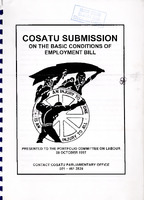 A 64-page formal submission to Parliament regarding the Basic Conditions of Employment Bill (BCEB). It tracks the transition from the 1996 Green Paper to intense negotiations in NEDLAC. COSATU argues for a mandatory "floor of rights" for all workers, especially domestic and farm labourers, while critiquing business attempts to maintain "apartheid cheap labour practices" under the guise of international competitiveness.
-
 A discussion document reflecting on the role of COSATU following the 1994 elections. It acknowledges the sympathetic nature of the new ANC-led government while emphasising the need for COSATU to maintain its "high moral ground" and organisational strength. The paper outlines a "Back to Basics" approach, focusing on the core union functions of collective bargaining, the living wage campaign, and meeting the basic needs of workers.
-
 A 1998 press statement outlining COSATU’s support for "strict anti-trust legislation." The document rejects business opposition to ministerial discretion in merger regulation and advocates for the forced divestiture (breaking up) of conglomerates that abuse their dominant market position. Key focus areas include the erosion of inherited corporate power, the prevention of excessive pricing, and the inclusion of "public interest" criteria—specifically the protection of jobs—in merger reviews.
-
 This policy document outlines the strategic mandate of the Congress of South African Trade Unions (COSATU) in the lead-up to the 1994 democratic elections. Adopted by the Executive Committee (EXCO), the programme formalises the federation’s "Three Priorities": Political Mobilisation: Ensuring a decisive electoral victory for the African National Congress (ANC) and securing its legitimacy to govern. Organisational Development: Strengthening the internal structures of COSATU to transition from a resistance movement to a sustainable force in a post-apartheid economy. Advocacy for Worker Interests: Establishing a framework to ensure the ANC-led government prioritises labour rights, specifically through the implementation of the Reconstruction and Development Programme (RDP).
-
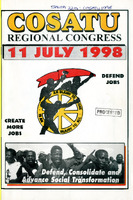 Records of the COSATU Western Cape Regional Congress held on 11 July 1998. The congress focused on mobilizing workers in the Western Cape province under the national theme of "Defend, Consolidate and Advance Social Transformation." Key agenda items included regional strategies for the 1999 General Elections, local government delivery, and addressing job losses in the regional textile and agricultural sectors.
-
 A policy resolution from the COSATU Education Conference focusing on the strategic priority of women's leadership development. Key mandates include: 1) The implementation of a quota system for training course participants; 2) A clear definition of "women development" that targets shop-floor workers to build leadership at all organisational levels; and 3) An inclusive approach designed to reach a broad base of women rather than a select few.
-
 A comprehensive training manual and workshop guide designed by the COSATU Education Department in September 1999. The pack provides a "baseline" introduction to the Employment Equity Act (EEA), focusing on its application to address discriminatory workplace practices. It uses an activity-based methodology to help shop stewards understand the Act's implications for collective bargaining. The document emphasizes reporting legal loopholes back to the Federation to strengthen future labor campaigns and challenges the employer's demand for "flexibility" by asserting the legacy of apartheid imbalances.
-
 A comprehensive draft resolution delegated by the 6th National Congress to the Central Committee. It serves as a unified policy framework, integrating resolutions from COSATU affiliates and findings from the "September Commission" (The Commission on the Future of the Unions). The document synthesizes a decade of policy conferences (1992–1997) to form the labor movement's formal proposal for the Presidential Jobs Summit. It covers economic policy, health and safety, and living wage mandates, wielding the same authority as a National Congress resolution.
-
 A draft policy document intended as a "dynamic organisational and fighting tool" for the democratic transition. It outlines the core demands of the labour movement regarding constitutional rights, including the right to strike, organisational independence, and gender equality. This version was circulated for affiliate discussion ahead of the March 1992 Central Executive Committee (CEC) and the subsequent Workers' Summit in May 1992.
-
 A formal resolution from the 1997 National Congress outlining the mandate for COSATU to intervene in affiliate unions facing internal problems or external disputes. It instructs the Central Executive Committee (CEC) to develop guidelines for such interventions based on constitutional clauses 3.9 and 3.10. The resolution emphasizes that while COSATU must provide visible leadership and coordination during major disputes with employers, these actions must not undermine the institutional integrity of the affiliate unions.
-
 A summary of COSATU's 1996 proposals to revitalise the Tripartite Alliance. It critiques the shift toward neoliberal economic policies (GEAR), discusses the "dual power" situation in post-apartheid SA, and proposes a binding Reconstruction Accord to prioritise the RDP.
-
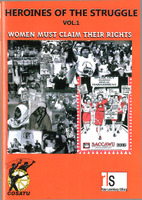 "The booklet serves as a commemoration of the heroines and veterans of the struggle. The brave women of the struggle, women who hold knife from its sharpest edge. Freedom cannot be achieved unless women have been emancipated from all forms of oppression. The booklet is the product of COSATU Archives in partnership with Rosa Luxemburg. The information is compiled by NANDIPAMITI (COSATU Archivist) pictures by William Matlala and COSATU Photo Archive."
-
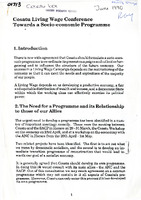 A strategic discussion paper proposing a comprehensive socio-economic framework for COSATU during the transition to democracy. It advocates for a "Growth Path" that moves beyond "bread and butter" issues to address industrial restructuring, human resource development, and the role of the State in a post-apartheid economy. It outlines the establishment of five specific commissions (Macroeconomics, Industrial Restructuring, Human Resources, LRA/Workers Charter, and Social Services) to synthesise labour policy with the ANC and SACP.