
Items
-
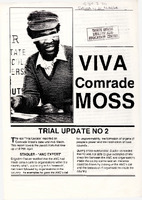 The last 'Trial Update" reported on Comrade Moss's case until mid-March. This report covers the period from that time up until 25th April.STADLER - "ANC EXPERT" Brigadier Stadler testified that the ANC had made certain calls to organisations within the country which, according to his "research", had been followed by organisations in the country. As examples he gave the ANC's call for ungovernability, the formation of organs of people's power and the destruction of town councils. During cross-examination Stadler conceded that he was not able to give examples of any direct link between the ANC and organisations inside the coutry but he said an inference could be drawn by looking at the ANC's call and the behaviour of organisations inside the country.
 -
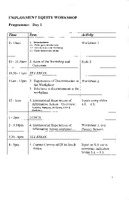 This document is an Employment Equity Workshop Programme, designed as a strategic training tool for trade unionists to navigate and implement the Employment Equity Act (EEA) of 1998. The workshop serves as a critical forum for assessing workplace discrimination and developing a unified union approach to affirmative action in the post-apartheid era. The programme emphasises that affirmative action is not merely a compliance exercise but a proactive method for redressing historical imbalances. By analysing international precedents and the specific strengths and limitations of South African legislation, the workshop aims to empower shop stewards and union officials to drive genuine transformation on the shop floor.
 -
 This document is informed by the struggles of women in the fight against colonialism and apartheid which were also encapsulated in the Women's Charter of 1954. The discussion is also premised on the charter that women drew up in 1993, prior to the 1994 elections. Our Constitution, in its quest to protect and promote gender equality in South Africa, drew largely from these documents.
 -
 This document is a Gender Policy Discussion Document issued by the Congress of South African Trade Unions (COSATU) for a session held between 27 and 29 March 2012. It serves to consolidate historical resolutions into a unified policy framework designed to address gender inequality within the workplace, the economy, the trade union movement, and broader society. The text acknowledges that while gender equality has been a foundational objective since COSATU's inception, progress across different union affiliates has been inconsistent. The policy outlines a vision for a society free from sexism, racism, and class exploitation, specifically seeking the emancipation of women from oppression within both domestic and professional spheres. Originally debated at the National Gender Conference in July 2000, this version was tabled for formal adoption to ensure all affiliates implement these principles within their own internal structures.
 -
 This document is a Socio-economic Discussion Paper produced by the Congress of South African Trade Unions (COSATU) for a session held between 27 and 29 March 2012. It argues for the decriminalisation of sex work in South Africa, framing the issue as a matter of human rights, labour protection, and social justice. The text critiques the continued use of the apartheid-era Sexual Offences Act of 1957, asserting that criminalisation exacerbates the "miserable conditions" of the poor and the working class—specifically black women—who are disproportionately driven into the industry by unemployment and the "feminisation of poverty." COSATU advocates for a rights-based approach that recognises sex work as work, thereby allowing individuals to access the protection of national labour laws and occupational health and safety regulations.
 -
 This document is a Maternity Protection Discussion Document produced by the Congress of South African Trade Unions (COSATU) for a session held between 27 and 29 March 2012. Developed in collaboration with the Solidarity Centre (AFL-CIO), the booklet serves as a comprehensive policy resource intended to strengthen the rights of pregnant and nursing workers in South Africa. The text acknowledges a wide-ranging partnership of contributors, including statutory bodies such as the Commission for Gender Equality (CGE), legal advocacy groups like the Legal Resources Centre (LRC), and international bodies like the International Labour Organisation (ILO). It specifically highlights the inclusion of vulnerable sectors through the involvement of the African Diaspora Women Workers Network and the South African Self-Employed Women’s Association (SASEWA).
 -
 This document is a Socioeconomic Discussion Paper produced by the Congress of South African Trade Unions (COSATU) for a session held from 27 to 29 March 2012. It focuses on the strategic organisation and protection of domestic workers, following mandates established at the 5th COSATU Congress and the 2011 Domestic Workers' Summit. The paper evaluates the feasibility of establishing advice centres to assist domestic workers and explores the creation of a "viable home" or dedicated union structure for these employees within the federation. A central theme is the alignment of South African labour practices with international standards, specifically the ILO Convention 189 (C189) on Decent Work for Domestic Workers. The document represents a collaborative effort between COSATU, the South African Domestic Service and Allied Workers Union (SADSAWU), and the National Labour and Economic Development Institute (NALEDI).
 -
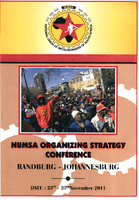 A strategic framework developed for the NUMSA Organising Strategy Conference held in Randburg, Johannesburg, November 23–25, 2011. The document integrates organising, campaigning, and bargaining into a unified "OCCB Strategy." This third draft incorporates feedback from the 2010 National Workshop and the 2011 Central Committee, as well as international benchmarking lessons drawn from a study tour of North American (Canadian) labour movements by the General Secretary and sectoral coordinators.
 -
 A multi-purpose educational flyer and union recruitment tool published in 2011. It outlines the core legal protections for domestic workers in South Africa under the BCEA, LRA, and Wage Act. The pamphlet specifically highlights the 2011 "Domestic Work is Decent Work" campaign at the ILO in Geneva, seeking international recognition for the sector.
 -
 DOMESTIC WORK IS WORK; DOMESTIC WORKERS ARE WORKERS; SADSAWU through our active involvement in the processes leading up to the adoption of the ILO convention on domestic workers, recognises that our country has made huge strides to protect domestic workers in relation to other countries. South Africa and particularly the Department of Labour played a leading role ensuring that the ILO adopted the convention on the 16th June 2011. Our right to organise, to a contract of employment, to participate in processes of setting national minimum wages and conditions of employment has been achieved long before the adoption of the ILO convention But we have to continue to lead and the nexi step is the ratification of the ILO convention on domestic workers by the South African government - let us be the first country to do so in Africa and in the world.
 -
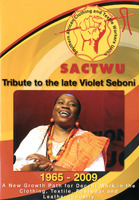 Violet Seboni was born on 18 September 1965. It was to be a turbulent start to life for this young girl who never got to know her father, in a story that started in sadness. And shortly after her birth, it was her mother too that she lost in circumstances that no one should experience. She knew pain and later in life she stood up for those in pain. Young Violet was raised by her grandmother for the first few years of her life, and when her grandmother died, it was her granny's friend - in a culture where ubuntu requires that we reach out to others - who took on the responsibility to rear the young girl and to become her comforter, her provider, her mother. Violet went to primary school and later to Madibane High School in Diepkloof, where she developed a love for netball and a passion for activism. After high school, she became pregnant and her beloved daughter Lesego was born. She looked for work, and like generations of young, working- class women before her, she turned to the clothing industry, to use her hands, her dexterity and her skill to earn a living to feed her young family. The role the industry plays, to give work, bread and life to those in need, is in itself a reason not to let the industry die simply due to the cold, harsh winds of global competition and indifference or inaction from those who have the power to intervene, to use trade measures and to use industrial policy tools to save jobs and absorb our people into decent work opportunities. The industry that young Violet chose is one whose factories in Joburg grew with the discovery of minerals and the rapid growth of an urban population that needed to be clothed. Violet's predecessors in the industry were white women sewing machinists, mainly Afrikaners, often the wives and daughters of the Afrikaner mineworkers who as 'by-woners', were like their black brethren, driven off the land and into the cities hungry for labour. Trade unionism took root among the male mineworkers - Die Mynwerkers Unie was their vehicle - and among female garment workers - through the Garment Workers Union.,A new growth path for decent work in the clothing, textile, footwear and leather industry
 -
 The BWI is the global union federation grouping of free and democratic unions, with members in the building, building materials, wood, forestry and allied sectors. The BWI groups together around 318 trade unions representing around 12 million members in 130 countries. The headquarters is in Geneva, Switzerland. Regional and Project offices are located in Panama and Malaysia, South Africa, India, Australia, Burkina Faso, Bulgaria, Lebanon, Kenya, South Korea, Russia, Argentina, Peru and Brazil. Our mission is to promote the development of trade unions in our sectors throughout the world, and to promote and enforce workers' rights in the context of sustainable development. The President of the International is Klaus Wiesehiigel from the Building and Forest Workers Union in Germany. The Deputy President is Stefaan Vantourenhout from the Building and Wood Workers union in Belgium and the General Secretary is Anita Normark from Sweden.
 -
 The 2010 World Cup is upon us, an event of great socio economic import to South Africa and indeed the African Continent. Not only is South Africa on the pedestal, but so is the African Continent. It is all systems go, so says major role players involved in delivering the 2010 FIFA World Cup to the World. However, we wonder if the same holds true for labour, that we can say it is all systems go, when, on the eve of the infrastructure roll out, we are grappling with issues of how we can stake a claim on behalf of the millions of construction workers that we represent.
 -
 Comrades, this historical 3rd National Summit is convened at a time when the National Democratic Revolution is under attack left, right and centre. We have recently held an ANC Policy Conference; SACP National Congress and COSATU Central Committee, as well as SACCAWU National Bargaining Conference. These Alliance meetings took a number of resolutions for implementation. One has observed a very sorry state of affairs in that some shopstewards who are seen to be very prominent in Shoprite meetings, do not attend SACCAWU structures, let alone COSATU, ANC & SACP structures. This Summit will have to discuss on how we are to revive structures at Shoprite and participation in the aforementioned structures.
 -
-
 In recent months, the Basic Income Grant proposal has generated an overwhelming response in Namibia, and the launch of the Basic Income Grant Coalition has added further public debate. This resource book is compiled in order to inform policy makers and civil society role players about the background and the details of the proposal for a Basic Income Grant in Namibia. In addition, it provides the results of research of the social, economic and financial implications of a BIG in Namibia. The first section of the book documents the launch of the Basic Income Grant Coalition. The Council of Churches, the National Union of Namibian Workers, the National NGO Forum, the Namibian Network of AIDS Service Organisations, the Legal Assistance Centre, and the Labour, Resource and Research Institute committed themselves to the common platform on April 27th 2005. The platform of the coalition as well as the speeches at the launch of Bishop Dr. Z. Kameeta (Evangelical Lutheran Church in the Republic of Namibia (ELCRN) and Vice President of the Council of Churches in Namibia (CCN)), Mr. P. Naholo, Acting General Secretary of the National Union of Namibian Workers (NUNW), and Mr. S. Tjaronda, Chairperson of the Namibian NGO Forum (NANGOF), are published in this first section. This resource book is compiled in order to inform policy makers and civil society role players about the background and the details of the proposal for a Basic Income Grant in Namibia. The second section explains the underlying concept of the Basic Income Grant. Crucial questions of understanding and clarification are addressed in order to form the basis for an informed debate about the concept. The third section introduces the key passages of the findings and recommendations made by the Government appointed Namibia Tax Consortium (NAMTAX). In 2002 the tax consortium “found that by far the best method of addressing poverty and inequality would be a universal income grant [= Basic Income Grantf (NAMTAX, 2002:60). This research is crucial as it lays the foundation on the basis of which the churches, unions, NGOs and AIDS Service organisations have now formed the coalition to join hands with Government to see that this proposal can be implemented effectively. The fourth and fifth sections provide relevant results stemming from social and economic analysis. The fourth section by Dr. C. and Dr. D. Haarmann is based on a Microsimulation Model modelling the developmental impact of a Basic Income Grant on poverty and inequality. The fifth and final section by Prof. M. Samson and Ms. I. van Niekerk calculates the costs of the Basic Income Grant and its various financing options. Based on a comparative international Tax Effort Analysis, the affordability given Namibia's current economic capacity is assessed. This section concludes by looking at likely second round effects on Namibia's economy if a Basic Income Grant is to be introduced.
 -
 Women in both the trade union movement and the formal work environment face obstacles which inhibit the progress of their concerns. Despite a range of gender resolutions passed at trade union congresses and the equality clauses inherent in the constitution and labour legislation, issues of particular concern to women are not mainstreamed in trade union negotiations. In instances where issues such as maternity benefits are fully integrated, women workers may still face difficult choices when it comes to ensuring that rights and labour laws are adhered to in the workplace. Many women workers often find that their position at work has been changed while they have been off on maternity leave, or they have been included in a retrenchment negotiation while away. An important question to ask in building a framework of gender indicators for collective bargaining, are what are the obstacles in trade unions which inhibit women's active participation in collective bargaining?
 -
 The apartheid system and capitalism used the patriarchal nature of the South African society through the sexual division of labour and divided the labour force on the grounds of class, race and gender to exploit them for cheap labour to maximize their profits. They exploited the notion of men as the head of the family to force men to become migrant labourers and disregarded the reproductive and domestic role of women.
 -
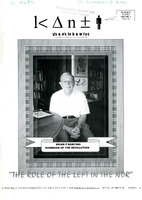 A community-focused independent publication (kapsamizdat) featuring an extensive interview with Brian Bunting regarding the history of the SACP, the Bunting family legacy, and the Tripartite Alliance. The issue critiques post-apartheid racial classification, the government's AIDS strategy, and the arms deal. It includes a "Faith Collective" section advocating for interfaith unity, as well as a historical profile of Sidney Percival (SP) Bunting.
 -
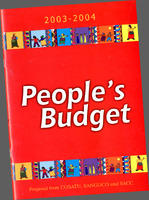 Accelerated transformation means eradicating poverty in one generation. The purpose of this document is to stimulate debate, discussion and critical comment on the development path in South Africa in order to achieve this goal. In so doing, we hope to impact on the thinking and actions of the democratic government. This input is intended for the 2003 / 2004 financial year. This enables the following: • Sustained dialogue with government: By producing this document a full year ahead of the 2003 / 2004 budget speech, we look forward to a constructive engagement with government • Encouraging engagement: This document opens up space for critical comment from all sections of society. This will enable us to refine proposals and to contest proposals with which we disagree. All are invited to critique, comment on and sharpen our proposals.
 -
 Organising new and maintaining existing members is central to the strength of trade unions. In a context where union densities are in decline across the world, the focus on organising, and especially on maintaining members, has increased. To maintain membership, unions are increasingly focusing their attention on the provision of services to members. The September Commission report and the Congress of South African Trade Unions (COSATU) National Congress in 2000 resolved that there must be organisational renewal within COSATU affiliates. Organisational renewal includes providing members with a high level of service. Resolutions envisaged each COSATU affiliate establishing capacity to monitor service delivery to members on a regular basis and deal with problems and complaints as soon as they arise. Improved service starts by listening to members and understanding what they want, why they joined the union and how the union addresses their needs, both at the workplace and, more broadly, in society as a whole. This survey was undertaken to assist four affiliates in evaluating their members' perception of the service that they receive from their union.
 -
 The new government faced enormous challenges when it came into office in 1994. For starters, the outgoing Apartheid leaders had thoroughly plundered the state coffers, awarding themselves and white civil servants massive pensions and 'golden handshakes'. The budget deficit was almost 9% of GDP The country/ had barely three weeks foreign exchange reserves, with a balance of payments crisis looming. The majority of inherited civil servants were generally hostile to the new government. The 'deep structures' of the State — by which I mean the ingrained habits and behaviour — were also generally hostile to the objectives of the democratic State. In addition, poverty levels were very high, and income inequality was among the worst in the world. And, of course, South Africa had the most institutionalised forms of racism in the world, which permeated through every law' and practice.
 -
 The Education Department believes it is important that when assembling a strategic education plan for the next three years, a thorough discussion needs to take place within the Union as a whole about the context that we find ourselves in, and the challenges, which emerge, for our members. What follows are the observations of the Education Department informed by the Unions Ten Year plan and other policy engagements. It is not an exhaustive survey that is offered here, but what are considered key points.
 -
 This booklet is about the way in which work is being restructured in the workplaces of South Africa. It is the first in a series of booklets dealing with various restructuring issues faced by workers. There are major changes being made in the workplace that impact on the lives of workers. For workers, restructuring brings changes to the way that their workplace is organised and this will impact on their working lives. These changes could hold threats or opportunities for workers. This first book will explain what is meant by restructuring and look at why many companies in South Africa are considering restructuring. It will also look at some trade union strategies around restructuring and some suggestions for negotiating restructuring.
 -
 This paper represents an initial set of ideas focused on employee ownership within the developing country context. The central question being explored is 'To what extent can employee ownership support the broader goal of poverty reduction in South Africa (and, by extension, in the developing country context)?'. This is a rather broad question, and as such this note sets out to begin the discussion on this question, rather than seek to provide a definite set of answers. The critical perspectives put forward in this note draw heavily on experiences and debates in South Africa, and particularly those within the labour movement.