
Items
-
 This document, titled "Action Notes: No. 6: Constitutions", is a practical guide for activists in South Africa on the legal and structural formation of organisations. It focuses on the crucial distinction between entities that require formal government registration (such as Close Corporations or Trusts) and grassroots bodies, like civic organisations and advice offices, which operate primarily through a self-authored constitution. The pamphlet explains that for many non-profit and community groups, a well-drafted constitution is sufficient to grant the organisation its own "legal personality." This status allows the group to enter into contracts, incur debt, or be sued as a distinct entity from its individual members—a concept known in South African law as a Voluntary Association. The guide provides a framework for drafting these foundational documents to ensure clear governance and legal protection for members.
 -
 This publication aims to familiarise negotiators with inflation statistics, which are not as straight forward as they might seem at first glance. It provides negotiators with the latest inflation figures (at the time of publication), and puts forward a few guidelines for dealing with inflation in the context of collective bargaining. After ail, if you know what the rules of the game are you can break them property,here put any information that you think is important but there is no field for it, if there isnt remove the field
 -
-
-
 To help participants develop a basic understanding of key economic concepts. To help participants to begin to apply these concepts to analyse current economic policy debates. To develop participants' confidence and encourage them to pursue on going learning in economic analysis.
 -
 The SAMWU anti-privatisation campaign goes right to the heart of all members in their role as service providers to the community. Any privatisation of municipal services would mean that people in community not have access to basic services. It would also mean a loss of jobs through retrenchment and restructuring. This has already happened in other parts of the world. Internationally, public sector unions are fighting privatisation. For all these reasons, SAMWU calls on all members to intensify the anti-privatisation campaign! Experiences internationally have shown that privatisation results in increase in tariffs and a decline in quality services. Our communities have never received a quality service under apartheid. Now things will even be worse: under privatisation only those who can afford to pay, will get services. A major political responsibility that confronts SAMWU: we must ensure that we win the struggle against privatisation. We are confident that based on the democratic participation of 'our gold', SAMWU workers, COSATU and the community we can be victorious.
 -
 Members of the Press are invited to a high profile public launch of the COSATU Autumn Offensive Recruitment campaign that will be held on Monday 23 March 1998 at CNR Old Verneeniging and Jacobs Street, Alrode in Alberton - Gauteng at 12noon. In attendance will be members of the COSATU Executive Committee led by President John Gomomo, the ANC and SACP leadership. An invitation has been extended to comrades Thabo Mbeki and Charles Nqakula to speak at the launch.
 -
 The name of the union shall be the SOUTH AFRICAN MUNICIPAL WORKERS UNION. The union shall be a body corporate with perpetual succession capable of entering into contractual and other relations and of suing and being sued in its own name and shall be an organisation not for gain. It shall hold property separate from its members. The liability of members shall be limited to the amount of subscriptions or other monies due to the union at any time in terms of this constitution.
 -
 As we promised, we held an interview with the Party's Jeremy. A small critique of our own conclusions is: The SACP has, and still fail to rise to expectations of what the Party of Hani and Slovo set. The leadership by the Party is not felt anymore, i.e. even located within the context of the current situation. We did confirm that Cde Jeremy was silenced, although the comrade indicated that the matter was taken up with the ANC and resolved. The point is: if the ANC can threaten in whatever way, a key leader of another Alliance partner - then our democratic revolution is in a serious danger. Cde Jeremy is silenced, Cde Charles is noticeably quiet (he silenced himself to survive), Oom Ray is strategically deployed to Uganda. The Party is gradually becoming another department of the ANC. It is well good for the Party to say, we have members in the Cabinet, MECs who hold office bearer positions, etc. But the question which remains is: what Party program are those comrades following, if they are accountable to the ANC first - how can they operate differently from the mainstream (which is dictated upon). The two caps debate need to be understood differently, an MEC who is a provincial secretary of the Party - can never be critical of the ANC and governance, without being silenced of conveniently using his/her Party position conveniently. We appeal to our members who are Party activists, to ensure that we dedicate our time and effort towards building the Party, signing the debit order and building the structures.
 -
 1. BACKGROUND 1.1 The key aspects on which the Committee was charged to advise the Deputy President on were: • the appropriate and functional relationships that could be evolved between government and organs of civil society with respect to the provision of capacity for the implementation of the RDP; • the feasibility of an appropriate funding mechanism that would enable a co-ordinated approach to the funding of civil society organisations, the relationships of such a mechanism with current development funding players and other transitional mechanisms; • a mechanism to promote a sustainable partnership between these organisations with government. KEY FINDINGS OF THE COMMITTEE After careful consideration of all pertinent factors, the Committee established that: 2. 1 In spite of broad support for the RDP, there is no coordinated approach to tackling poverty. Government has been able to attract aid and has not found it easy to use such large funding owing to processes of change management and the processes of setting up local government infrastructures. Concomitant with these issues is the lack of management skills at the Government levels. 2. 2 Organs of civil society involved in development work in South Africa remain a rich inheritance for the Government of National Unity. These institutions, generally referred to as Community Based Organisations (CBOs) or Non-Government Organisations (NGOs) span a wide variety of the development landscape. These organs of Civil Society seek to fuel the development agenda of South Africa through participation in the RDP, but have often found themselves frustrated by the lack of clear policy and connecting points with Government in general. 2. 3 Experience from other countries show that the role of CSOs in development and the sustenance of democracy is a key feature of advanced democracies. Foreign research proved that cooperation between CSOs and various tiers government has often produced positive results. Owing to their affinity, empathy and proximity to the broader populace CSOs have always proved to be effective in meeting the basic needs of the population they serve. 2. 4 The initial energizing force for development which broadly funded the CSO sector has transformed. Local development funding institutions have developed a new focus and business approach. The Kagiso Trust and the IDT are gearing themselves to operate as development implementation institutions as against solely the funding of development and the facilitation of funding for development initiatives. 2. 5 Foreign aid funding, money which was historically marked for CSOs, is largely being directly channeled to Government. This source of funding has progressively declined since the 1994 elections. Indications are that this pattern is likely to continue as erstwhile traditional International Aid donors prefer bilateral funding arrangements with government. Corporate grant funding which in any case has always been limited to the CSO sector will continue to flow to corporate programmes and will remain a significant factor to this sector. 2. 6 Development CSOs operate within a restrictive environment in respect of taxation and registration. 2.7 There is broad and significant support for a positive structural relationship and a coordinated funding mechanism between CSOs and Government to promote the objectives and principles of the RDP. 2.8 The need to establish a channel of communication between CSOs and government. Through this mechanism, government and CSOs would be able to agree on RDP and development.,Prepared for the Deputy President the Honorable Mr Thabo Mbeki
 -
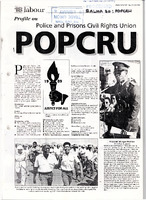 Police and Prisons Civil Rights Union (Popcru) was established in November 1989 under the leadership of former Lieutenant Gregory Rockman. Popcru was formed to combat problems within the police force which were caused by the former apartheid regime and the then racist SA Police management. Before the birth of Popcru, the public sector was not covered by any laws. As a result, even police officers, warders and wardresses could not openly express their political opinions, thus it became illegal for them to form a trade union. Since the passing of the Labour Relations Act in 1993, members of the SA Police Service (SAPS), Department of Correctional Services and traffic officers have joined Popcru in great numbers.
 -
 We enclose our preliminary response to the report. This serves as our contribution to the agenda for the meeting currently scheduled for 22 March 1996 in Cape Town. Intended to commence early and continue until lunch time - if not beyond. We record that we have discussed the representation of different departments which need to be present from Governments side -including yourselves, Constitutional Development, Water Affairs, Finance, and Labour. We would further note that the participants need to understand that we are not impressed in general when we arrange meetings only to have details change at the last moment. From our side you can expect a delegation of between 12-14 persons including representatives of our 9 regions and national office bearers. SAMWU first became aware of the MIIF during the Portfolio Committee Public Hearing on local government legislation held in November 1995. A copy of the full document was received by our office in mid-January 1996. A covering letter indicated that a key issue in the MIIF was the " nature and extent of private sector involvement in extending service delivery". A meeting was held, on 21 February 1996, between the Minister without Portfolio, the Director General in the RDP Office and a delegation from SAMWU. It is necessary to note that this first formal contact was very belated and does not serve to engender trust in any process. We do not accept that any serious attempt was made to involve the union prior to the document being made public. It is our view that the attitude to unions , as reflected in the document, was one of “unions will have to be accommodated “ (our Italics). Implying more of a necessary evil than any concern for a partnership. “ Partnerships†being reserved for business, small entrepreneurs and big capital. We have been assured that the document remain a consultative document and that we can still make our input. The fact is that it is already taken to represent government policy and is being acted upon in such terms. A case in point being the planning already being done by the DBS A in respect to water and sanitation (Municipal Engineer - Jan 96 ). It is necessary that Government correct this impression if further consultation is to be taken seriously. It is our view that in its current form the document is being used as a means of mounting an attack on the direct provision of services by local government.
 -
-
 This report evaluates the Civic and Advice Centres Programme (CACP) administered by Kagiso Trust (KT) with funds from, primarily, the Commission of the European Communities (CEC). Between 1987 and 1992 over R 13 mn was disbursed through this programme. The authors of this report were appointed by the CEC and KT as consultants in November 1992. This is our final report. This report is the product of an evaluation conducted by the consultants in accordance with Terms of Reference defined by the CEC and KT. As such the report does not necessarily reflect the views or policies of either the CEC or KT. It is important to indicate clearly what this report is and is not. It is a report for the funding organizations - KT and the CEC - on their funding of civics and advice centres. It is not a study of civics and advice centres perse. There are important aspects of the civic movement which are not examined here. Our recommendations are offered to the funding organizations. Neither our analysis nor our recommendations are intended to be prescriptive of or for civics and advice centres. It is up to civics and advice centres to assess their own experiences and to choose their own routes into the post-apartheid future. Our concern here in this report has merely been to point out to the funders how their funds have been used, and how funds might be constructively used in future to further the democratisation of governmental and developmental processes. The consultants are grateful to all of the individuals and organizations who were able to spare time to discuss with us their experiences and perceptions of the CACP. They are too many to name here, but they are listed in Annex B. Our role as consultants has been in part to collate the many incisive comments made to us in our many discussions around the country. There are few suggestions here which have not been made by one or other of our interviewees. We are grateful to the CEC and KT for the assistance they provided. At KT's head office we have been extensively assisted by Spencer Malongete, Pam Hamese and Muzwandile Lumka. We are grateful also to the staff of the KT regional offices who met with us and helped to schedule appointments with projects. Kagiso Trust organised a reference group for the consultants which on two occasions generously criticised early drafts of the report. It has not been easy to co-ordinate the work of three consultants based in Cape Town, London and Johannesburg. Our research was originally divided on a geographical basis. Jeremy Seekings examined the CACP in Cape Town, the Eastern Cape and Border, and parts of the Orange Free State. Khehla Shubane examined the CACP in the Transvaal and Natal. David Simon conducted research in parts of the Transvaal, Southern Cape, and Cape Town. Most of the sections of the report were drafted by one or other of the consultants, and revised in light of comments from one or both of the other consultants. Jeremy Seekings was primarily responsible for sections 2.4, 3, 4, 5, 7.1 and 8. David Simon was primarily responsible for sections 1, 2.2 and 2.3, 6.6, 7.2 and 7.3, and 10. Jeremy Seekings and David Simon drafted the rest of section 6. Khehla Shubane was primarily responsible for section 9 and the executive summary, and made extensive inputs into sections 3.3 and 5.
 -
 The Community Agency for Social Enquiry (CASE) was commissioned by the Joint Enrichment Project (JEP) to undertake research for the National Youth Development Conference. The research programme had three components:the compilation of a computerised and annotated youth database, comprising domestic research into youth, and the extraction of five policy papers covering the areas of education, employment-creation, AIDS, violence and social context, and historical context. an international comparative component, which focused on the youth brigades in Botswana, and the whole range of youth development initiatives taking place in Kenya and Uganda, covered in an additional two position papers. a national baseline and attitudinal survey into youth in South Africa. The results of all three components of the research project will be published in book form later this year. The summary reports of the local and international comparative policy papers are available in a separate booklet. This is the report of the national survey into youth in South Africa. Aims of the survey The survey has four main aims: demographic: to accurately describe how many youth are in the different parts of South Africa, how many are in or out of school or work, and so on. attitudinal: to allow youth to express their views on a range of social, economic, political and personal issues.to analyse youth marginalisation: to scientifically analyse and describe the marginalisation of youth within South African society. programmatic: to provide results which directly assist organisations designing programmes which target youth. Designing the survey The survey was designed by the CASE senior research team of Professor Mark Orkin, Director of C A S E; Dr David Everatt, Deputy Director of CASE and project co-ordinator; and Dr Ros Hirschowitz, Specialist Researcher at C A S E. The design process was lengthy and complex, because the aims of the survey were complicated. As a first step, CASE gathered together existing youth research and survey data, in order to see what we could learn from them. We then convened a design workshop to assist us. Participants in the C A S E national youth survey for JEP 1 workshop comprised people who had experience with youth, or with survey design. They included John Aitchison (CASE and the Centre for Adult Education, University of Natal), Debbie Budlender (CASE and the National Women's Coalition), Dr Jannie Hofmeyr (Research Surveys), Ms Vanessa Kruger and Professor Ari Sitas (University of Natal), Ms Anne Letsebe (SABSWA), Mr Steve Mokwena (JEP), Mr Rory Riordan (Human Rights Trust) and Dr Jeremy Seekings (University of Cape Town). We also needed input from the youth themselves. Discussion groups with youth (called 'focus groups') were held with youth from Alexandra and Soweto, from Ciskei and the eastern Cape, from Bophuthatswana and the northern transvaal, from Chatsworth and Claremont in Durban, and elsewhere. We reached youth from cities, squatter camps, towns and rural areas. The focus groups were organised by C A S E and Research Surveys, a professional market research company. The youth told us what their concerns were, what their aspirations and fears were, and what interventions they felt are necessary to improve their lives. CASE then designed a draft survey. We had to try it out (called 'piloting') to find out if the survey tapped the youth's actual views and experiences, and so give the JEP the information they sought. The survey was piloted on a representative sample of 100 youth (aged between 16 and 30) by Research Surveys. Using the results of the focus groups and the pilots, the CASE research team then produced the final questionnaire, which went into the field in November/December 1992.
 -
 Today Namibia is at the crossroads of its independence. The agony of death and destruction that the Namibians have endured for the past 105 years of colonial oppression is about to come to an end and freedom is in sight. The process of transition to independence has already started. On 1 November 1989, the Namibian people will exercise their long-denied right to self-determination by electing their own leaders who. by virtue of being elected by the masses will have the sovereign right to draft the constitution of independent Namibia. This will bring about a new political and socio-economic order. The task before the Namibian people is to seize this historic opportunity and ensure that they join hands to safeguard the revolutionary gains we have made in bringing our country to the threshold of independence. Seizing this opportunity means, first, to register as a voter, and second, to vote and send to the Constituent Assembly men. and women with a revolutionary will, honourable record, vision for a better future, integrity, experience and proven ability to fight for the interests of the broad masses of the Namibian people. Such men and women are to be found in SWAPO. SWAPO has stood tall in the face of formidable odds over the last twenty-nine years of its struggle to free Namibia. Because of this fact. SWAPO had participated in the formulation of Resolution 435 and fought bravely for the last 11 years for its implementation. The motivating force behind this struggle has always been to guarantee that power is given to the Namibian people to decide the future of our country' through free and fair elections. Now that Resolution 435 is being implemented, the Central Committee of SWAPO has the honour to place before the people of Namibia its concrete programme of action in the form of SWAPO's policy positions on a broad spectrum of political, economic, social and cultural issues. Together, these policy'positions form SWAPO's Election Manifesto.,sponsored by the Centre for Development Studies, University of the Western Cape & the National Democratic Institute for International Affairs, November 6-16, 1991
 -
 Imagine a "new South Africa" in which, to borrow an idea from a former bureaucrat of the US State Department, history has come to an end.3 A new society in which class, race and gender are no longer necessary categories to define the social phenomenon. South Africa will be, then, the "terrestrial paradise". However, I am afraid to remind the reader that in this particular African country, history has not come to an end. This country experiences the most open and rude expression of struggle (class, race and gender), and it is difficult to foresee that in this period of transition, history or the struggle, will come to an end. Popular justice vis ei vis state justice is, perhaps, one of the best examples in which the struggle between the oppressed and the oppressors is manifested. But the popular justice that I am thinking of, is that particular experience of "people's legality" that has emerged in South Africa since the popular revolts of the mid-1980s. It could have its origins in African (customary) traditions (Bapela, 1987), but the cultural experience that emerged during the last decade went beyond its traditionalist roots (Suttner, 1986). Thus, the distinctive element of popular justice is that it has been ingrained in a democratic movement for empowering the people. What people?4 Whose justice? In the specific context of South Africa, by people I understand the working class and working classes, unemployed and marginal sectors, and different social sectors that are struggling for equality (ie the youth, women, gays and lesbians, and others). By justice, I mean the development of a new legality that will take into consideration the many gains that have been achieved within the Western legal system of "rights and obligations" (Pashukanis, 1978:100), and that goes beyond that model in the construction of a democratic society with wider social participation. So far, it has been in South Africa's black townships that an incipient expression of popular justice has emerged.6 The 1980s people's courts represented a synthesis of a popular project defining its own structures of legality. State repression over these popular structures did not represent the end of the project. In contrast to other points of view that have viewed this experience as a prefigurative enterprise that did not accomplish its aims (see in general Allison, 1990), I argue that the experience of popular justice of the 1980s laid the foundation for a (long term) project leading towards a radical conception of democracy (Laclau, 1990:chapter 6).,Occasional papers (University of the Witwatersrand. Centre for Applied Legal Studies) ; v. 15
 -
 In this report we have focused more on policy issues than on an assessment of problems in the region, as we need to use our Regional Congresses in preparation for the issues which will be debated at National Congress. The government and the bosses are also trying to stop us making further gains. How do we respond? STATE OF THE NATION In the past year, a number of gains have been made by COSATU, some demands have been won, but many new areas of struggle have opened up. In the past year, a number of gains have been made by COSATU, some demands have been won, but many new areas of struggle have opened up. In October 1990, the SCN accord was signed, which gave us back the old Unfair Labour Practice definition, and also set the scene for introducing new legislation for farm, domestic and public sector workers. Since then, a number of unions have been meeting with sub-committees of the National Manpower Commission as well as the Commision for Administration (CFA) to argue for basic rights and legislation for these workers. COSATU now has a national Public Sector Forum under the COSATU Organising Department, and we are gearing up for this struggle as well as the struggle for an entirely and progressive Labour Relations Act.
 -
 Three hundred delegates from COSATU's 14 affiliates and nine regions met on the 9th and 10th March to discuss COSATU's Campaigns programme of action for 1991. The Conference decided that the major campaigns for the year will be: Campaign for a Constituent Assembly and Interim government closely linked to a Campaign for Workers Rights in a new Constitution. Campaign for job security and job creation entitled: "Jobs for ail - no retrenchments" Campaign for the extension of the Labour Relations Act to farm, domestic and public sector workers as weil as workers in the Bantustans.
 -
 The question here is: should skill and training be rewarded with higher wages? If the answer is yes, how much extra should a worker get if he moves from a lower-skilled job to a higher- skilled job? How can divisions between workers be avoided? If the answer is no, how will the union be able to prevent employers from paying higher wages to skilled workers who are in short supply? Let us take the grade continuum as running from unskilled labourer to artisan. How many grades should there be in between? If there are many grades, confusion is likely as it will be difficult to tell the difference between one job and another. If there are too few grades, low-skilled workers will never move out of the bottom grade. In the iron and steel industrial agreement, there are twelve grades. In the clothing industry in Cape Town, twenty five different jobs are listed. Under the Paterson grading system, there are only nine grades between labourer and artisan. NUMSA has demanded that the number of grades in the auto industry be reduced from as many as eleven to only five.
 -
 In 1652 the Dutch came to this land. Initially he sought to arrest refreshments for his ships that went to the east. Soon he realised that the land was good for them to settle. In settling he infringed on the way of life of the peoples living on this land destroying the social and cultural fabric of a peaceful society. Slowly but surely the wars of dispossession began. The land that was once the black mans was now in foreign hands. All that was in abundance was reduced to scarcity .People resisted but they were put down . Our history is shameful that it is drenched in blood. The Act of Union instead of bringing people together seperated and we remain seperated today. The 1913 Land Act instead of giving people back their land took it away from them. From 1910 to 1970 something like 200 laws were passed legislating against black people. The numerous pass laws restricting movement of people from one place to the other heaped indignity upon indignity on the black people. Workers suffered, they always do! They have to turn the wheels that produce the energy that makes South Africa turn. Over the years, with the dispossession of land, African people were drawn into wage labour. This was not a voluntary process. The goverment brought about Laws that asked money from people called taxes - hut tax, poll tax, dog tax etc. Prior to the formation of the Industrail and Commercial Workers Union strikes were a rare industrial relations exercise. With increased unionisation workers started to become aware that the laws passed by the government was to facilitate an economic end. That is why the ICU became embroiled in politics. Workers were affected by Apartheid laws that acted as leeches, sucking blood of the workers and draining them of their energy. They demonstrated against these laws. COSATU was launched in the same vein challenging the State to scrap apartheid - pass laws. Today we do not live in a new South Africa,the new is yet to come. The South Africa we live in is however, old and dying - decay has set in. History is a constant reminder of her shameful past - a past that will never be blotted out but can only act as an impetus to strive towards change. The Group Areas Act, the Population Registration Act, the Seperate Amenities Act are all geared to political and social separation of the masses. We have become victims of these laws
 -
 This is the first report under the voluntary Code of Conduct for Australian companies in South Africa. It marks Australia's entry into an area of monitoring and public reporting where the United States of America, the European Community (particularly the United Kingdom) and Canada have had Codes of Conduct since 1976 to 1978. Each of the countries concerned has companies with investment in South Africa and a physical presence there - through subsidiaries that operate as part of South African industry and that employ South African workers, including black workers. The Codes are intended to secure that companies from outside South Africa do not, when employing non-white (and particularly black) workers in South Africa, exploit the apartheid system. On the contrary, the objective is to work towards the elimination of discrimination at the industrial level - in pay rates, opportunities and otherwise - and at the same time to try to imp rove the position of the employees outside the work place. Those who press for stronger sanctions against South Africa and for active disinvestment policies criticise the Codes as weak palliatives for apartheid. In past years that might have been charged more forcibly. Today the existence of the Codes does not seem to be affecting decisions on sanctions. And the converse also seems to be true; with the sanctions that are presently operating the Codes continue to operate. Of course, when companies do disinvest, the Codes have fewer companies to cover and could eventually wither on that account. To the extent, therefore, that the Codes operate on the fact of foreign companies being in South Africa, they could be thought inconsistent with any policy of rapid disinvestment. However, there are at present no such policies operating at the level of Governments. A question arising from that is whether foreign companies, if they do remain in South Africa, should be subject to Codes and to reports back home as to their conduct, it being recognised that those reports, depending on their content and their reception, may either quieten or stir pressures for further disinvestment.
 -
 In the Republic of South Africa (and in South West Africa) social pensions are non-contributory and are paid out of state revenue, the funds for the purpose being voted annually by Parliament. With minor exceptions, the pensions are granted subject to a means test: that is, income levels are laid down which fix the maximum allowable income including pension. If the total income exceeds this amount an applicant will not be awarded a pension. When these totals are being calculated a certain sum is permitted, called 'free income', which does not affect the amount of pension that may be granted. (This 'free income' might be made up of earnings, or interest from investments, or profits from agriculture, etc.)These different figures vary according to the kinds of pension and to the population group. They are revised from time to time. Changes are announced by the Minister of Finance in his budget speech to Parliament and usually become effective some months later when details have been worked out by the departments dealing with the respective population groups. Because the conditions under which pensions are granted are fairly frequently changed, and improved, an application which was not successful one year may well succeed a year or two later. Therefore any applicant whose circumstances may have changed, or who believes that new rules may help his case, is advised to apply again.,Revised Edition
 -
 The year 1999 is the year of assessing performance and delivery. In the political arena we are reflecting on the accomplishments and shortcomings of our young democracy as we prepare our nation for South Africa's second democratic elections on the 2nd of June 1999. At this time, it is important that we also evaluate the progress we as a united labour movement made subsequent to April 1994, since the involvement of COSATU in our struggle for democracy was and still remains crucial. For women the 2nd of June 1999 presents itself as a challenge, especially women within COSATU. The challenge lies in the need to ensure that women are more represented in all structures of the federation, affiliates, down to local structures. Women make up the majority of citizens in South Africa and have been and remain under represented within the trade union movement. This has been the case since the launch of COSATU in 1985.
 -
 A consolidated policy document containing socio-economic resolutions delegated by the 6th National Congress. It integrates new resolutions from affiliates with established policies from previous conferences (1992–1997) covering Economic Policy, Health and Safety, and the Living Wage. As the inaugural meeting of the Central Committee, this document represents the highest policy-making authority on socio-economic issues between National Congresses.