
Items
-
 This research report investigates changes in working time in the retail sector in the 1990s in the broad context of the extension of trading hours, the deregulation of the distribution of goods in the South African economy and the resulting intensification of competition in the sector. The research data that forms the basis of the analysis comes from two surveys undertaken by the author in the course of 1996. The first was conducted in the Cape Town branch of the South African Commercial, Catering and Allied Workers' Union (SACCAWU), which gave detailed information on working hours, employment practices and conditions (hereafter referred to as the “Cape Town surveyâ€). The second survey was a questionnaire sent in November 1996 to Human Resource Managers of 51 of the larger retail companies in clothing, footwear, jewelry, furniture, general merchandise, and miscellaneous markets (hereafter referred to as the “retail surveyâ€). Although the response rate was very poor (only 7 companies responded), the information from the replies is nevertheless informative. The report begins with an account of the deregulation of retailing that has taken place rapidly from the late 1980s onwards, part and parcel of the shift in political power. For important sections of the formal retail trade sector, competitive pressures have increased significantly increased by this development. Employers have reacted by attacking wage costs, which has led to a change in the forms of labour contract in retailing towards insecure, “flexible†part- time or fixed term contract work, and a decline in the influence of trade unions in the sector. These developments form the environment for the report's focus on working time issues in retailing. The report examines the existing regime of working time for the retail trade sector as determined by Wage Determination 478 for the Commercial Distributive Trade. It assesses the impact on the Wage Determination of the current proposals and approach in the Employment Standards Bill, which will likely pass into legislation in some form during the current session of parliament. The paper analyses the Bill's proposals for flexible working time standards, and concludes that they contain several problematic clauses that would hamper trade union efforts to secure a positive outcome to flexible working time innovations in the retail sector. The data from the Cape Town survey is used to illustrate the normal working time patterns in retail based on the Wage Determination, and shows that working hours are generally longer than 40 hours per week for full-time permanent workers who work a 5.5-day week. Furthermore, weekend and evening trading is covered by “flexible workers†working various kinds of “non-standard†contracts. The national employment and output profile of the sector is then examined through official statistics. They show that total retail sector employment reached a 40-year peak around 1988/9, it has since declined, despite the continuous increase in total retail sales during the transition from apartheid to democracy. Full-time “regular†or full-time employment has remained static in the sector since 1988, and the number of full-time equivalent posts has similarly been static. “Flexible†jobs such as part-time, “late salesâ€, and casual jobs have however fluctuated quite widely over the same period, from a low point of around 12% of total employment in 1988 and 1994, to high points of 25% in 1989, and 16% in 1994. The overall pattern is one where flexible labour is used by employers to manage variation in demand over the working week, seasonal variation during the working year, and longer-term business cycle fluctuations, such as the period of limited economic growth since 1994. Measured as the ratio between total retail sales and total employment, labour productivity increased over the period 1988-1995. Using the data from the retail survey and the Cape Town survey, the relationship between extended trading hours, turnover, and flexible labour contracts is examined in more detail. Weekend trading accounts for a very significant proportion of retail sales, and various forms of casual contracts take up between 20% and 50% of available labour contracts in the companies concerned. For some companies, new stores are now designed around only 30% “core†permanent staff, with the other 70% of contracts being “flexibleâ€. A situation has therefore developed where full time “regular†workers are working relatively long hours (standard 45 per week + overtime), but are increasingly being supplanted by flexible workers with much shorter hours, poor pay, poor job security, and few (if any) fringe benefits of employment. This also undermines the bargaining position of trade unions in the industry, as bargaining units shrink. Because of the strong feelings of workers around reduction of working time to 40 hours, impending legislation on the issue, and the strong relationship in the industry between flexible labour, extended weekly trading hours, and seasonal variations in consumer demand, the issue of working time offers an opportunity to retail unions to make gains in shorter working hours, job creation, and employment security, if they can accept flexibility of working time for their established constituency. Innovations in working time such as “chosen time†and flexible working schedules need concerted attention from retail unions to prevent employers from controlling working time and employment contracts. Success depends on the degree to which unions can force employers into centralised bargaining. The paper looks at the failed attempt by SACCAWU to gain a centralised bargaining forum during 1996, which would have been an ideal instrument to address the issues around working time. This suggests that the best strategy for unions now is to concentrate on the struggle over the reduction of hours around the employment standards statute, and work on a “model†agreement with a large national employer, which can then be imitated with other employers, and then in a future centralised bargaining forum. The report then looks at examples where this opportunity has been exploited internationally, and there have been some trade union successes in company level bargaining. These examples combine job creation with reduced working hours, and some choice for workers over what hours they will work within the overall pattern of extended trading hours. The 1986 guidelines on flexible working time from the European retail workers' federation are examined, and are recommended as still a useful approach for the South African retail unions in the mid-1990s. The report ends by looking at contemporary workers' experiences of working time in South Africa at shop level as revealed by the Cape Town survey. The main barriers to workers accepting flexible working time are examined: these include problems of transport (and personal security), and child care. The section also assesses the way in which employers have maintained control over working time alterations at shop level to date. There is some interest among workers in shorter working hours - even with loss of some earnings - as well as changes in starting and finishing times of work. However, attempts by workers to negotiate favourable changes with their employers are usually unsuccessful, whereas unilateral changes in working time made by employers are more common.
 -
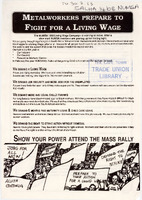 The NUMSA 1990 Living Wage Campaign is starting to move. After a slow start NUMSA members are gearing up for the big fight. We are going through big changes in South Africa. We want to tell the bosses and De Klerk: the workers will never end the struggle lor a Living Wage, jobs for all, houses for all, proper health care for all. De Klerk must meet our demands. We want to end the system that gives the bosses freedom to exploit workers. Our battle cry this year is: Our Industry, Our Country, Forward to Workers' Control. In February this year NUMSA/Es National Bargaining Conference set-out the workers demand.
 -
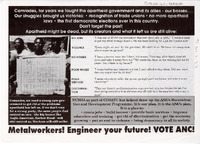 NUMSA as part of COSATU has helped draw up the ANC's Reconstruction and Development Programme. It is our plan. It is the ANC's plan. It is a plan to: • create jobs • build houses • provide basic services • improve education and training • get rid of discrimination • get the economy growing • put an end to violence • bring democracy to all in society. Comrades, we need a strong new government to get rid of the problems apartheid has left us. If we don't vote for a strong party, the same people that control us now - the big bosses like Anglo American, Barlow Rand - will still control us. Workers will still suffer.
 -
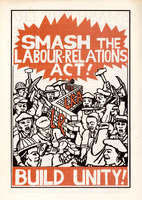 The South African state is facing a serious political crisis. Apartheid policies have been decisively rejected by the majority of citizens. The state is only able to retain power by force; by the declaration of the state of emergency, by detentions, by putting the SADF in the townships and by suppressing all opposition. These measures will eventually be defeated. But the state and the ruling class also face a critical economic crisis. This is linked to the political crisis. The capitalist class is trying to solve the economic crisis by squeezing even more profits out of the working class. To do this the capitalist class needs to keep wages down and to replace more and more workers by machines.
 -
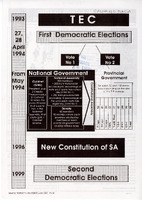 Every member is free to join any political party. NUMSA will encourage its members to vote ANC because it wants a strong government to fix up the country's and workers' problems. NUMSA members must not force anyone to vote for the ANC or any other party. NUMSA members must be free to vote (or not vote) for whoever they want. It is your right to vote; it is also your right not to vote. BUT you may not force anyone to vote or not vote. Voting stations will be in places like schools, community halls. Ask and discuss with your fellow workers, ask at NUMSA or COSATU offices, listen to your radio, look for posters and pamphlets nearer election time to find out.
 -
 It is a welcome move that the Minister has ordered an investigation in the security services within 2 years of the last amendment which was in November 1977. Regular adjustment to minimum wages ere imperative in a situation of rising cost of living. In the past an interval of about 4 years have lapsed before a new investigation is begun. Another positive aspect of this investigation is that the conditions are being investigated simultaneously throughout the major industrial areas in South Africa. This will help in bringing about a uniformity in the conditions of a group of employee 3 who ail do basically the same type of work. It is regretted that the scope of the investigation only includes undertakings in which employers and employees ere associated for the purpose of guarding, protecting etc. In she past this has meant that a large group of security guards are left out completely from the purview of the investigation and are hence not covered by any industrial legislation especially in regards to hours of work.
 -
 The FEDUSA Parliamentary Office provides legislative support to the affiliate members in the form of outputs ranging from publishing National Executive Reports, preparing and presenting oral and written submissions to the parliamentary portfolio committees in National Parliament as well as the publishing of a parliamentary affiliate newsletter on newsworthy issues being discussed in Parliament. A Bill Profile which serves as a reference document includes profiles of all legislation tabled in National Parliament, as well as monitoring and tracking progress through Parliament. The Bill Profile is an interactive service available through electronic media to all affiliate members.
 -
 Over the last thirty years, there has been considerable evolution in the thinking about gender equality issues and the actions needed to achieve real changes in the position of women vis-a-vis men. Prior to the 1970s, women were defined mainly in terms of their conventional reproductive roles, and efforts to improve women's welfare focussed on such programmes as literacy courses, home economics, child care and family planning. Though no doubt valuable, such welfare and family-oriented programmes had the effect of reinforcing women's traditional role in the family. Since the 1970s, there has been a shift to the division of labour based on sex, and the impact of development and modernization strategies on women. It is important to understand that improvements in women's status require analysis of the relations between men and women, as well as the concurrence and cooperation of men. As illustrated in the Beijing document: "Achieving gender equality and empowerment of women requires redressing inequalities between women and men and girls and boys and ensuring their equal rights, responsibilities, opportunities and possibilities. Gender equality implies that women's as well as men's needs, interests, concerns, experiences and priorities are an integral dimension of the design, implementation, national monitoring and follow-up and evaluation, including at the international level, of all actions in all areas."
 -
-
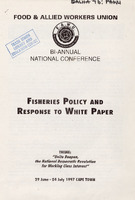 This paper is intended to serve as an aid to discussion in the Commission dealing with Sea Fisheries. Accordingly, its various sections provide an overview of the key issues which can inform discussion. Historically, access to marine resources was unrestricted. In order to facilitate the monopolisation of the fishing resource by a few white companies, a system of quotas was introduced. In this way many black fisher folk lost the access rights they had had for generations. At the present time, the fishing industry is completely biased in favour of a few large and medium sized white companies. This is illustrated by the fact that just three (3) companies hold;72% of the hake quota ;75% of the abalone quota , and 71 % of the sole quota. Overall , across all species, approximately nine tenths (9/10) of the resource is controlled by a hand-full of companies. Since 1994, some of these companies have attempted to blacken their faces. They have also sold minority shares to some, black business consortia. Further, a few members of the black elite have been given quotas. None of the above amounts to any kind of restructuring. None of the historic imbalances have been addressed. The above have merely been attempts to confuse the issue and to frustrate any process that attempts to restructure the industry. Prior to, and after the 1994 election, there were various initiatives by Alliance members to outline an equitable and just policy of reconstruction and development for the fishing industry.
 -
 It's that time of year again - exam time! But there's no need to panic. We've got lots of stories to help you get through the exams. Turn to page 22 for some study tips. For those of you doing Geography, don't miss the first part of our new series on mapwork. For history students, there's a story on the vote. Need to find books to help you with your studies? We've got information on how to find books in the library. But there are also stories to enjoy. Read about Prophets of the City, a great new rap group with a message. And don't forget to enter out exciting music competition or our drawing competition on page 25. You could be one of the lucky Upbeat winners! In the meantime, to all of you writing exams, we're holding thumbs. Good luck!
 -
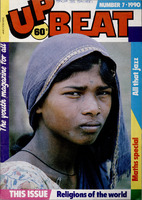 TB (tuberculosis) is a very serious sickness. It affects your lungs and other parts of your body. About 20 people die of TB every day in South Africa. And every year about 62 000 get the TB virus. In Alexandra township alone, 320 cases were recorded between January and May this year. Four people died from the disease. Doctors and social workers say things like overcrowding, unemployment, low wages and unhealthy dumping grounds cause TB. Most people who suffer from TB are black. Apartheid should be blamed for this. Many organisations, like SAYCO, Cosatu and Earthlife, have started to campaign for a clean and healthy environment. They want people to know how important it is to breathe clean air, drink clean water and eat clean food. We should work with our organisations to save ourselves and others from sickness.
 -
 Two years ago in Lebowa there were no school textbooks. But between March 1986 and September 1989 the Lebowa Education Department paid out R98 million to booksellers for books and stationary. So where were the books? A recent enquiry into the Lebowa Education Department found out that people who worked for the Lebowa Education Department also owned bookshops. These shops received the biggest orders to supply schools with books. But the books never got to the schools. When the enquiry did a spot check, they found 300 000 new books lying unused in storerooms and schools!
 -
 Mbulelois 14 and Adelaide is 12. They live in Pabaleilo, a township outside Upington. They have not seen their mother, Evelina de Bruyn, for more than a year. They would love to see her. But they can't. She is far away in a jail in Pretoria, waiting to die. Evelina was one of the accused in the Upington 25 murdertrial. In May 1989, Evelina, her husband Gideon Madlongolwane and 11 other people from Pabaleilo were sentenced to death for the 'common purpose murder' of Lucas Sethwala, a policeman. The judge said that Evelina de Bruyn did not actually take part in the physical attack on Lucas Setwala. B ut she was part of the crowd that marched on to the policeman's house and killed him. The crowd had a 'common purpose', and that was to kill the policeman. And so Evelina was sentenced to death. Many people think that the idea of a common purpose is wrong. Father Mkhatswa of the Human Rights Commission told Upbeat that people criticise this law because it is so serious. 'In mass funerals or meetings thousands of people come together. When violence starts you can't say that people planned the action. People are angry and upset. Also, how do you decide who was involved? Everyone present cannot be responsible.'
 -
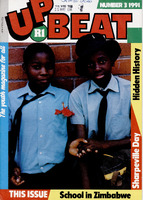 The 21 March is Sharpe- ville Day. On this day we remember what happened in 1960, when hundreds of people in townships all over South Africa marched on to police stations and burned their passes. In the morning of the 21 March 1960, thousands of people gathered outside the police station in the eastern Transvaal township of Sharpeville. They had been told that the police might announce changes in the pass law. At 1.15pm scuffle broke out outside the wire — fence of the police station. The police feared that the fence would collapse under the weight of the crowd. So they started to fire on the people. The people right in front immediately turned to flee, but could not get through the crush of people behind them. Sixty-nine people were killed and a further 180 wounded. Most of those killed were later found to have been shot in the back.
 -
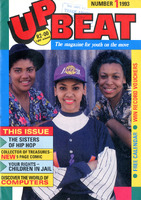 Welcome to Upbeat 1993! A new school year is underway. We all hope that the coming year will bring better things; new friends, an exciting romance, success at school and an end to the violence and uncertain future in our country. We all have it in us to make change to our lives. Listen, learn and ask questions. Don't be left behind because you don't understand. That's the theme of our calendar this year. And it's FREE inside this issue of Upbeat. Our leaders have said that there will be free elections this year. But many people don't know how to vote. Don't be in the dark. Upbeat will be running stories all about voting this year. Don't miss the first article on page 14. For many people the world of computers seems too complicated. In a three part series. Upbeat will tell you all about the exciting world of computers. You could also win a fantastic IBM computer worth R3 000. Discover the world of computers on page 20. And don't miss our great new comic on page 26. Collector of Treasure is a classic African short story by Bessie Flead. It tells the story of Dikeledi, a young woman who lived in a village in Botswana. For many years this story has shocked readers. The comic captures the drama and horror of Dikeledi's remarkable courage. Don't be without Upbeat this year. We've got lots of great new stories lined up. Subscribe or get Upbeat delivered to your school. Find out how to get Upbeat quickly and easily each month, on page 6.
 -
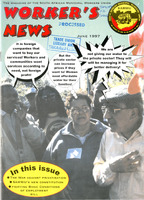 This inaugural issue of the magazine focuses heavily on the transition of local government in post-apartheid South Africa. It outlines the union's new constitution and takes a hardline stance against the privatization of water and emergency services, specifically in Benoni. It also provides a critical analysis of the Basic Conditions of Employment Bill and its potential impact on municipal workers.
 -
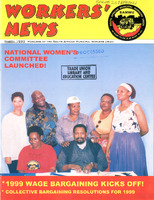 This issue marks the launch of the National Women’s Committee, emphasizing the union's commitment to gender equality. It provides a detailed guide to the "Framework Agreement" on restructuring and includes a "Workers of the World" segment on unionists in Sierra Leone and Uganda. It also features a guide for shopstewards on stopping sexual harassment.
 -
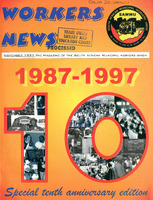 This commemorative issue serves as a historical record of SAMWU from 1987 to 1997. It traces the union's roots from the Cape Town Municipal Workers' Association (CTMWA) and other forerunners. It features an oral history-style interview between then-General Secretary Roger Ronnie and former leader John Erntzen, and highlights the union’s role in the anti-apartheid struggle.
 -
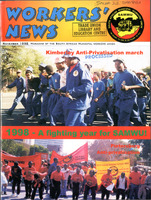 A review of a "fighting year," this issue focuses on collective bargaining successes and failures. It provides updates on deadlocks in Greater Johannesburg over wage exemptions and reports on the PSI (Public Services International) Africa Conference. A significant section is dedicated to the "Jobs Summit" and COSATU's strategy for employment creation.
 -
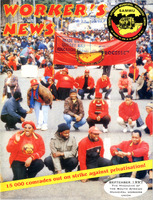 A militant issue documenting the strike of 15,000 workers against privatisation. It features significant political engagement, including interviews with Minister of Provincial Affairs and Constitutional Development Valli Moosa and Minister of Labour Tito Mboweni regarding the future of the public sector. It also includes an educational section on the history of the "Bread and Roses" strike.
 -
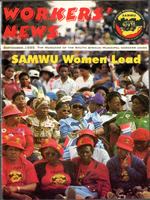 This issue highlights the "SAMWU Women Lead" conference and the ongoing battle against the "iGoli 2002" plan to privatize Johannesburg's municipal services. It also reports on a major occupational health crisis where workers were poisoned by chemicals in the Northern Cape, emphasizing the union's role in health and safety.
 -
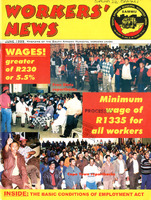 Published during the 1999 national elections, this issue analyzes the manifestos of various political parties (ANC, DP, IFP, NNP) from a labor perspective. It celebrates a wage settlement and provides an in-depth educational guide to the Basic Conditions of Employment Act (BCEA) to ensure workers understand their new statutory rights.
 -
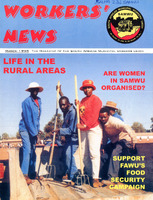 This issue shifts focus toward the challenges of municipal workers in rural areas and the specific struggles of women within the union. It details the National Anti-Privatisation Workshop and reports on international solidarity with workers in Cuba and Botswana. It also contains practical advice for workers facing retrenchment under the Labour Relations Act (LRA).
 -
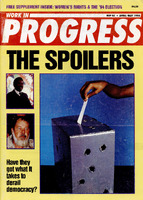 A 66-page issue published during the final countdown to the 1994 elections. The central theme, "The Spoilers," analyzes the threat posed by the white Right and "apartheid's bastard children" to the democratic process. Key features include scenarios for right-wing reaction, the role of the Peace Accord, a report on the war in Angola, and a supplement on women's rights and the election. It also features a major debate on the future of the SACP and the "Socialist Conference."