
Items
-
 In the early 1990's when internal fraud, theft and dishonesty became an issue of major concern, SASBO members decided to state their position on all forms of employee dishonesty. They expressed the view that criminals should be rooted out of the finance sector, because, inter alia: People of low integrity have no place in finance. Criminals also defraud their colleagues. Reduced profits through fraud would mean lower pay increases. Criminals pollute the working environment and their actions cast suspicion on everyone around them. When crimes take place, innocent employees are accused of not exercising sufficient vigilance and are subject to disciplinary actions, including dismissal. The SASBO National Council, therefore, instructed their Union not to protect guilty personnel. Yet they believed that accused members should receive a fair hearing. As a Union representing the interests of employees in a highly vulnerable workplace such as that found in the finance sector, SASBO, then, had a duty to condemn staff defalcation and fraud in the strongest terms, and to play whatever role that was necessary in ensuring that offenders were removed from the system. The need for SASBO to have a documented policy on the handling of cases involving theft, fraud and dishonesty, when its members were accused of being involved, was obvious. Applying the above principles, and aided by its legal advisors, SASBO's National Council, in September 1993, adopted the following policy on dishonesty:
 -
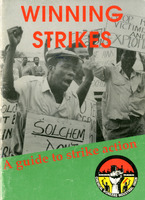 In recent years, CWIU has been amongst the top six unions involved in strike activity in South Africa. The militancy of our members dates back to the early seventies when it was often impossible to get union recognition without strike action. Over and above plant strikes, the membership of CWIU have a rich history of participating in political mass actions such as the stayaway in the Transvaal in November 1984 against conditions in the schools and townships, and against the LRA Amendments in the late 1980's, and in 1990 and 1991 against VAT. Today, when the bosses are talking about retrenchment, rationalisation, inflation, privatisation, deregulation and productivity, the strike remains one of the most powerful and favoured weapons of the organised labour movement. But not all strikes have been successful. A number of heroic battles fought by workers were defeated. At times workers go on strikes without properly preparing. At other times the issue that they are fighting can be bettter resolved through other avenues of struggle. This booklet is a manual for strike action. We hope that it will assist workers in taking effective and planned action to avoid some of the pitfalls of the past. The booklet outlines some of the key questions that workers should answer before going on strike. It also discusses the most important elements of strike organisation.
 -
 From Cosatu's inception in 1985, the federation developed a close association with the Congress movement. Conditions in the country dictated the need to go beyond bread and butter issues to embrace national and class struggle. This perspective was formally endorsed with Cosatu's adoption of the Freedom Charter in 1987. The 1987 Congress agreed Cosatu should build alliances with mass-based organisations with a track record of struggle and whose principles did not conflict with those of Cosatu. After the unbanning of the liberation movement, Cosatu's 1991 Congress resolved that the Federation should join the ANC and SACP in alliance in place of Sactu, thus becoming part of the Tripartite Alliance as we know it today.
 -
 Acquaintance rape is forced sexual contact by someone who knows you. The rapist may be a date, neighbor, friend, boss, colleague, delivery person or repair worker. The risk of a woman being sexually assaulted by an acquaintance is four times greater than her risk of being raped by a stranger. Women ranging in age from 15 to 24 are the primary acquaintance rape victims. Recent studies show that junior high school girls are also at great risk. Date rape is the most common form of acquaintance rape. Sexual assault, including acquaintance rape, also happens to men; men can be sexually exploited by other men or by women. Women can also be sexually exploited by other women. This brochure refers to the victim as “she†and the offender as “he†since most victims are female and most offenders are male. However, most of the information applies to male victims as well as female victims. As with all sexual assault victims, the acquaintance rape victim suffers physical and emotional trauma. She has been physically and emotionally violated, and she needs support. Sexual assault centers help victims cope with medical, legal and emotional needs after sexual assault. This brochure has been prepared by the Illinois Coalition Against Sexual Assault to help you learn more about this crime and where to get help if you are a victim. There are sexual assault centers throughout the state of Illinois; the list on the last page tells where these programs are located.
 -
-
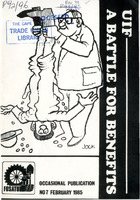 Unemployment has always been and still is a tricky problem for capitalists. On the one hand lots of unemployed workers make it easier for employers to keep wages low. But if there are too many unemployed workers then they might support moves for immediate and fundamental change in the society. Employers and the governments of capitalist countries have tried to solve this in different ways and at different times. But in most countries some income has been given to the unemployed for part of the time they have been without jobs. They have usually done this by providing some kind of benefits paid to the unemployed for a certain limited period of time. 1 lie fund from which these benefits are paid is usually controlled and administered by the government. However, there are many different ways that these benefits can lie financed. Before looking at what happened here in South Africa let us look at the problem of unemployment benefits generally in a capitalist state.
 -
 The course materials for Rights at Work consist of: 13 separate printed booklets (latex-bound and punched so that they can be kept in a file), in the first print, the discovery exercises were only duplicated. In the second print, the discovery exercises represent the 13th booklet, a selection of duplicated case studies. Sets of the printed booklets will be available for each student to act as resource material during the course, and as a 'reference' book after the course. The case studies are provided as 'master copies' to be reproduced in sufficient student numbers by the tutors. As from the second print-run of materials (March 1980) each student 'set' of 13 booklets will arrive from the printers unseparated as one latex-bound 'volume'. It is strongly recommended that tutors separate out the 13 booklets themselves and hand them out separately week by week. Each booklet has a colour cover with cartoon, so the process of separation is fairly easy. To hand out the whole set of material at the beginning would be daunting for most students. The booklet of discovery exercises can either be handed out to students to keep, with the tutor directing students to the appropriate activity each week. Or tutors can keep the booklets and extract and hand out the appropriate activity each week. These tutors notes describe the overall aims and methods of the course and the job of the tutor in turning these course materials into a successful course. The notes are divided into two parts. The first part deals with the overall approach to the course, in terms of aims, structure and methods, and how to plan a course. The second part gives brief notes on using individual sections of the course.
 -
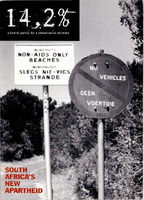 AIDS starts with a virus. Like all viruses, it's a parasite fragile and impotent. It cannot reproduce except within human cells, It's tiny. Over 500,000,000 HIV viruses could fit the dot on top of this i. In the wrong environment HIV dies. In the right environment, it dominates. AIDS is dominating South Africa with all ready 2.4 million people infected, with estimates of 20% of the working population being infected within four years. South Africa has willingly opened itself to domination. This time, not colonial political oppression or the cruelty of racial apartheid, but domination by a virus all of us saw coming. The Ministry of Health welcomed the virus by failing to impart a practical and realistic National AIDS strategy. Instead, entertaining us with a R14.3 million play called Sarafina 2 and a discredited new cure for AIDS Virodene.
 -
-

-
-
 In South Africa at present there are 104 Industrial Councils. However, the one for the Iron, Steel, Engineering and Metallurgical Industries is the largest and most important covering nearly 500 000 workers. But only about 100 000 of these workers belong to trade unions. At the Industrial Council the employers and trade unions negotiate an agreement that covers all 500 000 workers. At present on the union side there are 14 trade unions - M A W U will make it 15. But most of these unions are racial unions and what are called craft unions - that is their members only do certain kinds of jobs e.g. boilermakers or electricians etc. On the employer side nearly all the 8400 factories in the industry are members of the employer association SEIFSA. It is SEIFSA - which is the largest and most powerful employer association in South Africa - that negotiates for employers on the Industrial Council.
 -
 The Federation of South African Trade Unions - FOSATU - was formed on the 14th and 15th April 1979 at an Inaugural Congress held at Hammanskraal, north of Pretoria. The Congress was attended by 130 delegates representating 12 founding unions. FOSATU was formed as a federation to unite all workers irrespective of race, creed or sex who shared the common objective of struggling for the rights of workers. Our prime objective is to organise workers in their workplace and through the strength of their organisation to eliminate the racial discrimination and racial divisions that are used to perpetuate the exploitation of the oppressed majority of workers. It is a federation of industrial unions bound by common policies and objectives and based on the closest possible cooperation to the mutual benefit of all its affiliates and their members.
 -
 As the elected minute secretary, from the Second AGC 1992, I took over the portfolio as acting Regional Secretary when Mundisa Sinuka resigned in October 1992. In SADTU, we can only have a successful union if all our branches are functioning effectively and our members are committed. Members on the ground have been demotivated and this makes our task all the more difficult. Branches tend to work during times of crisis and it should be borne in mind that SADTU is not a crisis union but is there to educate, bur id. protect and defend the rights of teachers.
 -
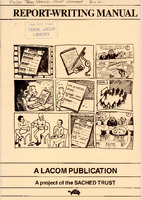 For a number of years the Cape Town branch of the LACOM project has conducted workshops on report-writing, notetaking and minute-taking. Through this manual we hope to share our experience in these areas with a wider group of people. We know that a number of manuals already exist on these topics, so why have we decided to write yet another one? This manual is different. It is especially helpful for facilitators who are organising and conducting report-writing and note-taking workshops. This is because this manual gives practical details on how to help people write reports and what methods to use in workshops. But this manual can also be used as a reference and follow-up for people who have attended these workshops.
 -
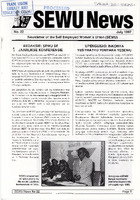 Newsletter of the Self Employed Women's Union (SEWU) focusing on the third annual national conference (July 22-24, 1997). Topics include structural changes to accommodate national growth, resolutions on political non-alignment and child labor, and efforts toward financial self-sufficiency following the collapse of SADWU. It also reports on expansion into the Western Cape and Eastern Cape.
 -
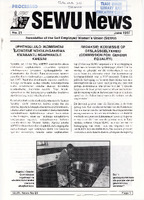 Newsletter of the Self Employed Women's Union (SEWU). This issue details SEWU's presentation to the Commission for Gender Equality regarding the needs of women in the informal sector. It covers the challenges of cross-border trade for Zimbabwean women in Cape Town, and the ongoing struggle for self-employed women to access credit and banking services. It also discusses the establishment of member-led savings clubs to foster financial independence.
 -
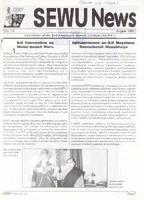 Newsletter of the Self-Employed Women's Union (SEWU). This issue reports on the attendance of SEWU delegates (Pat Horn, Eunice Ntshangase, and Sarah Nkunkwana) at the ILO conference in Geneva to advocate for the protection of home-based workers. It also covers discussions from the Habitat II conference regarding women's rights to housing and land across various countries including Zimbabwe, Namibia, and Kenya.
 -
 A membership information brochure for the Self Employed Women's Union (SEWU). It outlines eligibility criteria for self-employed women, membership fees (R10 joining fee and R5 monthly sub), and the union's core objectives. Key goals include building unity among unrecognised women workers, developing negotiation and leadership skills, providing legal advice, and assisting with issues such as child care, credit access, and maternity benefits.
 -
 This document should be used by ail of us involved in Education as a basis for discussion on organising education in the Federation. We have pulled together all the relevant information and reccommen- dations which we hope will assist Led- comm, Educators and our constitutional structures in understanding what our tasks are in the locals and in affiliates. The Redcomm agreed that an Education Programme must go beyond being just a number of workshops and seminars. It must be a dynamic process which must contribute to the strengthening of our structures, improving the quality of our debates and promoting leadership of the working class in our struggle for democracy.
 -
 THE South African Commercial Catering and Allied Workers Union (Saccawu) launched a medical aid fund yesterday which the union said would be used as a springboard for the establishment of its own medical aid scheme. Saccawu assistant general secretary Herbet Mkhize said the fund would operate under Medscheme's Meddent Medical Scheme for about nine months while the union conducted further research into establishing its own medical aid scheme. Mkhize said trade unions were no longer only competing with one another but also with legal firms that were now offering their services to workers. “Now a trade union has to convince potential members that it offers the best services, “Mkhize said.
 -
 Since 1989 most workers in South Africa have had their wages taxed under the Site Tax system. SITE stands for Standard Income Tax on Employees. Under the Site Tax system, the employer is responsible for making sure that workers pay the correct, amount of tax. This is different from the old Pay As You Earn (PAYE) system where the Receiver of Revenue had to make sure that the amount of tax paid was correct. Now the employer works out how much tax has to be paid from the personal information, such as number of children, given to them by each worker. But COSATU has seen that many workers have been taxed too much by their employers. This is mostly because no-one has explained to workers how the Site Tax system works and what tax reductions they are entitled to.
 -
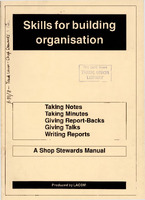 Getting and carrying out mandates is one of the most important duties of a shop steward. This booklet has been prepared to help shop stewards carry out this duty. In a democratic organisation the job of a representative is to represent other people's views and wishes - to carry out the mandate of the people who elected them. For the people to feel that this is happening they must be able to know what their representatives are doing and saying. They can only know this if they get report-backs from their representatives on what they have been doing. The representatives on their own cannot make decisions for the people. People must be able to discipline representatives who don't represent their views.
 -
 This workshop is designed to give you a reliable introduction the Employment Equity Act. It is based on hard information and on ACTIVITIES or discussion exercises that will help you to understand how the Act works, who it covers , and what the implications are for trade unionists. Each of the Activities is complemented with information that will help you to understand the Act in more detail. Sections have been added to help you find further information, and to understand the terms that are used in the Act itself. In a two day programme, you are not going to be an 'expert' on the Employment Equity Act, but we hope that you will feel more confident about using the Act, especially in ensuring that it is used to address a wide range of discriminatory practices at the workplace. As with most legislation, the more that you begin to use it, the more its strengths and weaknesses will emerge. It is very important that any weaknesses in the practical application of the Act are reported through your Union to the Federation. This will help the Federation to campaign for improvements in t he legislation, and to close any loopholes that allow employers to avoid their responsibilities.
 -
 COSATU must intervene in affiliates where it has identified problems, where problems have been brought to its attention and / or has been requested to do so. The CEC should draw guidelines on how and under which circumstances the federation and its structures may intervene taking into account clauses 3.9 and 3.10 of the constitution. Such intervention should not undermine affiliates where such problems exist. COSATU leadership must be visible during major disputes between affiliates and employers and co-ordinate solidarity with workers involved in such disputes.