
Items
-
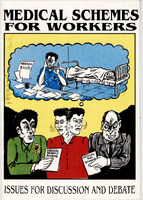 Medical insurance schemes have become one of 111 the many fringe benefits being negotiated by unions. Medical insurance schemes are tied to the struggle for an adequate health service. Workers' decision on whether or not to join medical insurance schemes has an important bearing on the operation of health services in a future democratic society. This booklet examines medical aid schemes, their advantages and disadvantages, how they operate and what possible alternatives to medical aid schemes exist. The booklet also looks at the state's health strategy and how medical aid schemes fit into this. Chapter One of this booklet discusses the broad issues relating to medical insurance. Medical Aid Schemes and Medical Benefit Schemes are discussed in chapters two and three. Chapters four and five are for extra information. Some specific medical aid schemes are evaluated in chapter four. Chapter five looks at the tariff structure (cost) of medical services provided at Natal Provincial Hospitals. Medical Insurance means all the different types of schemes that operate to insure people against medical costs. A medical insurance could take the form of a medical aid scheme, a medical benefit scheme or other types of schemes. This-booklet concentrates on medical aid and medical benefit schemes.
 -
 It would be desirable to establish a "platform" to market South Africa as an investment destination for foreign investors. The platform should not be limited to portfolio investors only, but should also include marketing to potential direct investors, lenders and development aid granters. The platform should relate to a "defined range" of potential investments. The group did not feel competent to define the range because it was not adequately representative. However the group did feel that the defined range should exclude the extreme left and the extreme right. By way of example the extreme right would be a short-term investment in a project in Botshabelo and an investment of the extreme left would be a non-income generating social upliftment project.
 -
 In the transition from apartheid to democracy, strong economic growth will be needed. This growth must succeed in overcoming the handicaps which apartheid imposed on South Africa. And it must bring higher living standards to the black majority, a reduction in absolute poverty levels, and a more equitable distribution of resources. The key to sustained and balanced economic growth is investment. Investment in productive capital must be greatly increased, and soon.
 -
 A year after African National Congress leader Nelson Mandela's release from prison, South Africa's Black trade unions, particularly the million-member Congress of South African Trade Unions (COSATU), remain at the heart of the movement for political democracy and economic and social change. Union activists have been instrumental in revitalizing mass opposition to apartheid — launching ANC branches, organizing local consumer and utility boycotts, and leading strikes over wages, job security and workplace racism that cost the white-run economy over four million work days during 1990. But labor's role in the struggle for political and economic democracy has increasingly made the unions the target of state-sponsored political violence. Black labor's resistance to oppression goes back to the 1920s, when the militant Industrial and Commercial Workers Union built a national membership of over 100,000. But it was not until 1981, after a wave of illegal strikes forced the apartheid regime to lift the ban on Black unions, that labor began to emerge as a major anti-apartheid force. With Mandela's African National Congress and other organizations still outlawed, Black workers increasingly saw their unions as a vehicle for their political aspirations.
 -
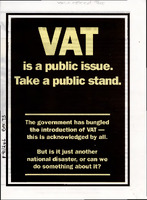 Although VAT is now part of daily life, it can be changed. Tax laws are changed all the time in the normal course of events. Public opinion and public action can change VAT. But the public must act. The government's record of disastrous financial management is costing us all — remember Mossgas? remember Inkathagate? It cannot go on. It is our democratic right and duty to press for changes that will make VAT serve the country. VAT enters every home in the country — it should be debated and managed as a public issue. We have already seen the value of action. There is overwhelming support for our demands to change VAT. That's why the government was forced to amend the VAT system twice in the few weeks before implementation.
 -
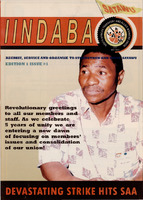 This year we are five years old. It is an important time in the history of our young merged union representing transport, cleaning and security workers under the revolutionary banner of federation COSATU, the liberation movement and the working class as a whole. On the 18 may 2000 we launched the new SATAWU comprising of members from the former SATAWU and former TGWU, bringing together public and private sector transport workers and cleaning and security workers. The battles that we have had to engage in, have been decisive and have contributed fundamentally to changing our society for the better. The bruising 1989 SARHWU strike stands out as one event that altered the labour relations in the public sector through the power and determination of organised transport workers. While the historic strike by our security members in kzn in 1993 also led to the first historic wage negotiations and the resultant sectoral determination in the industry setting a minimum floor of rights for all workers.
 -
 SANIBONANI NONKE FOSATU (X2) SIYANIBINGELELA NONKE NGO 1985 (X2) We greet you all FOSATU we greet you all in 1985 SIYANIBINGELELA NONKE NGO 1985 (X4) We greet you all in 1985.
 -
 COSATU must intervene in affiliates where it has identified problems, where problems have been brought to its attention and / or has been requested to do so. The CEC should draw guidelines on how and under which circumstances the federation and its structures may intervene taking into account clauses 3.9 and 3.10 of the constitution. Such intervention should not undermine affiliates where such problems exist. COSATU leadership must be visible during major disputes between affiliates and employers and co-ordinate solidarity with workers involved in such disputes.
 -
 This booklet is to be used by unions organising in South African Breweries subsidiaries. The aim of this booklet is to provide an understanding of SAB which will help in working out how to negotiate with a monopoly of this size. As such, the booklet is divided into two sections. The first section looks at SAB, who owns it, how it is structured, how profitable it is, what it owns, etc. This section summarises the essential information about the company. We have drawn on a report by the Labour Research Service to assist in this section.
 -
-
 The decline in world energy consumption caused by the twin oil price hikes of 1973 and 1979 checked development in the major market economies and triggered the process of industrial restructuring that has so profoundly affected all sectors and all regions. ore efficient use of more expensive energy and strategic policy changes have made major contributions to easing the historical reliance upon energy inputs - especially in the case of oil. As a result the ratio between energy consumption and growth of gross world production has diminished by nearly 25 % over the past fifteen years. It has been estimated that full use of available energy-efficient technologies could cut per capita energy use by as much as 50% without impeding economic growth. The extent to which these gains are realized will depend upon a wide variety of economic and developmental factors, among which the price management of fuels is a very important one. here has also been a change in the industrial mix of the major OECD economies with the decline of old industries using high energy imputs and the rise of high technology sectors with different and lower energy requirements. The shift of much basic manufacturing to new locations in the developing world and to the hitherto centrally planned economies is likely to precipitate a further important change in energy requirements. emand for energy is forecast to continue to grow at only about half the rate of general economic growth over the short to medium term. Consumption is very uneven on a world scale, however. In 1988 the world consumed energy equivalent to some 8 billion tonnes of oil (Tonnes Oil Equivalent, or TOE) - an average of 1.3 tonnes for every man, woman and child on Earth. While citizens of the USA will consume an average of 8 TOE per capita, however, the average for both Japan and Western Europe is around 3 TOE, while people in the Third World still rely on fuelwood and dried animal dung as important energy resources, consuming only a small fraction of a TOE each in many cases.
 -
-
 All married women earning over R150 per month or over R34 per week have PAYE deducted from their wages. PAYE is income tax which is paid by workers on the "pay as you earn" system. Married men, however, pay tax only when their wages are over R500 per month. Single women pay tax only when their wages are over R350 per month. As you can see from the tables which follow, the tax on married women can be quite high. For example, if a married woman earns R220 per month, she will have R9,45 per month deducted from her wages for PAYE. (See Table No. 4). Married women who have children pay the same tax as if they haul no children, too. And there is no reduction in tax if you are over 60 years old, as there is for men. There is nothing can be done about this discrimination against married women until the government changes the tax rules.
 -
 In terms of section 109 (1) of the Occupational Diseases in Mines and Works Act, 1973 (Act 78 of 1973) which repealed the Pneumoconiosis Compensation Act, 1962 (Act 64 of 1962) as amended, the Black Affairs Authority, defined as the Director-General : Co-operation and Development, is charged with the payment of a benefit or any other amount awarded by the Compensation Commissioner for Occupational Diseases in terms of the Act, or the previous Act, to or in respect of a Black person.
 -
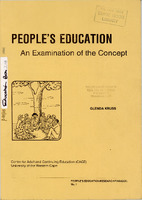 This research report sets out to examine the concept of People's Education in South Africa from December 1985, when the call for People's Education was first made, to September 19877“It is the result of a preliminary six month research project which set out to lay the basis for a long term study of international perspectives on People's Education. The researcher experienced the difficulties associated with doing contemporary research in a charged political environment. Several of the potential interviewees were either in detention or 'on the run' because of their commitment to People's Education. The contemporary nature of the research focus also meant that the sources of relevant printed materials were limited and dispersed. The study demonstrates that People's Education is concerned with more than responding to 'the education crisis'. In addition, it is attempting to address the problem of a future education system in a post-apartheid society. As adult educators we are excited by the challenges that People's Education offers. It is one of the first times in South Africa that 'lifelong education ' is on the agenda where education in the school is seen as only one aspect of necessary education provision. Adult Education at the workplace, in voluntary associations, in political movements, in the home, is seen as integral to the educational process both in the period of social transformation and in a future, post-apartheid society. This study has confirmed that People's Education cannot be ignored. People's Education has achieved what many previous investigations into education have not achieved; it has involved a wide range of grassroots people in the debates around the future of South African education. It is an ongoing process. As Ken Hartshorne is quoted as saying : "Both the debate on and the process leading to post-apartheid education are well underway; they are loaded with complexities, uncertainties and risks, because they are taking place in an unstable and unresolved vortex which changes from day to day, from place to place." I would like to acknowledge the assistance of colleagues who played an important role in the process of the study : Professor Owen van den Berg who was very helpful in the setting up of the project, and Mr Brian O'Connell who assisted with the conceptualisation and ongoing discussion of the project. In addition, his critical reading of the draft of this report provided many invaluable suggestions. Thanks are also due to our colleagues at UWC and elsewhere who took time to read the draft paper and offered constructive criticisms.
 -
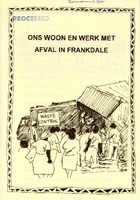 Ons woon langsaan 'n vullishoop, 25km buite Kaapstad, oppad na Malmesbury. Ons plek se naam is Frankdale. Ons het geen skole, toilette of elektrisiteit, en ook geen gesondheidsklinieke nie. 'n Mobiele kliniek kom een keer per maand.
 -
-
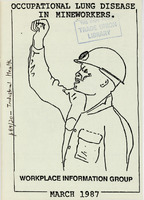 Many mineworkers get occupational diseases. An OCCUPATIONAL DISEASE is caused by the conditions that miners work in. Mineworkers have the right to health. Improved working and living conditions and regular medical care can protect the health of mineworkers. Lung diseases are common occupational diseases among mineworkers.
 -
-
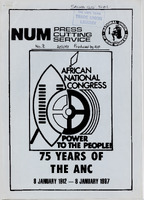 The African National Congress, 75 years old tomorrow, is no longer being written off in South Africa as “the world's least successful terrorist organisation.†The black nationalist movement, which turned to violence after it was banned in 1960, is nowhere near a classic guerilla' victory in its fight for majority rule. But after three years of unprecedented black revolt in South Africa's townships, it has won recognition from the Government as its main enemy and a major security threat. Political analysts say this has in turn helped the outlawed ANC boost its overt political support in the townships — an increasingly important goal since it accepted how South African conditions impede conventional guerilla warfare. South African Government sources used to pour scorn on the ANC's guerilla operations and it justified crackdowns on dissent by speaking in general terms of an international, communist-backed' "total onslaught" against its rule.
 -
 We have arrived at a very important stage in the development of our country - one that will be most testing and challenging for all of us. Our second revolution, so to speak, is only beginning. The Government of National Unity, has come a long way in addressing the key political questions. Advancement from here lies in our economic prerogative. We are all concerned with the major economic challenge that lies ahead. Sustainable economic growth, the creation of wealth and equity, the provision of jobs and basic needs underpin the need to provide mechanisms which will facilitate growth, development and delivery. But our concern is not limited to our domestic economy.
 -
 The aim of this paper is to provide updated figures on women's representation in leadership structures in COSATU. These figures enable the federation to review progress and to set targets for women's leadership, as resolved in the 1997 COSATU Congress. The paper provides the most recent statistics (for 1998) on women's leadership in COSATU at regional and national level. The intention of this report was to focus on collecting the actual figures and is therefore confined to a more quantitative (statistical) reflection on women's leadership. It will be valuable to embark on further research that examines the qualitative aspects, in other words, women's experiences of leadership.
 -
-
 The intention of this paper is to highlight debates and issues regarding the use of guota systems in strengthening women's leadership in the labour movement. The paper is aimed at broadening the debate from mere acceptance or rejection of the guota. Debates on the use of guotas tend to be heated and controversial and can lose sight of the central objective, which is the development of strategies for women's empowerment. A large proportion of trade unions internationally have adopted forms of the quota system as a strong measure to deal with the ongoing under-representation of women in leadership. The quota system has also been introduced effectively in a number of parliaments all over the world, including South Africa. The countries with the highest representation of women in parliament have all had to use quotas to achieve this. The paper draws from a review of some of the international literature, as well as interviews undertaken with trade unionists and parliamentarians (see Appendix A for a list of interviewees). This paper will also highlight some examples where quota systems have been adopted, including three COSATU affiliates, namely CWIU, NEHAWU and SAMWU.
 -
 South Africa is in the process of renegotiating the Southern African Customs Union Agreement with Botswana, Lesotho, Namibia and Swaziland. The origins of the Agreement date back to 1889 making this one of the world's oldest customs union agreements. The present version of the Act dates back to 1969. Since that time various conflicts have arisen between member countries regarding the objectives and operations of the agreement. Given the new political situation and the changing international trade climate, a decision has been made to renegotiate the agreement entirely. Discussions are now underway and these are being co-ordinated through the Customs Union Task Team which comprises representatives of the various countries. The South African government, through the Department of Trade and Industry recently held a workshop in order to brief interested parties. Parties have been invited to comment on the process and the Department has agreed to involve the Nedlac Trade and Industry chamber in any decision about the future of SACU.