
Items
-
-
-
 In circumstances in which the breach of a rule or failure to meet a required standard is not serious enough to warrant a final written warning or dismissal, the appropriate Local Chairperson, Regional Secretary or General Secretary may issue a verbal warning or first written warning after discussion with and counselling of the official.
 -
 This policy shall be binding on all NUMSA staff who qualify for travel allowances/payment for the use of their motor vehicles in execution of their duties, which shall include but not be limited to: attending factories, workshops; taking members home after meetings; organising workers. Travel between home and office shall not be deemed to be travel on union business. This policy can only be changed or amended by a Central Committee meeting or a National Congress. The rate of compensation shall be reviewed from time to time.
 -
 This pamphlet provides an outline of those features of the Local Government transition process, with which workers will have to deal.
 -
 Low wages are a cause of poverty. They are unjust and they lead to economic inefficiency. Low pay is not the result of "market forces" or of individual productivity. It is the result of the vulnerability of certain sectors of the workforce and the cost structure of low-wage industries. A National Minimum Wage is a practical solution that has been adopted in many countries. It is one of the demands of the Freedom Charter. The National Minimum Wage can be developed by COSATU as a powerful campaign tool in the fight for a living wage . The National Campaigns Conference, held in May 1990, asked the Living Wage Working Croup "to establish what National Minimum Wage should be suggested to develop a program of action to achieve a National Minimum Wage". The conference agreed that the level of the National Minimum Wage will be decided at the second National Campaigns Conference in August 1990. This reader pulls together all the documents and resolutions that have guided the Living Wage Working Group in its work on the National Minimum Wage.
 -
 As this edition of Work In Progress was going to print the state effectively banned 17 organisations and an undisclosed number of individuals, and severely restricted the Congress of South African Trade Unions. By doing this the government of State President PW Botha has escalated its ongoing war against the people of South and Southern Africa. Precisely why the state chose to act this way at this time is not clear. Visible resistance to apartheid in the townships has declined under the burden of emergency rule, and popular political and community organisation has been severely weakened. One possibility is that government is attempting to limit the massive resistance expected against the October local government elections, including the boycott call made by a number of those organisations effected by the latest clampdown. But whatever the reason, there remains no excuse whatsoever for believing that 'reformers' within the state hold any power. If the distinction between 'militarists' and 'reformers' is real, then the militarists have so obviously won ascendency that talk of 'reformers' wielding influence in government is absurd. There is even less excuse for those elements which stubbornly hold to the belief that the Botha administration has a reform programme. There is no doubt that it has plans to change the face of South Africa. So did the Nationalist government of Verwoerd. But it was never suggested that this involved 'reform'. Change can be for the worse - and this is what the changes being made by Botha's militarists involve. South Africa is a society at war. Government is at war with the majority of South Africans and Namibians, with the Angolan nation, and with the majority of frontline states. In Natal, it seems unwilling or unable to use the might of its laws against the vigilante perpetrators of a bloody and enduring civil war. On the labour front, its proposed amendment to the Labour Relations Act, combined with emergency restrictions on Cosatu, aim to close down trade union organisation or render it impotent. This war against the working class has another side, seen in Botha's new economic deal, the wage freeze and moves to privatise substantial areas of the public sector. Many of the articles in this issue of WIP deal with facets of this war - from the ANC's armed struggle to Botha's economic war against the working class; from the Maritzburg civil war to allegations of riot police on the rampage in townships. Government's 24 February banning of organisations and individuals, and the restrictions on Cosatu activity, must be seen in this context of a society at war with itself.
 -
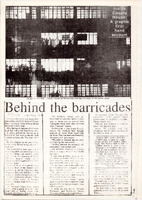 I saw a badly injured and handcuffed man pushed down the stairs of Cosatu House in central Johannesburg during this week's police siege. After hitting the bottom of the stairs head first with a dull thud, he lay still. A young policeman moved up to him and hit him once on the rib with rubber pick-handle. The man didn't stir. He was dragged on the ground to a police truck before being thrown in head first.
 -
 At the Cosatu National Congress, a debate around the issue of globalisation erupted. At the core of the debate was whether the federation was opposed to globalisation or not. Some unions fell that as a federation we should be opposed to globalisation and all what it represents. Others felt that we should be opposed not to globalisation but its negative effects or the current form of globalisation.
 -
 This workshop is designed to give you a reliable introduction the Employment Equity Act. It is based on hard information and on ACTIVITIES or discussion exercises that will help you to understand how the Act works, who it covers, and what the implications are for trade unionists. Each of the Activities is complemented with information that will help you to understand the Act in more detail. Sections have been added to help you find further information, and to understand the terms that are used in the Act itself. In a two day programme, you are not going to be an 'expert' on the Employment Equity Act, but we hope that you will feel more confident about using the Act, especially in ensuring that it is used to address a wide range of discriminatory practices at the workplace. As with most legislation, the more that you begin to use it, the more its strengths and weaknesses will emerge. It is very important that any weaknesses in the practical application of the Act are reported through your Union to the Federation. This will help the Federation to campaign for improvements in the legislation, and to close any loopholes that allow employers to avoid their responsibilities.
 -
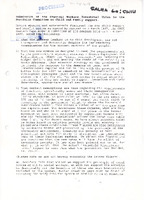 Having studied and extensively discussed the new child support and benefit system as agreed by cabinet on 5 March 1997, the CWIU Western Cape Women's Committee at its seminar held on 5-6 April 1997, noted j:tee following: 1) That the pSC-cess leading up to this development was not transparent and democratic despite its far-reaching consequences for the poorest sections of our people. 2) That the new system is designed to meet the requirements set by the government's economic strategy - Growth Employment and Redistibution (GEAR) for "fiscal restraint" and reducing the budget deficit and not meeting the needs of the majority of South Africans. This economic strategy of the government is in itself its response to the demands of local and international capital and not in line with the promise of "A better life for all" as embodied in the Reconstruction and Development Programme (RDP) and the new constitution which states the right for all "to have access to social security, including, if they are unable to support themselves and their dependents, appropriate social assistance". 3) That certain assumptions are made regarding the requirements of families, specifically women and their unsupported children, with regard to their survival, let alone decent living standards. In particular we refer to the new rates of R75 per child (under the age of 6 years) per month which is according to the government "slightly above the household subsistence level". This raises a number of serious questions and implications. Who determined these figures, what are they based on and who is it aimed at ? For years in the labour movement we have been confronted by capitalist bosses with similar "scientific statistics" across the bargaining table when fighting for decent wages. We have always rejected these as being based on existing poverty levels and seeking to perpetuate these conditions. These figures are also determined by academics hidden and protected by the privilege of the university environment, treating our poverty as mere scientific subjects for study to strengthen the ideological hand of their capitalist masters. We reject the figures and are convinced that the new rates will have the effect of increasing poverty. It has also been pointed out to us, for what it is worth, that the actual "Household Subsistence Level" figure is more than what the government has decided, ie. R96.83.
 -
-
 CWIU is committed to the development of all its staff members. Therefore all staff members will have the opportunity to further their skills and. education supported by the Union. 1.1. The primary objective is to ensure that the aims and objectives of the union are achieved through an efficient,effective and excellent staff; 1.2. In addition,the union believes that individual staff members should have the opportunity to realise their full potential; Therefore,in implementing a Staff Development policy a balance will be achieved between organisational needs,which are primary,and personal needs of staff members.
 -
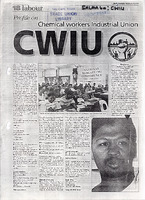 Chemical Workers Industrial Union (GW1U) CW1U wus launched in November 1074 following a wuvo of strikes by workers in Durban, who wero demanding bettor wages. During those dark yours when repression wus at its highest peak, workers hud no hade unions to assist them. In chemical, transport, textile and .paper industries, workers formed trade unions to take their struggle forward. They also formed a tight .federation, the Trade Union Advisory and Co-ordinating Committee (TUACC). At its launch in 1974, CWIU was concentrated in Durban and had just under 1 000 members. In July 1980, a branch was opened in the "old†Transvaal. In building a national union, CWIU merged with Glass and Allied Workers Union (Gawu) in 1982. In the interim, other branches where launched throughout the country, though it was easy task with security cops keeping surveillance on every movement of union officials. To build a stronger united worker-front, CWIU took quantum leap when it merged again with Plastics and Allied Workers Union in 1986.
 -
 We the Trade Union representatives here present firmly commit ourselves to a unified democratic South Africa, free of oppression and economic exploitation. We believe that this can only be achieved under the leadership of a united working class. Our history has taught us that to achieve this goal we will have to carry out the following tasks: To organise the unorganised workers and build effective trade unions based on the democratic organisation of workers in the factories, mines, shops, farms and other workplaces. Organise national industrial trade unions, financed and controlled by their worker members through democratically elected committees.
 -
 The CWIU recognises the need to develop a long term organisational vision, develop and implement creative and effective strategies, prioritise campaigns/activities in order to be able to sustain these, adapt and change by a process of restructuring, deal effectively with political and economic issues. Development of a long term Vision Congress reaffirms our objective of a socialist future Our programmes must therefore reflect this vision. The trade union movement as a working class organisation has a major role in any socialist programme. The labour movement must remain independent. This independence must not be compromised. Overall strategy for trade union movement The current direction of Cosatu towards so called "Strategic Unionism" must be thoroughly discussed. A progamme of discussion on this must be implemented in the Union. We confirm our belief in the following principles and any strategy must be based on these: worker control, accountability of leadership a combination of negotiations,mass action and struggle as the means to achieve our goals/demands.
 -
 Since the late 1980's, there has been a serious realisation on the part of Cosatu and CWIU leadership, of the need for Centralised Bargaining. Two broad areas of concern which pressurised us in this direction were: 1) The low level of class consciousness on the part of the majority of members during this period especially with regard to the complete lack of solidarity around wage struggles. 2) The organisational incapacity of the unions to cope with the excessive demands of plant based bargaining. This wasted resources and undermined the quality of work and achievement of annual wage bargaining. Faced by this reality, achieving consensus on the need for a campaign to achieve centralised bargaining at leadership level was relatively easy. Unions in other sectors eg. metal, mining, clothing, textile and the public sector, regularly set examples of what could be achieved by well run centralised bargaining. Numsa's experience illustrated the strengths and pitfalls of centralised bargaining - ie. Numsa's mandating and report back processes, the Mercedes Benz strike by opponents to the "one bite at the cherry".
 -
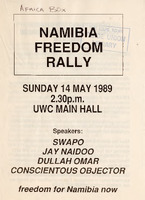 Die mense van Namibia het uiteindelik hul vryheid gekry! Hulle het getriomf teenoor die koloniale regering in Pretoria en die brutale apartheid magte. Die mense van Namibia sal binnekort hulle self kan begin regeer. Hulle sal 'n nuwe nasie bou - vry van onderdmkking en uitbuiting.
 -
 Machipanda, February 3,1995 (AIA/Brian Latham)—Many Zimbabwean peasants have quietly found the solution to land shortages by crossing into neighbouring Mozambique where it is plentiful. For as little as US$ 10 a field, they are acquiring land and a place to live — probably illegally — from chiefs and headmen across the border. Information on how to get land is easily accessible in Machipanda, the Mozambique border town at the head of the Beira Corridor from Zimbabwe to the Indian Ocean. Confusion reigns in Mozambique in the aftermath of the devastating civil war. And in a country reputed to be the poorest on earth, the government can do little to control the flood of border jumpers in both directions: Mozambicans enter Zimbabwe to sell everything from guns to clothes donated by aid agencies and Zimbabweans enter Mozambique in search of land to till.
 -
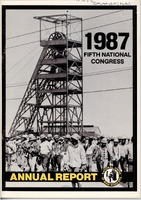 1986 was a tumultuous year as mineworkers waged gallant battles on many fronts. It was a year when mineworkers were continuously compelled to take militant action to advance not only their cause as mineworkers but to advance the liberation struggle. The State of Emergency brought about a level of dedication and commitment amongst mineworkers that had never been experienced before as several structures of the union had to function without their leaders for some time. The intransigence of bosses in wage negotiations propelled mineworkers to unprecedented levels of militancy and compelled many employers to capitulate in the end. 1986 saw mineworkers participating in many more strikes than other workers and their participation in nationwide stayaways was clear evidence that "THE MINERS HAVE ARRIVED."
 -
 Windhoek, January 16,1995 (AIA/Joshua Amupadhi) — Many impoverished Namibians are demanding swifter change to better their lives following elections which restored the ruling SWAPO party to power for another five years. SWAPO, the former guerrilla organisation which fought for the independence of Namibia from apartheid South African rulers, won an easy victory in the first post independence elections in December. Those interviewed say five years were enough for the former liberation movement to have made a good start on improving the standards of living of many previously disadvantaged Namibians and dismantle apartheid structures established during 75 years of South African colonialism. One SWAPO supporter says independence has created only a black elite to join whites in the rich suburban areas but has not narrowed the gap between the rich and poor.
 -
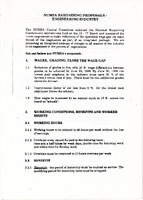 The NUMSA Central Committee endorsed the National Bargaining Conference's deliberations held on the 15 - 17 March and mandated the union negotiators to make reductions of the apartheid wage gap the main thrust of the negotiation as part of an integrated package. We are proposing an integrated package of changes to all aspects of the industry to be negotiated in the process of negotiations.
 -
 Sowa, January 3, 1994 (AIA/Caitlin Davies) — Mercy Manakedi Theetso is 29 and has four children. She breast-fed her first child for 18 months, her second for eight months, and she didn't breast-feed her third child at all. “I was working and the baby stayed with my mother so we used a bottle for the first four months, then we used a cup,†explains Theetso. “Myself, I like to breast-feed but I don't have the time.†In the 1960s Botswana's medical practitioners began giving new-born babies the bottle. Now, 30 years later, there is a concerted effort by the Botswana government to promote a return to breast-feeding. But as women have gone out of the home to work, reversing the trend is not an easy task. However, breast-feeding does remain popular in Botswana. “It's a culturally acceptable norm,†says Virkloti Morewane of UNICEF, and boys and girls are fed for the same amount of time.
 -
 During the 1930's the world experienced the most wide-spread and severe economic depression in its history. The beginning of the Great Depression was signalled by the great crash on the New York Stock Exchange in 1929.
 -
 A purely academic observer would probably find significant cause for optimism about the evolution of the trade union rights situation in Africa in the 1990's, and about the observance of human rights more generally. The continent has lived under the sign of democratization since the beginning of the decade, and the extent of political transformation has been unprecedented and astonishing. Since 1989, at least 25 African nations have adopted entirely new constitutions or major constitutional reforms. To them may be added those countries - for so long an isolated minority - which already operated pluralist democratic systems and those, more numerous, which are still engaged in processes of transition and reform.