
Items
-
-
 The achievement of international competitiveness within a 10 year time frame with: a minimisation of the loss of job opportunities in the textile industry, the growth and net creation of jobs in the clothing sector, both formal and informal, successful, in general, export-orientated textile and clothing industries, the acceptance by the industries of a greater responsibility for their own future by lessening their dependence on government by improving productivity through human resource development, work organisation and upgraded technology; a conscious move out of the lower end of the market but simultaneous efforts to retain these activities within the region; and a competitive environment where everyone gains, including the consumer, by making basic goods more affordable.
 -
-
 The launch of NEDLAC offers a unique opportunity to our country - a chance to rebuild the economy and society through a consensus forged among workers, investors, government and the community. The road to that consensus will, no doubt, be stormy and rocky. You cannot bring together Jabu Xulu, earning R200.00 per week, after working for 15 years, with a family of five to feed; and John Smith, the Chief Executive Officer of a major conglomerate, earning R20 000.00 per week, and expect that it will be a calm and easy process.
 -
 The aim of this discussion document is to begin a debate about the future role of COSATU. Its success will depend on concrete debate, discussion by membership and criticism of issues and/or direction. The analysis of the past three years will be addressed in a separate paper in preparation for the CEC and 5th National Congress] Since our inception, our guiding principle has been to bring about the transfer of power to the people. The present political settlement, no matter how flawed, takes us a step closer to that goal. All polls indicate that barring a miracle, the ANC will have around 60% representation in the next parliament and Government of National Unity and Reconstruction. This will indeed represent a break with the past and a real victory for workers and the country as a whole.
 -
-
-
 The first six months of 1989 has proved to be as busy as predicted, and the demand for mediation and arbitration services has increased steadily during this period. Year on year, whereas there were some 120 mediations and 75 arbitrations during the first six months of 1988, there were 195 mediations and 117 arbitrations during the first six months of 1989. This increase in demand may be attributed to a number of factors. In the first place, with the ever increasing unionisation of workers in South Africa a wider range of parties are resorting to third party intervention to resolve disputes. Secondly, labour and management who have had experience of mediation and arbitration, have continued to use third party neutrals to assist them in the process of dispute resolution. And thirdly, given the current political climate and the attitude of the major trade union federations to the recent amendments to the Labour Relations Act, it is apparent that parties are turning with greater frequency to independent third party neutrals to assist them resolve conflict. There are, for example, an increasing number of recognition agreements which require that conflicts of right be adjudicated through private arbitration under the auspices of IMSSA. Some German multinationals have, in accordance with the IG Metaal Code of Conduct for German investors in South Africa, agreed to refer disputes of right to private arbitration. IMSSA has for some time now been cited in the disputes procedures of many recognition agreements as the source of mediators.
 -
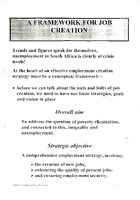 Trends and figures speak for themselves, unemployment in South Africa is clearly at crisis levels! At the heart of an effective employment creation strategy must be a conceptual framework - • before we can talk about the nuts and bolts of job creation, we need to have our basic strategies, goals and vision in place
 -
 This workshop is designed to give you a reliable introduction the Employment Equity Act. It is based on hard information and on ACTIVITIES or discussion exercises that will help you to understand how the Act works, who it covers, and what the implications are for trade unionists. Each of the Activities is complemented with information that will help you to understand the Act in more detail. Sections have been added to help you find further information, and to understand the terms that are used in the Act itself In a two day programme, you are not going to be an 'expert' on the Employment Equity Act, but we hope that you will feel more confident about using the Act, especially in ensuring that it is used to address a wide range of discriminatory practices at the workplace. As with most legislation, the more that you begin to use it, the more its strengths and weaknesses will emerge. It is very important that any weaknesses in the practical application of the Act are reported through your Union to the Federation. This will help the Federation to campaign for improvements in the legislation, and to close any loopholes that allow employers to avoid their responsibilities. All Labour Legislation, including the new Employment Equity Act should serve as a 'base-line' or minimum standard. Employer and Union observance of the minimum standards as laid down in law should be our starting point. Through collective bargaining and improved Union organisation, we aim to improve upon the standards set by the law, and increase the protection of our members. This is a real challenge. It is especially important for us all to recognise that as we enter into a period where employers are demanding more 'flexibility', the introduction of a new law to correct the legacy of imbalances left by apartheid at the workplace deserves our special attention. We hope this workshop is the first in a series of educational events that will cover this vital new area. The main aim of this workshop is to help you to understand the basic workings of the law, and how best it can be implemented. We also hope this programme encourages you to find out more about Employment Equity issues, and contribute positively to the struggle for the eradication of inequality. This pack is designed for a series of two-day introductory workshops that are being sponsored by COSATU in each region. A workshop of COSATU Educators held in September 1999 helped to assemble the material, and to test its appropriateness. As a result there are a considerable number of educators who can advise, and facilitate this workshop and who can be contacted via COSATU Education Department. We would also be very interested to hear how the pack has been used, and in particular how it can be improved to meet the needs of trade unionists who want to tackle discrimination using the tool of the Employment Equity Act, as well as other organisational means. If you use this pack, feedback would be most welcome.
 -
-
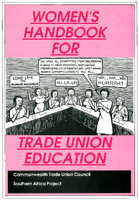 All over Africa today, and particularly in the Southern Region, women in trade unions are wanting to stand up and be counted. How do we get counted, is a question we ask ourselves? Education being the unanimous answer, we were all very happy when the CTUC decided to fund a Women's Handbook project with the blessing of the Southern African Trade Union Co-ordination Council. The project was implemented in July 1986 in Harare, Zimbabwe. Sisters from Botswana, Lesotho, Swaziland, Zambia and Zimbabwe got together and our initial objectives were:- • To identify problems faced by working women in the region. • To come up with solutions to these problems. Once the main topics had been defined - i.e. women in society, in trade unions and the law, bargaining issues, health care and education for women - we set about drafting material which was to be used for pilot courses with women workers in each country. Now, nearly a year later, after having met again in Mbabane, Swaziland in March/April 1987, we have our handbook. We want this book to be used to help women educators run courses for the rank and file women workers. Here it should be noted that as women who feel we have always been discriminated against, we do not wish to carry this on by excluding our male counterparts. Therefore even though our book is aimed at women, we would welcome assistance from our brothers! Finally, we hope that this book will be instrumental in bringing about an end to our struggle for women in the labour movement.
 -
 During the financial presentation of the company, the impression was created that the attributable income is unrealistic due to the fact that capital expenditure for the first six months were way below budget.
 -
 COSATU noting the unfolding education crisis within the Western Cape has called for a stayaway of all of its members and supporters in the Western Cape in support of its demand for measures that will guarantee quality public education, should the Provincial Government fail to meet the demands detailed.
 -
 The democratic South Africa was birthed through negotiation and dialogue, and a range of socio-economic policy matters continue to be determined on this basis. Social dialogue that focuses on policy, legislation and generally advancing the best interests of society takes place between organised labour, business and government on regular basis in a range of statutory and non-statutory tripartite forums.
 -
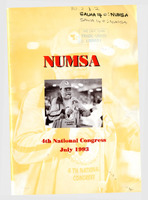 A comprehensive booklet documenting the proceedings of NUMSA's Fourth National Congress held in Johannesburg. It includes the General Secretary's Report, full transcripts of resolutions and debates, and discussion documents regarding the Reconstruction Accord and industry restructuring.
 -
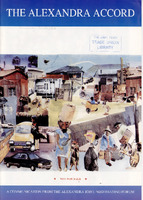 The Transvaal Provincial Administration, the Alexandra Civic Organisation and the Alexandra City Council have signed an agreement called the Alexandra Accord. This agreement commits the parties to the development of Alexandra and ends the rent and services boycott. The Alexandra Accord also sets up a Joint Negotiating Forum (JNF) to find ways to solve the problems in Alexandra. The other members of the JNF are: the Central Witwatersrand Regional Services Council, the Sandton Town Council, the Randburg Town Council, Eskom, the Rand Water Board and the Development Bank of Southern Africa. This book explains the story behind the Accord and gives the residents of Alexandra information about the JNF. We hope that you will share this publication with other residents, discuss it with your friends and read it to those who cannot read. VIVA ALEXANDRA!
 -
 This summary is intended primarily for unionists who want to get an overview of key substantive features of the new Labour Relations Act (LRA) that will most probably take effect in April or May next year.
 -
 The type of meetings we have in mind are general members' meetings with more than ten people in attendance. These notes are relevant where you have an opportunity to think beforehand about what you are going to say and to spend some time on preparation. Sometimes you may have to speak 'on the spur of the moment' in response to information, a statement or an event. In these circumstances, you should try to get your thoughts together before you speak, rather than simply 'thinking out loud'. The most important point about the 'spur of the moment' type of situation is to say what's on your mind. Don't leave it to someone else. These 'spontaneous' contributions to meetings can be very effective. People usually can recognise when someone is speaking 'from the heart'! Sincerity, honesty and conviction are much more important for effective speaking than 'polish' and presentation. Hundreds of books have been written and millions of pounds 'earned' telling people how to get their message across. While good presentation can help, for the trade union movement what people say is more important than how they say it. A speech is effective if the audience remembers most of the points made by the speaker.
 -
 At present, profit sharing does not fit into the philosophy of any trade unions in South Africa. It is not a part of the policy of any union I know about. Where profit sharing schemes exist and are accepted by the unions, this is because of special circumstances. This talk is in three parts: First, I will explain where my union, the National Union of Mineworkers, has accepted profit sharing schemes and why it has done so. Secondly, I will outline the different levels of agreements that we have negotiated on profit sharing and the principles we have agreed should govern such schemes Thirdly, I will speak of the implementation of the schemes, and their potential for providing a basis for greater worker participation in the enterprises which have negotiated profit sharing agreements.
 -
 THIS IS INFORMATION MATERIAL CONCERNING STUDIES IN STUDY CIRCLES. IT IS AIMED, PRIMARILY, AT BEING A GUIDE TO THOSE WHO HAVE NOT PREVIOUSLY TAKEN PART IN SUCH STUDIES. THE MATERIAL WAS PREPARED BY THE IUF EDUCATION SECRETARIES JOINTLY WITH PARTICIPANTS IN THE IUF STUDY CIRCLE LEADERS' SEMINAR IN THE PHILIPPINES, IN AUTUMN 1981. THE MATERIAL GIVES A THOROUGH INTRODUCTION OF THE STUDY CIRCLE METHOD. IT ALSO DEALS WITH THE ROLE OF THE CIRCLE LEADER AND THE PARTICIPANT AS WELL AS THE REQUIREMENTS OF MATERIAL "DESIGNâ€.
 -
 The Reconstruction and Development Programme (RDP) was developed by the African National Congress (ANC) prior to entering government. The RDP was developed as an integrated and coherent socio-economic policy framework aimed at transforming South African society. Within this framework the ANC, as the majority party in the Government of National Unity (GNU), undertook to develop detailed policy positions and a legislative programme.
 -
 Historically, access to marine resources was unrestricted. In order to facilitate the monopolisation of the fishing resource by a few white companies, a system of quotas was introduced. In this way many black fisher folk lost the access rights they had had for generations. At the present time, the fishing industry is completely biased in favour of a few large and medium sized white companies. This is illustrated by the fact that just three (3) companies hold : • 72% of the hake quota; • 75% of the abalone quota, and • 71 % of the sole quota Overall, across all species, approximately nine tenths (9/10) of the resource is controlled by a hand-full of companies. Since 1994, some of these companies have attempted to blacken their faces. They have also sold minority shares to some black business consortia. Further, a few members of the black elite have been given quotas. None of the above amounts to any kind of restructuring. None of the historic imbalances have been addressed. The above have merely been attempts to confuse the issue and to frustrate any process that attempts to restructure the industry.
 -
 The headings of the clauses in this agreement are for the purpose of convenience and reference only and shall not be used in the interpretation of nor modify nor amplify the terms of this agreement for any clause hereof.
 -
 The response to the first issue of SPREAD-IT was encouraging - to say the least. Not only did we find people reading it during centre staff meetings and during NCC debates, but we believe it has set a trend - the NWC is now also compliling a bulletin of news! Well, our spreading function is certainly becoming infectious - which, of course, was our intention. We even ran out of copies.