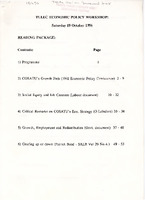
Items
-
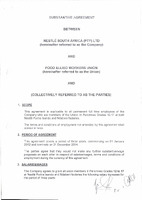 Substantive agreement between Nestlé South Africa (PTY) LTD and Food Allied Workers Union and collectively referred to as the parties.
 -
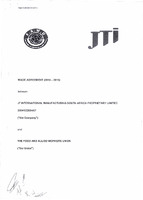 Wage Agreement (2014-2015) between JT International Manufacturing South Africa Proprietary Limited and the Food and Allied Works Union on the 17th of July 2012.
 -
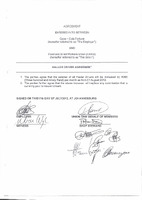 Hauler Driver Agreement: Agreement entered into between Coca-Cola Fortune and Food and Allied Works Union on the 17th of July 2012.
 -
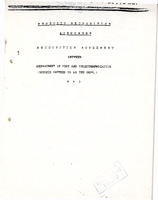 A draft agreement outlining the formal relationship between the Department of Post and Telecommunication and POTWA. Covers objectives, collective bargaining, access for union officials, rights of shop stewards, and detailed grievance and dispute procedures.
 -
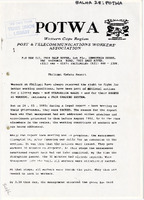 A report detailing the sacking of hundreds of workers at the Philippi yard following a report-back meeting on grievances. It lists worker demands (living wage, fair grading, end to victimization) and calls for regional solidarity.
 -
A leading anti-apartheid weekly newspaper published in South Africa. Launched in early 1986 by the Catholic Bishops' Conference, it was a cornerstone of the "alternative press." It was notable for being black-owned, black-edited, and staffed almost entirely by black South Africans. The paper focused on workers' rights, grassroots resistance, and liberation theology. It faced severe state repression, including the two-year detention of editor Zwelakhe Sisulu and a temporary ban in 1988.
-
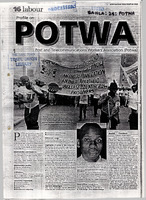 A profile article providing a history of POTWA (founded August 1986 in Soweto), its regional structures, membership profile, affiliation with COSATU, and major industrial victories, including wage increases and opposition to privatisation. Includes biographies of national office bearers like Ramateu Monyokolo and Tlhalefang Sekano.
 -
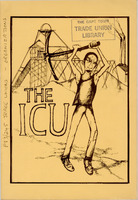 A booklet detailing the history, organisation, and decline of the Industrial and Commercial Workers' Union (ICU) in South Africa during the early 20th century. It covers key events such as the 1919 Cape Town dock strike, the 1920 Port Elizabeth riots, and the organisation of farm workers. It also includes biographical sketches of leaders like Clements Kadalie and Selby Msimang, and discusses the union's relationship with the ANC and the Communist Party.
 -
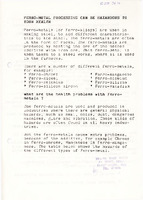 Ferro-metals (or Ferro-alloys) are used in making steel, to add different characteristics to the steel. The ferro-metals are often in the form of rocks. The ferro-metals are produced by heating the ore of the needed additive with iron ore. This ferro-metal is then taken to a steel works, where it is used in the furnaces.
 -
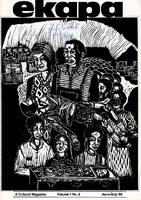 A grassroots cultural and political journal from the late apartheid era. This issue features an interview with Dr Allan Boesak on democratic socialism, a detailed report on the "War Zone" of Crossroads, biographical profiles of exiled poets Dennis Brutus and Arthur Nortje, and numerous protest poems and graphics addressing the State of Emergency and judicial injustice against students.
 -
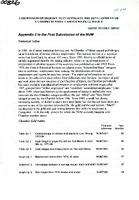 In 1985, the Central Statistical Services and the Chamber of Mines ceased publishing a racial breakdown of mining industry employment. This marked the end of a statistical series that dated back for almost 100 years. Since 1985, there is no official series of racially segmented data for the mining industry, while the racial breakdown of employment in all other sectors of the economy was published up until 1992. From 1993, the Central Statistical Services introduced a new “Unspecified Race†category into its published employment data, making the identification of trends in employment and income by race less certain. The statistical information on racial issues in this submission must reflect these difficulties with the data. In respect of gold and coal mines that are members of the Chamber of Mines, the Chamber periodically has made available unpublished information on employment and total wages after 1985, grouped into “skilled employees†and “unskilled / semi-skilled employees.†Until about 1989, when legal barriers to the employment of blacks in skilled jobs were removed, the two Chamber categories reflect the old “White†and “Non-White†categories used by the Chamber before 1986. Since 1989, a small, but slowly increasing number, of skilled workers have been black, but this has not been taken into account in any of the statistics presented for the gold and the coal sectors. “Black†employment in the gold and coal mining industry thus refers to employees in Categories 1 to 8, the only groups for which the NUM currently bargains with Chamber member mines.
 -
 In June 1990, the United Democratic Front [UDF] appointed Brian Cumin, National Director of Lawyers for Human Rights as Commissioner to investigate and report on the reasons for the violence in Oukasie Township, Brits, since February 1986. Brian Cumin was empowered to appoint additional Commissioners to assist him. David Bam and Mpho Molefe, both practising Attorneys in Pretoria were duly appointed as co-commissioners. As part of their report on the reasons for the violence in Oukasie, the Commissioners have taken the liberty of making recommendations to the United Democratic Front.
 -
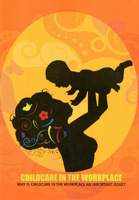 In this booklet, the Labour Rights for Women (LRW) campaign looks at Childcare in the Workplace in South Africa. Nearly all working parents face the challenge of finding safe, appropriate childcare for their children while they work. In the past, women were traditionally seen as the primary carers of their children, with their work and careers coming second to their roles as mothers. But as the face of the workplace changes, many more women are in fulltime employment. Many more women also work in the informal sector. And many more women are developing their own career paths. In South Africa especially, many more women are also becoming the primary wage earners in their families, and many are also single parents. This means that changes in childcare policy and practice in the workplace are necessary. If parents, especially women, are to be productive members of the workforce whose contribution is taken seriously, they need a functioning system of childcare in the workplace to support them.
 -
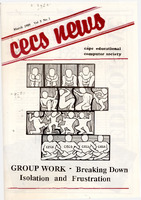 One of the most significant features of this year has been the employment of the four new people by CECS. Having so many new people in influential positions can be potentially dangerous for an organisation such as CECS which is rim along democratic lines. It thus becomes incumbent on the members of CECS to be vigilant against too much of the responsibility for the running of the organisation resting on the shoulders of the employed staff. Members should actively participate in decision-making so that it is they who determine the course of CECS. Each and every member should view themselves as an indespensible part of CECS, and that they share in the responsibility for the successes and failures of the organisation.
 -
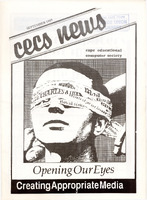 This edition of the CECS newsletter focuses on the democratisation of media through computers ("Computers For All"). It highlights a June 1989 camp at Wattle Park, Noordhoek, where high school students and teachers were trained in desktop publishing, photography, and scanning to create community media. Key topics include "Transformative Education," desktop publishing software reviews (Ventura, Publish It!, Newsmaster), and a feature on computer viruses ("Ghosts in the Machine").
 -
 COSATU must intervene in affiliates where it has identified problems, where problems have been brought to its attention and / or has been requested to do so. The CEC should draw guidelines on how and under which circumstances the federation and its structures may intervene taking into account clauses 3.9 and 3.10 of the constitution. Such intervention should not undermine affiliates where such problems exist. COSATU leadership must be visible during major disputes between affiliates and employers and co-ordinate solidarity with workers involved in such disputes.
 -
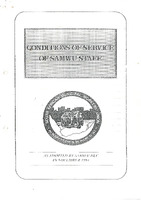 This document is as adopted by the SAMWU NEC in November 1994. It serves to define the wages and conditions of employment applicable to all SAMWU staff and is the only conditions of employment document of the union. Employees who were staff of a pre-existing trade union which merged with SAMWU who have conditions which were previously declared personal to holder ( in terms of merger agreements ) are required to examine this document and to individually register where they, consider that their terms differ from this document. No improved condition hereby introduced can be taken to apply to such employees as a matter of right . They have a choice of registering specific conditions as †personal to holder " or converting to the full set of conditions as contained herein. Where they register a condition as personal to holder the NEC will decide whether new conditions hereby introduced are also applicable to them. It is further recorded that whilst these conditions of service are open to be ammended from time to time ; as-the NEC may decide , any representations for amendments shall normally only be considered during the later part*of-each year.
 -
-
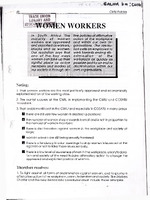 In South Africa the majority of women workers are oppressed and exploited as workers,blacks and as women. Our resolution says that one of the key ways women can take up their rightful place as active members and leaders of our society is through active policies of affirmative action at the workplace and within our own organisations. The resolution calls on employers to work towards ending discrimination at the workplace as quickly as possible and for an end to discrimination within our own organisations.
 -
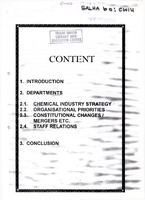 The idea to restructure the union is not a new one. Political changes in our country compelled almost all the unions to consider the possibilities of restructuring the union and the industry in general. New approaches to Collective Bargaining Strategies came to the fore. The good example of these Bargaining strategies was the NUMSA THREE YEAR BARGAINING STRATEGY (1993). Later in the same year, CWIU also introduced its Bargaining Strategy in the form of five pillars. The common thing about Numsa and CWIU bargaining strategies is that they both failed to deliver and the process of setting up working groups are more complex than expected. The main cause of the tap problem in my view is that the existing union structures are a big deterent to the development and implementation of new bargaining strategies. Our Centralised Bargaining victory and the new LRA will demand major union restructuring if we want to utilise the openings created by these new developments. In this discussion paper, I will focus on how we should restructure our union. In this paper, I am suggesting that the union (CWIU) must be made up of four semi-autonomous departments.
 -
 This Trade Union shall be a body corporate with perpetual succession capable of entering into contractual and other relations and of suing and being sued in its own name and shall be an organisation not for gain.
 -
 The COSATU leadership is asking all its affiliates to discuss a way forward for South African workers. The COSATU National Office Bearers have produced a document titled "COSATU 1993 Discussion Paper on a Way Forward". It deals with the "Reconstruction Accord". This Accord is a plan for organised labour during this period of transition in South Africa. Since this plan is laying the foundations for a future South Africa, the COSATU document is therefore a plan for the future of the working class. In this short paper we are going to answer the most important questions concerning this COSATU document: Is this the way forward for the workers? Is this plan going to free the workers from the chains of poverty and suffering? Is this plan going to lay the foundations for workers control of the economy, of politics and of the country? Is this plan going to stop retrenchments and starvation wages? In other words, we are going to study the COSATU leadership 's proposals from the point of view of the needs of the workers.
 -
 Globalisation of finance: restructuring of capital such as global financial speculation, mergers + closures). Globalisation of production: restructuring of work (changing processes and location of production), restructuring of labour markets (structural unemployment, rise in part-time and casual workers and homeworkers). Globalisation of culture: dominance of 'American lifestyles'. Globalisation of the state (government): restructuring of the state (state following rather than compensating for 'free-market logic', restrictions on trade union freedoms and political rights, shifts away from national control over resources and policies to international structures such as WTO, IMF, World Bank).
 -
-