
Items
-
-
 Over the past few months, the Namibian labour movement - particularly the country's largest trade union federation, the National Union of Namibian Workers (NUNW) - has been the subject of debate and media attention. Contradictory statements by union leaders, the NUNW's position on the elections in Zimbabwe and the federation's role in the privatisation of Air Namibia have raised serious questions about the vision and mission of Namibian trade unions. This article hopes to shed some light on recent developments against the background of the ongoing challenges facing the labour movement since independence.
 -
 This report focuses on COSATU's organisation in the 21st century in terms of organising and service strategies; organisational structures; and leadership, management and staff development. In each section, the proposals point to key directions for organisational renewal. The report will be discussed at the Central Committee meeting on November 19 to 22, 2001. It should be subjected to detailed debate and mandating in the run up to the Central Committee. The Seventh National Congress established the need for this organisational review. It noted the “need for a thorough organisational review,†in order to avoid a piecemeal and ad hoc approach. It therefore resolved, “A commission be established: to review structures of the Federation at all levels, including the substructures of the CEC, to propose policy changes and where appropriate propose constitutional amendments. The commission must report to the Central Committee in 2001, which will refer any proposed constitutional amendments to the next Congress.†In February 2001, the CEC established the Organisational Review Commission. At the time, it noted worrying trends in some unions' ability to maintain services to members, and therefore decided to extend the review to include all aspects of organisational development. In April, the CEC approved terms of reference. The members of the Commission are listed in Appendix 1. They include NOBs of COSATU and affiliates, regional office bearers, some COSATU heads of department, representatives of NALEDI and DITSELA, and an (expert on organisational review. In preparing this report, the Commission held several workshops, and the extended September CEC discussed the draft in depth. Still, the Commission's work was constrained by the lack of time and resources. Members have many other responsibilities, including mobilising for the strike against privatisation in August. The Commission itself did not have a dedicated budget.
 -
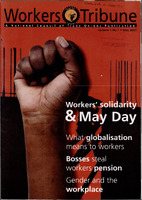 Nactu, the second largest trade union federation with a membership of more than 500 000 workers from across various sectors, publishes this month its new baby. Workers Tribune, a monthly magazine that will communicate the federation's message to its members and other interested parties. It was not by accident that the birth of this important publication should coincide with May Day. For Nactu, May Day is the embodiment of workers' and peoples' struggles that has culminated in the freedom that South Africa enjoys today. We also know that these struggles occurred in an unfriendly, and often hostile environment, with many of the liberation heroes and heroines laying down their lives for the love of freedom and justice. We now enjoy democracy and freedom, and we must work hard at preserving it. We must always be mindful that it is easy to abuse freedom, and so we must strenuously be on the lookout for tendencies that seek to undermine freedom. We may have a new political order in our country, but there can be no question that the working class is still facing new challenges against capital, even black bosses. We still live in an environment that creates tensions between the working class and the bosses. We still have thousands of our comrades who have been retrenched because of the desire by bosses to realise big profits. And so, the struggle for workers' complete emancipation from tyranny is far from over. All bosses, including some we shared pain and abuse in the apartheid trenches, are capable of reverting to old ways. We must not forget that, like the erstwhile bosses of the apartheid era, they operate within an environment that is determined from outside,, and so they have to play the game according to pre-determined rules. The emergence of turncoats is on the increase. And for reasons I have alluded to, that should not surprise us. The trade union movement should increasingly prepare itself for other battles. But we should also empower ourselves with knowledge, so that when we dialogue with the bosses we raise compelling arguments. Slogans qlone do not work. We need to develop intellect as well. And so in this issue, Comrade Cunningham Ngcukana begins the process of teaching, and mental empowerment. He helps his readers to have a better understanding of what globalisation is all about, explaining that it is more profitable for unions to have profound appreciation of the workings of this system if they have to use it to their advantage. Ngcukana also writes about May Day. He tells us about the origins of this day. It is history we need because it is both informative and inspiring. A fine and commendable work by the general secretary of Nactu. There is also an article on gender equality in the workplace. Brenda Modise wrote it for us, and do read and enjoy it. To break the heaviness of the magazine, we also run a variety of pictures that seek to introduce to readers some of Nactu's leaders. We believe that it is important that you know your leaders in the trade union movement. Most importantly, however, we want to create a dialogue between ourselves and readers. Do, therefore, send us letters, commenting on various issues raised in this number. We hope to be of service to you. Do have a nice read.
 -
-
-
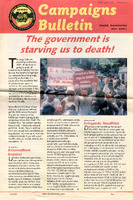 The wage talks are resuming on May 8th 2001. At the time of going to print, all provinces were holding marches all over the country to highlight our demands for a living wage. Currently on the table is a proposal by the conciliator that all parties should agree to accept an 8% across the board increase, and an increase in the minimum wage to R1900. Firstly this proposal has not yet been accepted by the employer. At the conciliation, the employer stuck to 5% only. Secondly this falls short of our demand. It means we will not get the R300 across the board. Any worker earning below R3800 per month is going to get an increase of less than R300. The hardest hit will be workers earning from R1700 - R3000 who will only get R136 - R240. There is nothing more we can get from conciliation or negotiations. It is now up to YOU the workers to decide if you will accept the 8% offer put on the table by the conciliator!
 -
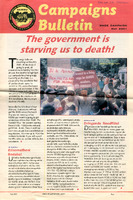 The wage talks are resuming on May 8th 2001. At the time of going to print, all provinces were holding marches all over the country to highlight our demands for a living wage. Currently on the table is a proposal by the conciliator that all parties should agree to accept an 8% across the board increase, and an increase in the minimum wage to R1900. Firstly this proposal has not yet been accepted by the employer. At the conciliation, the employer stuck to 5% only. Secondly this falls short of our demand. It means we will not get the R300 across the board. Any worker earning below R3800 per month is going to get an increase of less than R300. The hardest hit will be workers earning from R1700 - R3000 who will only get R136 - R240. There is nothing more we can get from conciliation or negotiations. It is now up to YOU the workers to decide if you will accept the 8% offer put on the table by the conciliator!
 -
-
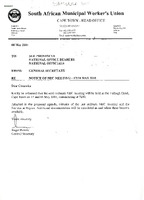
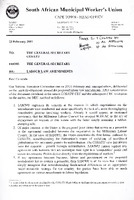 Our National Executive Committee met on 20/21 February and, amongst others, deliberated on the latest developments around the proposed labour law amendments. After consideration of the document circulated at the recent COSATU CEC and the subsequent CEC resolution on the matter, our NEC resolved as follows: SAMWU expresses its concern at the manner in which negotiations on the amendments were conducted and more specifically the lack of a more thoroughgoing consultative process involving workers. Already it would appear, as cautioned previously, that the Millenium Labour Council has usurped NEDLAC as the site of engagement on matters of this nature with the latter simply assuming a rubber- stamping role. Of major concern to the Union is the proposed joint vision that serves as a preamble to the agreement concluded between the negotiators in the Millenium Labour Council. In the view of SAMWU, the vision constitutes the first formal embrace by COSATU, notwithstanding the Federation's vision of socialism, of neo-liberal globalisation viz. economic growth for redistribution. The COSATU view has always been the opposite - growth through redistribution. SAMWU cannot support any agreement with business that acknowledges their right to a 'competitive' profit and secure investments. Profits derive directly from the exploitation of workers. If any agreement between business, labour and government on the proposed amendments has to contain a preamble, then SAMWU is of the view that it should simply recognise that notwithstanding fundamental differences on an appropriate macro-economic strategy for the country, the parties have been able to reach agreement on various amendments to labour legislation.
 -
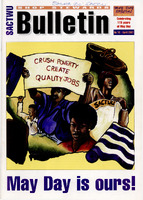 Cosatu has decided that May Day 2001 should focus on our campaign for jobs, and highlight the International Labour Organisation (ILO's) Declaration on Fundamental Principles and Rights at Work and its Follow-up. This is an important document. Adopted by the ILO's International Labour Conference on 18 June 1998, it arose out of "...concerns in the international community over the processes of globalisation and the social consequences of trade liberalisation...." The Declaration commits member countries to respect the following four core categories of fundamental rights at work, to promote it and to work for it to be universally achieved: • Freedom of association and the effective recognition of the right to collective bargaining; • The elimination of all forms of forced or compulsory labour; • The effective abolition of child labour; • The elimination of discrimination in respect of employment and occupation. The Declaration, importantly, emphasises that all member countries have an obligation to respect these fundamental principles, irrespective of whether they have or have not ratified the relevant ILO Conventions. As part of this special May Day edition of the Sactwu Shop Stewards' Bulletin, we reproduce the entire Declaration and its Follow-up. Discuss, debate and report back!
 -
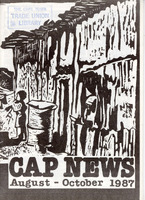 Third-quarter issue of 1987. Highlights include a technical guide on relief printing (linocut and woodcut), a poem on unemployment by R.Z. Siwangaza, a "Salute Our Hero" profile of Basil February (a freedom fighter who died in Zimbabwe), and the "Tristam & Them" comic strip by Magnes.
 -
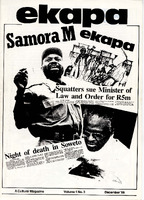 A resistance-era cultural journal published in December 1986 during the State of Emergency. This issue focuses on "A Culture of Resistance" and includes an editorial on "People's Culture," an interview with jazz vocalist Sathima Bea Benjamin, a legal update on KTC squatters suing the Minister of Law and Order, a tribute to the late Samora Machel, and a historical comparison with the Chilean resistance under Pinochet.
 -
A landmark black trade union and political organisation in South Africa. Founded in 1919 in Cape Town by Clements Kadalie, it grew from a dockworkers' union into a mass movement representing urban and rural black workers across Southern Africa. At its peak in the mid-1920s, it claimed over 100,000 members. The organisation was characterised by its "One Big Union" philosophy and its resistance to the pass laws and low wages.
-
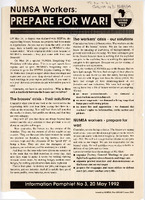 This archival document is an "Information Pamphlet" issued by the NUMSA head office in Johannesburg during a period of intense industrial unrest in South Africa. The record captures the escalation of a labor dispute between NUMSA and the Steel and Engineering Industries Federation of South Africa (SEIFSA), along with employers in the Motor, Auto, and Tyre/Rubber sectors.
 -
 COSATU must intervene in affiliates where it has identified problems, where problems have been brought to its attention and / or has been requested to do so. The CEC should draw guidelines on how and under which circumstances the federation and its structures may intervene taking into account clauses 3.9 and 3.10 of the constitution. Such intervention should not undermine affiliates where such problems exist. COSATU leadership must be visible during major disputes between affiliates and employers and co-ordinate solidarity with workers involved in such disputes.
 -
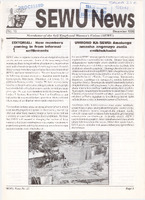 ewsletter of the Self Employed Women's Union (SEWU). The editorial focuses on organizing marginalized women in informal settlements, peri-urban areas, and hostels (e.g., Inanda, Umlazi, and Dalton Hostel). It includes reports on international exchange visits, including Beauty Ngcobo's trip to India to study SEWA, and Pat Horn and Ruth Masikane's research trip to West Africa (Ghana, Benin, Togo, Cote d'Ivoire, and Senegal).
 -
 The National Union of Metal Workers of South Africa (Numsa). following Cosatu, has since its foundation argued for a 40 hour week and a ban on overtime to increase employment. The goal of a shorter working week should not. however, limit itself to employment. Metal workers work long, hard hours, an average 49 hour week in 1995. (ILO.1996:334) Shift workers often work longer, with serious health and safety risks, including shorter lives. A poor and inefficient transport system cuts at least another 5 to 10 hours a week from the time urban africans spend away from home, community and leisure. (CSS. 1995)1 Workers too must have the right to a healthy work environment and proper access to leisure time and family. The organisation of working time is also important, impacting on the ability of workers to effectively access education and training.
 -
 It is often said that it is not enough to be busy in the trade union movement or even in the corporate environment nowadays. The big question is: what is it you are busy with? What to do about countless scheduled or impromptu meetings, political sessions, mass campaigns, workshops, relationship and capacity- building consultations in the regions and nationally, has become another matter of daily debates in our structures. Everyone in the labour movement has a view on why this and that meeting or the other campaign has to be taken up with urgency. Many of us are regarded as experts on labour activities. And this results in time pressures and internal hurly-burly. It is because the organization must achieve its ultimate goals in the end. Ultimate goals inform our major organizational objectives ranked by their highest priority. These include progress on the motor recruitment campaign. the white-collar workers recruitment drive, monitoring major bargaining, food prices, fuel price increases and the latest CPI-X and regional policy workshops, culminating in the National Bargaining Conference in April 2007. Charles Schwab, the world's greatest industrialist. with great ability and perspicacity, is known as a most efficient, fabulously rich steel worker who led and transformed the Bethlehem Steel plant into the largest independent global steel producer. But, that did not immunize him from pressures and time-wasting interruptions. He once issued a challenge to a management consultant to show him the way to get more things done with his time and promised to "pay any fee within reason.†The consultant, without hesitation gave him a pad of blank paper and wrote on it: “Each night write down the things you have to do tomorrow, number them in the order of their importance. Start working on priority item number one and continue until finished. Then start item number two, then three, and do not worry if you have not managed to finish them.†The consultant was paid handsomely within seconds of dispensing this discreet advice. She was probably paid a million dollars or more. Some extremely important considerations arise in relation to this big question, as we intensify our 2007 programme of confronting the class logic of capital through collective bargaining. We have to look at them carefully, if we are to realize the objectives we have set for the giant metalworkers’ union this year.
 -
 Wage agreement entered into between FAWU obo employees and Shannon Partners Pty (Ltd).
 -
 Memorandum of a wage agreement entered into between FAWU and Beestepan Boerdery (PTY) Ltd.
 -
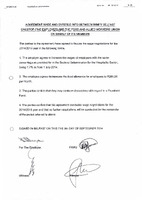 Agreement made and entered into between Wimpy Belfast Onestop (the employer) and the Food and Allied Workers Union (FAWU) on behalf of its members.
 -
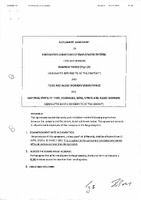 Settlement agreement on wages & substantive conditions of employment entered into and between Rainbow Farms (Pty) LTD and the Food and Allied Workers Union (FAWU) and National Union of Food, Beverages, Wine, Spirits and Allied Workers.
 -
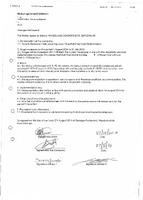 Mutual agreement between FAWU obo the employees and Georges Restaurant.
 -
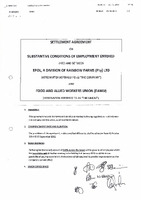 Settlement agreement on substantive conditions of employment entered into and between Epol, a division of Rainbow Farms (Pty) LTD and Food and Allied Workers Union (FAWU).