Items
-
-
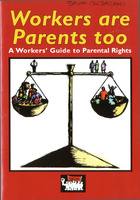 This booklet is a follow-up to the Parental Rights' Manual for negotiators produced by SACCAWU in 1999. These publications have been the product of painful soul- searching. They are attempts to highlight the plight of women in the workplace and represent the uncompromising resolve of the union to challenge the inequalities and discrimination that workers, especially women, suffer as parents. This booklet is intended to assist negotiators, shop stewards and ordinary workers in knowing and exercising their parental rights. In order to win the struggle for parental rights, the understanding of worker rights must reach all the way to the shop floor. This booklet will help to make that understanding a reality. We wish to thank the commitment and dedication by all workers and union officials who have worked tirelessly for the realisation of the noble goal of parental rights and have forced the bosses to reason beyond dogmatic greed to maximise profits. Achievements won thus far have not been easy victories, nor can they be attributed to kindness or a change of heart by the employers. This booklet builds on our manual and further inspires us to translate our dreams into reality.
 -
 When the National Union of Mineworkers was formed an experienced unionist said to me "organising workers in South Africa is the art of the possible". But organising workers in the mining industry is the art of the impossible. It has been the art of the impossible because it has been the art of trying to make a fundamental change in a system by using structures and instruments that were designed to perpetuate that system. It lias been the art of the impossible because it has been the art of trying to make a revolution with moderate tools tli at were invented to prevent a revolution. Because of the nature of the mining industry, which is conservative or ultraconservative by any definition, the black miner has been condemned to seek radical ends within a framework which was designed to prevent sudden and radical changes. For almost one hundred years now, black miners have not been able to change their status. The African Miners' Union in 1946 under J B Marks made an attempt but was brutally crushed by a combination of employer and government forces. It is against this background that our union has developed its organising strategies. Organising has taken place around a number of issues, some of which are safety, wages, and working- class unity.
 -
 This document is a Project Proposal for an HIV/AIDS Manual, designed to integrate public health advocacy into the core functions of the South African trade union movement. The proposal recognises that the HIV/AIDS epidemic is not merely a medical issue but a critical industrial and social challenge that threatens the well-being of the workforce and the stability of the economy. The manual’s primary objective is to move HIV/AIDS awareness from the periphery of union activity to the centre of the mandate of shop stewards and negotiators. By framing the epidemic as a labour issue, the proposal seeks to ensure that protections for HIV-positive workers—such as non-discrimination, access to treatment, and sick leave—become standard components of collective bargaining agreements.
 -
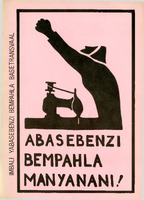 Abantu abamnyama bahlupheka ngakumbi ngokuye kusanda kobungxowankulu emZantsi Afrika. Abamhlophe abaninzi bazuze kobubungxowa nkulu. Abamhlophe babanolawulo kwinkompani zemiGodi; belawula nefaraa ezinkulu kwanamizi Mvaliso ngo- kunjalo. Abasebenzi abamhlophe emigodini ba- sebenzisa uMona ukuzuza ngokuphindwe kalishumi kunabamnyama.Kodwa ayingabobonke abamhlophe ababanelo- thamsanqa. Abanye abamhlophe babehluphekule. Belahlekana nemihlaba yabo ngokungxothwa ngo- nofama abatyebileyo. Baya ezidolophini apho bahlala ngokuhlwempuzeka okukhulu njengabobonke abamnyama. Uninzi 1walamahlwempu amhlophe yayi- ngamaBulu.Lamahlwempu amaBulu ayengafundanga engenayo na- nqeqesho ngezoshishino bafumana kunzima uku- fumana imisebenzi. Babanokwenza umsebenzi aba- ngawuqeqeshelwanga kodwa abaqeshi babewunika abemnyama bona babehlawula phantsi. uRulumente wancedisana neqaqobana lalamahlwempu amhlophe angena ngqeqesho ngokuwafunela umsebenzi kwa- Loliwe.
 -
-
 Numsa's Special National Congress convened from December 17 to December 20, 2013. It was attended by 1,200 delegates representing 338,000 metalworkers from 50 Locals throughout the provinces of South Africa. Numsa was proud to announce in the Congress that it is the biggest union in the history of the African continent. In the last 17 months, since our 9th Congress in Durban, we have grown from 300,000 members to 338,000 members. We are ahead of schedule in our goal to organise 400,000 workers by the time of our 10th Congress in 2016.
 -
-
 COSATU, along with other alliance partners, was very instrumental in the creation of national gender machinery that was put in place by the democratic state after 1994. COSATU was part of a very important meeting held in 1995 to discuss national gender machinery which was held at the World Trade Centre. This meeting concluded on a Commission for Gender Equality, the Office of the Status of Women and the mainstreaming of gender in society. The South African women's conference held in Amsterdam from 13-18 January 1990 and tagged, “Malibongwe Women's Conference†was a pivotal point in South African women's history. This conference was able to discuss the preferred role of women in South African politics and society. The conference analysed the challenges faced by women and proposed a number of resolutions to address with women's emancipation as well as gender equality. These focused on working women; education, health, culture, family, women's unity, natal violence and repression. “The subsequent programme of action gave the notion of a struggle for 'non-sexism' greater prominence, and recognised that national liberation did 'not automatically guarantee the emancipation of women.'†This was a pioneered the discussions on the establishment of national gender machinery in line with global democratic practice and the mainstreaming of gender across society and its institutions in order to avoid the “ghettoisation†or marginalization of women and women's issues in South African society. These discussions were initiated by the Women's National Coalition (WNC). As the negotiations for South Africa's transition to democracy started two to three years before democracy, women found themselves marginalized once again. They quickly formed the Women National Coalition which was able to push for women's inclusion in the negotiations processes as well s to fight for women'sissues to find their way onto the negotiations' agenda. The Women National Coalition was able to do this very effectively as it had established a “Negotiations Monitoring Team which provided reports and information to Women National Coalition member organisationsâ€. Through this coalition, a “Women's Charter for Effective Equality†was developed built on the back of the “Women's Charter†that was developed in 1954 by the Federation of South African Women (FEDSAW). The coalition continued to exist and to provide leadership and to draw on the resolutions of the Amsterdam Women's Conference. This ensured that an even broader consultation took place amongst women back home in South Africa to strengthen the Amsterdam resolutions and to put a plan in place for the implementation of new WNC resolutions, hence the constitution was able to include women's concerns including the inclusion of a Commission for Gender Equality amongst the institutions referred to in Chapter 9 of the South African constitution. The Presidency was also given the mandate of being in charge of the gender programme and in this office the Office of the Status of Women was located.
 -
 A year has gone by, after the adoption of International Labour Organisation's (ILO) Convention 189 for Domestic Workers. We have worked so hard for nearly four years, to ensure that our work is recognised as decent work! On 16th June 2011 we made history when Convention 189 was adopted. In this year gone by, only one government has signed the ratification of Convention 189. We set ourselves a goal: We want at least 12 governments to sign, one each month as part of the international 12 to 12 Campaign with the International Trade Union Congress (ITUC) and International Domestic Workers' Network (IDWN). South Africa shcAild be the second government to sign and ratify 189, meaning it becomes labour law, as South Africa was the most supportive and vocal government leading the campaign for Convention 189 at the International Labour Conference.
 -
 The BWI is the global union federation grouping of free and democratic unions, with members in the » building, building materials, wood, forestry and allied sectors. The BWI groups together around 318 trade unions representing around 12 million members in 130 countries. The headquarters is in Geneva, Switzerland. Regional and Project offices are located in Panama and Malaysia, South Africa, India, Australia, Burkina Faso, Bulgaria, Lebanon, Kenya, South Korea, Russia, Argentina, Peru and Brazil. Our mission is to promote the development of trade unions in our sectors throughout the world, and to promote and enforce workers' rights in the context of sustainable development. The President of the International is Klaus Wiesehugel from the Building and Forest Workers Union in Germany. The Deputy President is Stefaan Vantourenhout from the Building and Wood Workers union in Belgium and the General Secretary is Anita Normark from Sweden.
 -
-
 Comrades National Office Bearers of SACCAWU, other leadership of the Union at various level, the Wits Regional leadership of SACCAWU, the Shoprite Checkers NSSC NOBs, Officials, esteemed guests and delegates to this Summit, a substructure to the NSSC, I bring you warm and revolutionary greetings on behalf of the Shoprite Checkers NOBs and the entire NSSC and the entire SACCAWU membership. We are indeed honoured that you have all, particularly the SACCAWU NOBs, Officials and Guests, went to great length and sacrifices to ensure that you form part of this historic Summit. It is historic in that it is the only meeting of national competence convened in the year the NSSC turns twenty. Lest we forget, the Shoprite Council was launched in 1987, and has over the years relaunched to match the developments that were taking place within the company as it was growing its brands. Without your presence, we have no doubt that our debates would be poorer, leading to decisions that might in the long run prove inappropriate. You are once more welcome and assured that you are free to participate in the deliberations over the next few days. The Council have seen various onslaughts through the years and survived the iron-fisted resolve of the brutal apartheid regime and the capitalist system in its changing forms. It is the experiences of the time that has moulded numerous Shopstewards to an extent of understanding the necessity of participating within the Union and Federation structures. It is no coincidence that today, this Council has many of its Shopstewards in the CEC of the Union. It is of course worthless to have numbers in such structures if we do not play a positive and constructive role in shaping the direction of the Union. We can only do so if we are really grounded on the traditions of the mass democratic movement and the national democratic revolution.
 -
 Comrades National Office Bearers of SACCAWU, leadership of the Company Council, distinguished guests & delegates to this Summit, we extend to you revolutionary greetings from the National Office Bearers of Shoprite Checkers, and the masses of Shoprite Checkers workers who are SACCAWU members. This gathering takes place exactly a year after our national strike. It also takes place after lot of significant gatherings of all the Alliance Partners i.e. COSATU Central Committee, SACP National Conference, ANC National Policy Conference, and on fhe home front, the SACCAWU National Bargaining Conference. It is the important that the deliberations in this gathering should look at all decisions taken during this significant event, the Bargaining Conference, and put them into practicality. This Secretariat Report will cover the activities since the National Shopstewards Council of June 2006 in Durban.
 -
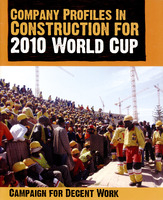 This booklet is a resource for construction trade unions, shop stewards, workers and allied organisations involved in the struggle to improve working conditions for those involved in FIFA World Cup 2010 construction projects, it also serves as a resource for the construction sector as a whole. This booklet provides profile 'snapshots' of the major companies, national and international, involved in World Cup 2010 construction projects. These 'snapshots' include a description of history and operations, profits for the 2006 financial year, executive and non-executive remuneration and state the specific 2010 contract awarded to each company. To give a broader picture of profitability in the construction sector, we have included other companies (in Annexure 1), that may not be involved in 2010 projects directly. We also provide information on the minimum wages for the civil engineering sector, which is contrasted to the remuneration packages of executives in the industry. Through this booklet, we aim to arm those involved in the struggle for decent work with information to be used for discussion, debate and action amongst workers; and contribute to the building of the independent knowledge of the working class. After all, 'knowledge is too important to be left in the hands of the bosses'.
 -
 Comrades National Office Bearers of SACCAWU, other leadership of the Union at various level, the Wits Regional leadership of SACCAWU, the Shoprite Checkers NSSC NOBs, Officials, esteemed guests and delegates to this Summit, a substructure to the NSSC, I bring you warm and revolutionary greetings on behalf of the Shoprite Checkers NOBs and the entire NSSC and the entire SACCAWU membership. We are indeed honoured that you have all, particularly the SACCAWU NOBs, Officials and Guests, went to great length and sacrifices to ensure that you form part of this historic Summit. It is historic in that it is the only meeting of national competence convened in the year the NSSC turns twenty. Lest we forget, the Shoprite Council was launched in 1987, and has over the years relaunched to match the developments that were taking place within the company as it was growing its brands. Without your presence, we have no doubt that our debates would be poorer, leading to decisions that might in the long run prove inappropriate. You are once more welcome and assured that you are free to participate in the deliberations over the next few days. The Council have seen various onslaughts through the years and survived the iron-fisted resolve of the brutal apartheid regime and the capitalist system in its changing forms. It is the experiences of the time that has moulded numerous Shopstewards to an extent of understanding the necessity of participating within the Union and Federation structures. It is no coincidence that today, this Council has many of its Shopstewards in the CEC of the Union. It is of course worthless to have numbers in such structures if we do not play a positive and constructive role in shaping the direction of the Union. We can only do so if we are really grounded on the traditions of the mass democratic movement and the national democratic revolution. The Summit is convened after various components of the Alliance convened their own important gatherings. The deliberations in all such gatherings clearly points to the fact that our revolution is threatened by new tendencies ranging from internal squabbles and political intolerance of each other's views. The fact that our ANC is now a contested terrain should not surprise us as this was to be expected once we took over political power. What is surprising though is the apparent manipulation of some of our comrades by some forces intent on discrediting the Movement and the Alliance. Such state of affairs place a challenge to the working class, particularly organized labour to fight in defense of the revolution.
 -
 Comrades National Office Bearers of SACCAWU, leadership of the Company Council, distinguished guests & delegates to this Summit, we extend to you revolutionary greetings from the National Office Bearers of Shoprite Checkers, and the masses of Shoprite Checkers workers who are SACCAWU members. This gathering takes place exactly a year after our national strike. It also takes place after lot of significant gatherings of all the Alliance Partners i.e. COSATU Central Committee, SACP National Conference, ANC National Policy Conference, and on the home front, the SACCAWU National Bargaining Conference. It is the important that the deliberations in this gathering should look at all decisions taken during this significant event, the Bargaining Conference, and put them into practicality. This Secretariat Report will cover the activities since the National Shopstewards Council of June 2006 in Durban.
 -
 Comrades, this historical 3rd National Summit is convened at a time when the National Democratic Revolution is under attack left, right and centre. We have recently held an ANC Policy Conference; SACP National Congress and COSATU Central Committee, as well as SACCAWU National Bargaining Conference. These Alliance meetings took a number of resolutions for implementation. One has observed a very sorry state of affairs in that some shopstewards who are seen to be very prominent in Shoprite meetings, do not attend SACCAWU structures, let alone COSATU, ANC & SACP structures. This Summit will have to discuss on how we are to revive structures at Shoprite and participation in the aforementioned structures. For the record, it will prudent for one to bring to the notice of the Summit that to date, we have concluded a hand-over of which I will elaborate under NFC in this Report.
 -
 Numsa's National Bargaining Conference is almost upon us. Wage negotiations in all Numsa's sectors will start from May. Bargaining is the focus of this Bulletin (pages 12-28). We give you some basic facts and figures to arm yourselves for centralised bargaining. We also include information on the new black economic empowerment (BEE) codes as well as employee share ownership schemes (esops). You will need this information to negotiate in your own companies. Division rocked the Cosatu congress last year. Woody Aroun summarises a paper of Joel Netshitenzhe on the issue of factions within organisations while Alex Mashilo gives his own views on how to deal with them. Cosatu's recent Central Executive Committee analysed the current political conjuncture. See if you agree with it and prepare yourself for the challenges that face you in a year in which both the SACP and the ANC will be holding key conferences. What do you think of Desai's challenges to Cosatu? Are you up to them? Take yourself through Enver Motala's piece on education. Did your schooling give you these critical skills? Are your children getting these skills from their schools? Are Numsa's education courses helping you to grasp those skills that you didn't get at school? And what about education and training at work - are these filling the gaps in your education?
 -
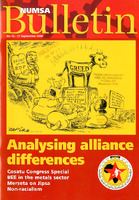 An annual Numsa Bulletin seems to be becoming the norm! However our aim is still to bring them out more often. Cosatu Congress is the focus for this Bulletin (pages 17- 39). We assume that you have Cosatu's resolutions and secretariat report so you will not find them here. We have instead included other background documents and articles that we think will help comrades debate resolutions in the September Congress. read the different understandings of the NDR by the alliance partners (page 18) how should we judge the actions of a developmental state (page 20) how Cosatu's jobs and poverty campaign can learn from Spain (page 23) understand what the Financial Sector Charter is all about (page 26) But there is much more to read - read the contributions from readers (pages 8-15), decide which brand of feminism you support (page 48) and do the test to see how gender sensitive you are. Learn tips from Aubrey ka Saki on how to avoid the VW- type situation (page 51) and absorb the findings of BEE research into Numsa-organised companies (page 55). How does your company compare? Do you have Esops in your company? Should Numsa adopt Esops as a way of going the BBBEE route or is it too risky? Study how the Merseta plans to complement Jipsa and how Bolivia is nationalising its hydrocarbons sector (despite a few hiccoughs!) Look at the glossary for definitions of those long words that always pop up at congresses and add words that are troubling you to it.
 -
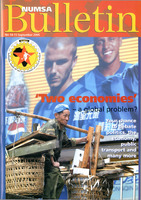 It is a year since the last Numsa Bulletin was published in September 2004. Last year Numsa's educators forum discussed how we could use the Numsa Bulletin more effectively. Included in this Bulletin are a number of topical issues that challenge you to debate issues at your local shop steward councils or your workplaces: If you are violently opposed to GEAR, have your views challenged by Motlanthe (page 14), Get your local to analyse what was agreed in the Alliance Summit earlier this year and give your score on whether you think the Alliance has met its targets (pages 22-23). Debate differences between the ANC's NGC document on two economies and Cosatu's response (pages 24-27). If you are an engineering shop steward in Middelburg, Witbank, Vanderbijlpark, Richards Bay, Pietermaritzburg, Vereeniging, then force a debate on the slow integration of House Agreements into the Main Agreement (pages 40-41). If you are an auto shop steward, then read Dumisa Ntuli's ideas (pages 42-44) on the shortcomings with black economic empowerment initiatives in the auto industry and debate the issues in your local/workplace. When was the last time you briefed members in your workplace? Do the organisational test on page 49 and see if you are up to the job. If you fail, redeem yourself by reading the health and safety, training and education sections and then debating and discussing the contents with your fellow members.
 -
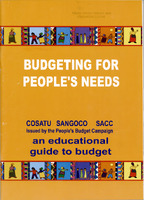 We hear a lot about the budget as an important expression of government policy. But what is the budget, what does it tell us about government programmes, and how can we influence it? This booklet aims: To support broader understanding and debate on budgets and fiscal policy as the basis for improving the public's ability to hold government accountable; To explain debates on and key concepts in fiscal policy, budget reform and government expenditure on major programmes; and In that context, to explain the proposals in the People's Budget and how the People's Budget Campaign works. The People's Budget Campaign is supported by a coalition of COSATU, the South African Council of Churches (SACC) and the South African NGO Coalition (SANGOCO). The People's Budget Campaign seeks to help people understand the budget better. Based on broad discussions and hearings, it works to develop proposals to improve government spending programmes.
 -
 We acknowledge Karen Hurt for the material development of the Report Writing section, Martin Jansen of the Labour Research for his contribution on the Wage Policy in Relation to the Macro economy, Saccawu's contribution on the Parental Rights and the Solidarity Center for HIV/AIDS. Thanks to all those who participated in the 2001 programme, without whom the redevelopment of this Block would not have been possible. These notes are developed to provide a support to facilitators when preparing to facilitate this course. They are not prescriptive! Please use them in a spirit of sharing ideas with other facilitators of this course and if you have insights and reflections from your facilitation experience, please let us have your comments to add to these notes!
 -
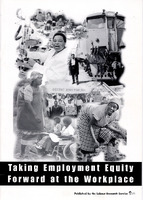 In 1998 the South African Parliament passed the Employment Equity Act. This law seeks to help establish equity in the workplace. It prohibits unfair discrimination in employment and requires employers to practice affirmative action. Employers who are designated by the Act must promote the employment of blacks, women, and disabled people in order to correct the discrimination of apartheid employment practices. The idea of producing an education booklet on Taking Employment Equity Forward at the Workplace came out of a series of workshops that were run in Gauteng, Kwazulu-Natal, and the Western Cape in September and October 2000. The workshop programme was designed by the Labour Research Service and run together with Khanya College and the Workers' College (Kwazulu-Natal). Affiliates of the trade union federations COSATU, NACTU, and FEDUSA were represented at the workshops, as were some unaffiliated trade unions. Of the 70 participants, 80% were shop-stewards and 26% were women. The main task of the workshops was to help participants gain some understanding of the Employment Equity Act so that they could help their trade unions to develop policies and practices around this legislation. This also meant that the workshops needed to explore workers' experiences of discrimination in the workplace and the broader legacy of inequality left by apartheid capitalism. Experiences of affirmative action practices in other countries were also discussed in the workshops.
 -