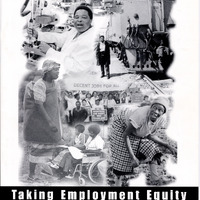
Taking employment equity forward at the workplace
Item
-
Title
-
Taking employment equity forward at the workplace
-
Date Issued
-
02-Oct
-
Description
-
In 1998 the South African Parliament passed the Employment Equity Act. This law seeks to help establish equity in the workplace. It prohibits unfair discrimination in employment and requires employers to practice affirmative action. Employers who are designated by the Act must promote the employment of blacks, women, and disabled people in order to correct the discrimination of apartheid employment practices. The idea of producing an education booklet on Taking Employment Equity Forward at the Workplace came out of a series of workshops that were run in Gauteng, Kwazulu-Natal, and the Western Cape in September and October 2000. The workshop programme was designed by the Labour Research Service and run together with Khanya College and the Workers' College (Kwazulu-Natal). Affiliates of the trade union federations COSATU, NACTU, and FEDUSA were represented at the workshops, as were some unaffiliated trade unions. Of the 70 participants, 80% were shop-stewards and 26% were women. The main task of the workshops was to help participants gain some understanding of the Employment Equity Act so that they could help their trade unions to develop policies and practices around this legislation. This also meant that the workshops needed to explore workers' experiences of discrimination in the workplace and the broader legacy of inequality left by apartheid capitalism. Experiences of affirmative action practices in other countries were also discussed in the workshops.
-
Format
-
pdf
-
Language
-
English
-
Type
-
text
-
Identifier
-
http://hdl.handle.net/10962/139431
-
Archive
-
Cory Library for Humanitites Research
-
Provenance
-
The item is held at the Cory Library for Humanities Research, Rhodes University, on behalf of the Labour Research Service
-
Extent
-
44 pages
-
Rights
-
Labour Research Services
-
Rights Holder
-
Labour Research Services
-
Use/re-use
-
The materials are made available explicitly for research and educational purposes. Any use of these materials must be cleared with the Labour Research Service.