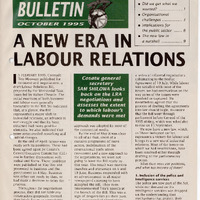
Negotiations Bulletin - A new era in labour relations
Item
-
Title
-
Negotiations Bulletin - A new era in labour relations
-
Date Issued
-
Oct-95
-
Description
-
IN FEBRUARY 1995, Comrade Tito Mboweni published for comment and negotiations, a draft Labour Relations Bill, prepared by the Ministerial Task Team led by Halton Cheadle. The initial reactions of both business and labour were generally favourable to the Bill. We indicated that, at a glance, the Bill represented a major shift in industrial relations, an advance in our struggle and that its basic structure had many positive elements. We also indicated that some areas needed reworking and radical changes. By the end of April, labour was ready with its positions. These had been agreed upon by Cosatu's Central Executive Committee (CEC) and in further discussions with Fedsal and Nactu. These positions were published on May Day and presented to business and the government on 4 May. Business was either not ready by then, or had made a decision to delay the process. Throughout the negotiations process, they did not table any constructive proposals. Instead they labeled ours as unworkable and unreasonable. The same approach was adopted by most of the commercial media. By the end of May it was clear to all of us that, short of a massive programme of mass action, mobilisation of the international trade union movement and a new approach to the negotiations, we were not going to have the Bill ready by this year. The result was massive marches and stay aways on 6 and 19 June. Business responded with an advertisement in all major newspapers' claiming to have accepted the Bill. They even misrepresented Tito's speech at the launch of the Bill. This was a sign of desperation on their part. A new round of negotiations started again on 21 June 1995 with a series of trilateral negotiations culminating in the Nedlac Agreement of 19 July. While labour was satisfied with most of the issues, we had reservations on the way some of the issues were resolved or captured. We nonetheless agreed that the process of drafting the agreements into law should begin, to ensure that the bill went through parliament before the end of the 1995 sitting, which was scheduled to rise on 15 September. We now have a new law, which, as 1 have indicated earlier, represents a victory for labour and brings in a new era of industrial relations. Most of the issues on which we had reservations, have been resolved either through drafting or the parliamentary process.
-
Format
-
pdf
-
Language
-
English
-
Type
-
text
-
Identifier
-
http://hdl.handle.net/10962/137567
-
Archive
-
Cory Library for Humanitites Research
-
Provenance
-
The item is held at the Cory Library for Humanities Research, Rhodes University, on behalf of the Labour Research Service
-
Extent
-
16 pages
-
Rights
-
Congress of South African Trade Unions (COSATU)
-
Rights Holder
-
Congress of South African Trade Unions (COSATU)
-
Use/re-use
-
The materials are made available explicitly for research and educational purposes. Any use of these materials must be cleared with the Labour Research Service.