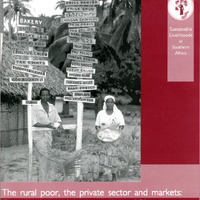
The Rural poor, the private sector and markets: changing interactions in southern Africa
Item
-
Title
-
The Rural poor, the private sector and markets: changing interactions in southern Africa
-
Description
-
One of the central tenets of much current development thinking in southern Africa is that market-oriented strategies and private sector involvement must be the basis for future economic growth. This has underpinned structural adjustment and economic policy reform policies in the region over the last decade or more. It also underlies the argument for encouraging external foreign direct investment (FDI) as a motor for growth. However growing evidence suggests that such a strategy has not paid off. Economic growth rates have been disappointing, private, and particularly foreign, investment has been limited, and employment in the formal sector has fallen dramatically.1 Structural adjustment and market liberalisation have clearly not delivered the developmental benefits claimed of them, and people's livelihood opportunities have, ft seems, declined over the same period and their levels of vulnerability have increased. The increasing recognition that the standard neo-liberal prescriptions were not having the expected benefits, especially for poor people, has resulted in some rethinking about how best to redirect the benefits of globalisation and economic reform towards the poor, and how to offset some of the losses. Thus 'pro-poor growth strategies', 'making markets work for the poor' and 'growth for redistribution' have become well-worn slogans. However, the practical and policy measures required, whereby the benefits of an engagement with a globalised economy, investment by the private sector and liberalisation privatisation measures can result in poverty reduction, remain vague.A number of issues arise. For the sceptics, questions are raised about the degree to which the turn to a 'pro-poor' markets approach is simply rhetorical gloss, added to the discredited neo-liberal paradigm, or actually a genuinely new policy perspective in its own right. It is important to differentiate between broad economic policy reform objectives (which, with some nuances, remain largely in the standard neo-liberal form) and sectoral policies which contain explicitly pro-poor elements. While retaining the argument that market liberalisation and external investment are key, such policies may include some strategic elements of state- directed intervention which boost the access of the poor to new markets and investment opportunities. It is this stance, where the state intervenes to improve access and for particular groups of people, redressing to some extent the imbalances caused by the lack of level playing fields of existing markets, which potentially sets a pro-poor perspective apart.
-
Identifier
-
http://hdl.handle.net/10962/74448
-
Date Issued
-
Aug-03
-
Rights
-
University of the Western Cape, Programme for Land and Agrarian Studies
-
Rights Holder
-
University of the Western Cape, Programme for Land and Agrarian Studies
-
Provenance
-
The item is held at the Cory Library for Humanities Research, Rhodes University, on behalf of the Labour Research Service
-
Type
-
text
-
Extent
-
30 pages
-
Format
-
pdf
-
Language
-
English
-
useGuidelines
-
The materials are made available explicitly for research and educational purposes. Any use of these materials must be cleared with the Labour Research Service.