
Self-Employed Women’s Union (SEWU)
Item set
- Title
- Self-Employed Women’s Union (SEWU)
- Alternative Title
- Self-Employed Women’s Union (SEWU) - South Africa
- SEWU
- Subject - Occupation
- Independent trade union
- Description
- Founded in 1993 by trade unionist Pat Horn with support from volunteers and inspired by SEWA (Self-Employed Women’s Association in India).
- Subject
- Informal sector -- organisation
- Women’s Union
- Self-employed women
- Collective bargaining
- Trade union -- South Africa
- Temporal Coverage
- 1993-
- Type
- Collection
- Publisher
- Self-Employed Women’s Union (SEWU)
Items
-
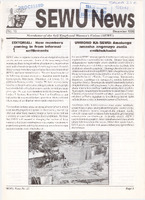 ewsletter of the Self Employed Women's Union (SEWU). The editorial focuses on organizing marginalized women in informal settlements, peri-urban areas, and hostels (e.g., Inanda, Umlazi, and Dalton Hostel). It includes reports on international exchange visits, including Beauty Ngcobo's trip to India to study SEWA, and Pat Horn and Ruth Masikane's research trip to West Africa (Ghana, Benin, Togo, Cote d'Ivoire, and Senegal).
 -
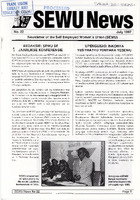 Newsletter of the Self Employed Women's Union (SEWU) focusing on the third annual national conference (July 22-24, 1997). Topics include structural changes to accommodate national growth, resolutions on political non-alignment and child labor, and efforts toward financial self-sufficiency following the collapse of SADWU. It also reports on expansion into the Western Cape and Eastern Cape.
 -
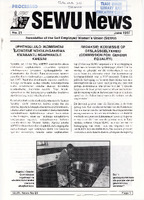 Newsletter of the Self Employed Women's Union (SEWU). This issue details SEWU's presentation to the Commission for Gender Equality regarding the needs of women in the informal sector. It covers the challenges of cross-border trade for Zimbabwean women in Cape Town, and the ongoing struggle for self-employed women to access credit and banking services. It also discusses the establishment of member-led savings clubs to foster financial independence.
 -
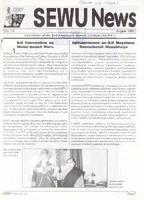 Newsletter of the Self-Employed Women's Union (SEWU). This issue reports on the attendance of SEWU delegates (Pat Horn, Eunice Ntshangase, and Sarah Nkunkwana) at the ILO conference in Geneva to advocate for the protection of home-based workers. It also covers discussions from the Habitat II conference regarding women's rights to housing and land across various countries including Zimbabwe, Namibia, and Kenya.
 -
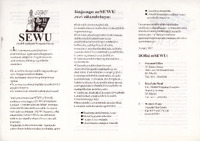 A membership information brochure for the Self Employed Women's Union (SEWU). It outlines eligibility criteria for self-employed women, membership fees (R10 joining fee and R5 monthly sub), and the union's core objectives. Key goals include building unity among unrecognised women workers, developing negotiation and leadership skills, providing legal advice, and assisting with issues such as child care, credit access, and maternity benefits.