
Work in Progress (WIP) Collection
Item set
- Title
- Work in Progress (WIP) Collection
- Alternative Title
- WIP Collection
- Description
- A series of the independent political and social journal Work in Progress, established in 1977 by the Southern African Research Service (SARS). WIP provided a platform for radical analysis of South African political economy, labor struggles, and state repression. It was notable for its rigorous "Labor Bulletins," its coverage of the treason trials, and its role in debating the transition to a post-apartheid democracy. The collection documents the intellectual history of the "Internal Front" of the anti-apartheid struggle.
- Date Issued
- 1977 – 1994
- Language
- English
- Provenance
- The item is held at the Cory Library for Humanities Research, Rhodes University, on behalf of the Labour Research Service
- Type
- Collection
- Genre
- Periodicals
Items
-
 A 66-page issue published during the final countdown to the 1994 elections. The central theme, "The Spoilers," analyzes the threat posed by the white Right and "apartheid's bastard children" to the democratic process. Key features include scenarios for right-wing reaction, the role of the Peace Accord, a report on the war in Angola, and a supplement on women's rights and the election. It also features a major debate on the future of the SACP and the "Socialist Conference."
 -
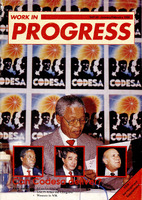 A 56-page issue centered on the debut of CODESA. It provides a strategic analysis of whether the negotiations can "deliver" democracy. Key features include an assessment of the SACP after its 8th National Congress, the role of Islam in Africa, a profile of women in Umkhonto we Sizwe (MK), and the launch of the Reconstruct development supplement.
 -
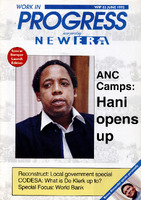 A 61-page special bumper edition incorporating New Era. The issue is landmark for its investigative focus on the ANC's detention camps, featuring an interview with Chris Hani. Key features include an analysis of F.W. de Klerk’s strategy at CODESA, a special focus on the World Bank’s role in South Africa, and a Reconstruct supplement on local government. It also features PAC Secretary-General Benny Alexander speaking personally.
 -
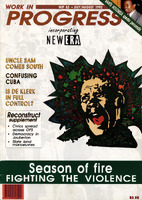 A 54-page issue documenting the crisis of violence in South Africa. Key features include an analysis of whether President F.W. de Klerk maintained control over the security forces, a personal interview with Transkei leader Bantu Holomisa, and an investigation into U.S. foreign policy toward South Africa ("Uncle Sam Comes South"). It includes the Reconstruct supplement focusing on OFS civics and state land manoeuvres.
 -
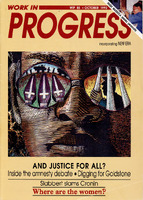 A 55-page issue incorporating New Era. The central theme, "And Justice for All?", examines the amnesty debate and the quest for accountability. Key features include an interview with musician Hugh Masekela, Frederik Van Zyl Slabbert's critique of Jeremy Cronin's "strategic perspectives," an investigation into the Goldstone Commission's findings on state violence, and a critical look at the marginalization of women in the transition process.
 -
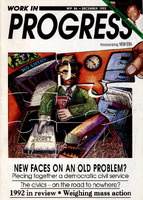 A 64-page issue incorporating New Era. Key features include an analysis of the "civil service" dilemma, a review of the political events of 1992, and an assessment of the "civics" movement. It features a personal interview with PAC leader Dikgang Moseneke, an evaluation of the "Rolling Mass Action" campaign, and a discussion on the future of Non-Governmental Organisations (NGOs).
 -
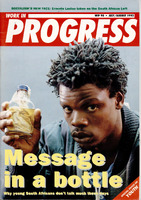 A 65-page issue featuring a "Special Focus on Youth." It explores the shift in rhetoric from the "Young Lions" of the 1980s to the "Lost Generation" of the 1990s. Key features include an analysis of youth marginalization, a major theoretical piece by Ernesto Laclau on the future of the South African Left, and proposals for a national youth ministry and peace corps. It also critiques the disparaging views of the youth held by mainstream media figures like Ken Owen and Jon Qwelane.
 -
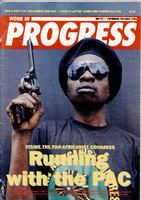 A 66-page issue focusing on "Eyes on the Prize"—the upcoming 1994 elections. Key features include an in-depth assessment of the PAC's policies and support base, a warning about COSATU losing its top leadership to the ANC's electoral list, and a critique of the SACP's call for Left unity. It also explores the "lost generation" of youth and the transformation of civic organizations in the transition period.
 -
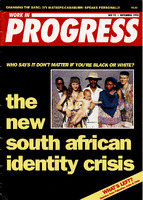 A 66-page issue focusing on the "New South African Identity Crisis." The editorial highlights lessons from the PLO-Israeli peace agreement and the visit of Chilean politician Manuel Cabieses Donoso. Key features include an interview with Ivy Matsepe-Casaburri on changing the SABC, a critical look at the "negotiated revolution" in Palestine by Edward Said, and updates on the Left in Cuba and Chile. It also addresses the danger of important issues "slipping off the agenda" as elections approach.
 -
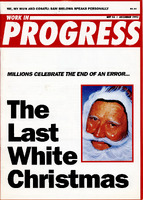 A 67-page issue reflecting on "the end of an error" and looking forward to 1994. The editorial emphasizes the shifting roles of activists moving from "overalls and t-shirts" to parliamentary "leather seats." Key features include a personal interview with COSATU General Secretary Sam Shilowa ("Me, My Mum and COSATU"), an analysis of the new "interim" constitution, and the launch of "The WIP Papers," a series of booklets on the global Left.
 -
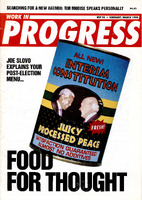 A 66-page issue published during the final countdown to the 1994 elections. The central theme, "The Spoilers," analyzes the threat posed by the white Right and "apartheid's bastard children" to the democratic process. Key features include scenarios for right-wing reaction, the role of the Peace Accord, a report on the war in Angola, and a supplement on women's rights and the election. It also features a major debate on the future of the SACP and the "Socialist Conference."
 -
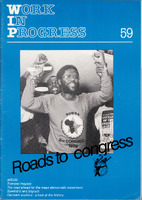 A 49-page issue analyzing the transition of the State of Emergency from an aggressive attack to an "all-encompassing political strategy." Key features include a report on the NUMSA second congress and its focus on the Freedom Charter, a strategic map for the Mass Democratic Movement (MDM), an investigation into the Transkei inquest into the killing of Batandwa Ndondo, a history of garment workers' unions, and a study of the long-standing Soweto rent boycott.
 -
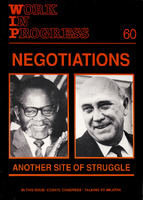 A 46-page issue exploring the theme of negotiations as "another site of struggle." Key features include a detailed report on the third COSATU Congress and its "working compromises," an analysis of the "dual roles" of Inkatha and Chief Buthelezi, and a discussion of the SACP's perspective on insurrection versus negotiation. The issue also tracks labor trends, including the impact of the hunger strikes on state policy and the increase in worker militancy during the first half of 1989.
 -
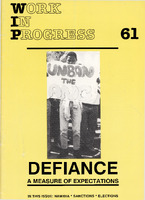 A 53-page issue documenting a "maize of crossroads" for the South African government. Key features include an analysis of the Defiance Campaign and its mass demonstrations, the strategy behind the international sanctions movement, and the upcoming Namibian elections. The issue also critiques the 1989 tri-cameral elections, examines the "anti-LRA" (Labour Relations Act) workers' stay-away, and explores the role of the Democratic Party in parliamentary politics.
 -
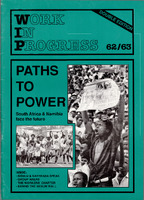 A double edition exploring "Paths to Power" for South Africa and Namibia. Key features include an analysis of the fall of the Berlin Wall, the release of high-profile ANC leaders (Sisulu and Kathrada), and the drafting of the Workers' Charter. It also covers the pre-independence elections in Namibia, the Group Areas Act, the Conference for a Democratic Future (CDF), and a critical look at the privatization of ISCOR and deregulation.
 -
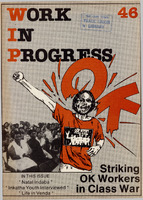 A 48-page issue documenting the ninth month of the State of Emergency. Key features include the clandestine launch of the South African Youth Congress (SAYCO), an interview with the Inkatha Youth Brigade, an analysis of the "whites-only" 1987 election, and a report on the first nation-wide maternity agreement in the metal industry. The issue also tracks the COSATU "Living Wage Campaign" and provides a detailed "Labour Monitor" of strikes at companies like OK Bazaars and AECI.
 -
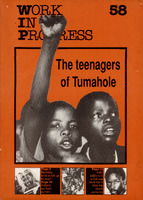 A 35-page issue capturing the peak of mass resistance and legal challenges in the late 1980s. Key features include the "historic" workers' summit aimed at uniting COSATU and NACTU, the Delmas Treason Trial (focusing on ANC soldiers facing the death sentence), the "Broederstroom Three" terrorism charges, and an analysis of the "teenagers of Tumahole" (Parys) and their role in community resistance. It also examines South Africa's maneuvers during the Namibian transition to independence.
 -
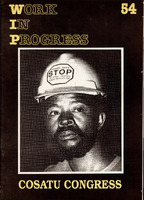 A 37-page issue published under the threat of emergency media restrictions. The editorial critiques Home Affairs Minister Stoffel Botha's "media terrorist" rhetoric and explains the journal's move to thinner paper to maintain its cover price despite inflation. Key features include the 1988 COSATU Congress, the campaign against the Labour Relations Amendment Bill (LRAB), P.W. Botha's "meaningless" reform package, the history of May Day in South Africa, and an investigation into "buccaneering capitalism" in the Beira Corridor.
 -
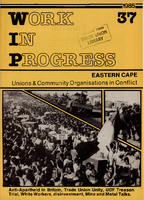 A 47-page issue documenting "rapid realignments" in South African politics during a period of intense recession and revolt. The lead article analyzes the March 1985 stay-away in Port Elizabeth and the resulting conflicts between trade unions (FOSATU) and community organizations (PEBCO/UDF). Other key features include reports on the UDF Treason Trial, British anti-apartheid movements, white worker politics, and the progress of national unity talks between major trade union federations.
 -
 A 48-page issue published during a deepening crisis of "township rule." The editorial reflects on the police shootings in Uitenhage's Langa township, characterizing the situation as a "civil war." Key articles include a critique of the Namibian "Honourable Peace" negotiations, the formation of COAWUSA, a study of the SASOL dismissals, and an analysis of the "Media Murders" (retrenchments at SAAN). The issue also highlights the emergence of a "surprisingly united disinvestment lobby" in the USA.
 -
 A 54-page issue focusing on the regional war in Namibia and the internal political realignments in South Africa. Key articles include an analysis of the war’s impact on Namibian civilians ("Caught in the Crossfire"), the General Workers' Union’s debate over joining the UDF, the SADF's "Civic Action" hearts-and-minds program, and an investigation into the "On the Family" ideology. The issue also tracks legal developments in the "Courts" section, including the treason trial of ANC member Sithabiso Mahlinza (Banda).
 -
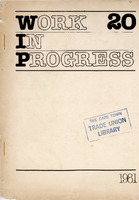 A 47-page issue centered on the state's shifting labor and security strategies. The lead editorial defines apartheid as a "specific option adopted by capitalism to structure production." Key features include an analysis of the "Total War" doctrine, a critical review of the Wiehahn Commission's recommendations for labor reform, a study of strike patterns in the 1970s, and an investigation into the "Babelegi Exploiters Paradise" in Bophuthatswana.
 -
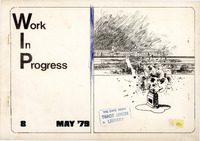 The issue was published on the second anniversary of the June 16 Soweto student revolt. The editorial frames the period as an "intensification of crises" across the sub-continent. Key articles include an analysis of the South African military raid on Cassinga, a theoretical paper on "Classes in Africa," a report on the 1978 Isithebe strikes, and an investigation into the role of NAFCOC (National African Federated Chamber of Commerce) and black business interests in the "separate development" framework.
 -
 A detailed report on the industrial unrest in Isithebe, the 'growth point' of the KwaZulu Bantustan. It contextualizes the 1978 strike within the broader decline of strike frequency in South Africa since the 1973 Durban strikes. The record highlights the shift from purely economic demands to political and ideological struggles (including the 1976 Soweto Uprising and political funerals). It documents the strike involving 1,000 workers that successfully closed all 1,700 factory jobs in the Isithebe industrial area.
 -
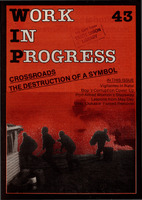 A 48-page issue documenting the intensification of internal conflict under the State of Emergency. The lead article by Josette Cole analyses the destruction of the Crossroads squatter camp by "wit-doeke" (vigilantes). Other reports cover the emergence of Inkatha-aligned vigilantes in Natal, the persecution of ethnic minorities in Bophuthatswana, the launch of UWUSA as a rival to COSATU, and women’s resistance to rape in Port Alfred. The issue also tracks the June 16 stay-away and the sentencing of Helene Passtoors.