
Upbeat Magazine Collection
Item set
- Title
- Upbeat Magazine Collection
- Description
- A series of the monthly educational magazine Upbeat, published by the SACHED Trust. Launched in 1981, the magazine provided a "counter-curriculum" for black South African teenagers facing the limitations of Bantu Education. It integrated academic support (English, Math, Science) with "People’s History," career guidance, and social awareness. The collection documents the evolution of youth culture, student resistance, and alternative pedagogy during the late apartheid era.
- Language
- English
- Provenance
- The item is held at the Cory Library for Humanities Research, Rhodes University, on behalf of the Labour Research Service
- Type
- Collection
- Genre
- Periodicals
- Subject
- Youth—South Africa—Periodicals
- LiteracySee all item sets with this value
- Vocational guidanceSee all item sets with this value
- People's History
- Alternative education—South Africa
- Location - Physical Location
- Cory Library for Humanities Research
- Rights
- South African Committee of Higher Education (SACHED)
- Access Rights
- The materials are made available explicitly for research and educational purposes. Any use of these materials must be cleared with the Labour Research Service
Items
-
 It's that time of year again - exam time! But there's no need to panic. We've got lots of stories to help you get through the exams. Turn to page 22 for some study tips. For those of you doing Geography, don't miss the first part of our new series on mapwork. For history students, there's a story on the vote. Need to find books to help you with your studies? We've got information on how to find books in the library. But there are also stories to enjoy. Read about Prophets of the City, a great new rap group with a message. And don't forget to enter out exciting music competition or our drawing competition on page 25. You could be one of the lucky Upbeat winners! In the meantime, to all of you writing exams, we're holding thumbs. Good luck!
 -
 TB (tuberculosis) is a very serious sickness. It affects your lungs and other parts of your body. About 20 people die of TB every day in South Africa. And every year about 62 000 get the TB virus. In Alexandra township alone, 320 cases were recorded between January and May this year. Four people died from the disease. Doctors and social workers say things like overcrowding, unemployment, low wages and unhealthy dumping grounds cause TB. Most people who suffer from TB are black. Apartheid should be blamed for this. Many organisations, like SAYCO, Cosatu and Earthlife, have started to campaign for a clean and healthy environment. They want people to know how important it is to breathe clean air, drink clean water and eat clean food. We should work with our organisations to save ourselves and others from sickness.
 -
 Two years ago in Lebowa there were no school textbooks. But between March 1986 and September 1989 the Lebowa Education Department paid out R98 million to booksellers for books and stationary. So where were the books? A recent enquiry into the Lebowa Education Department found out that people who worked for the Lebowa Education Department also owned bookshops. These shops received the biggest orders to supply schools with books. But the books never got to the schools. When the enquiry did a spot check, they found 300 000 new books lying unused in storerooms and schools!
 -
 Mbulelois 14 and Adelaide is 12. They live in Pabaleilo, a township outside Upington. They have not seen their mother, Evelina de Bruyn, for more than a year. They would love to see her. But they can't. She is far away in a jail in Pretoria, waiting to die. Evelina was one of the accused in the Upington 25 murdertrial. In May 1989, Evelina, her husband Gideon Madlongolwane and 11 other people from Pabaleilo were sentenced to death for the 'common purpose murder' of Lucas Sethwala, a policeman. The judge said that Evelina de Bruyn did not actually take part in the physical attack on Lucas Setwala. B ut she was part of the crowd that marched on to the policeman's house and killed him. The crowd had a 'common purpose', and that was to kill the policeman. And so Evelina was sentenced to death. Many people think that the idea of a common purpose is wrong. Father Mkhatswa of the Human Rights Commission told Upbeat that people criticise this law because it is so serious. 'In mass funerals or meetings thousands of people come together. When violence starts you can't say that people planned the action. People are angry and upset. Also, how do you decide who was involved? Everyone present cannot be responsible.'
 -
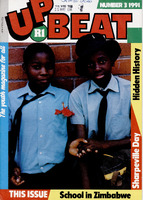 The 21 March is Sharpe- ville Day. On this day we remember what happened in 1960, when hundreds of people in townships all over South Africa marched on to police stations and burned their passes. In the morning of the 21 March 1960, thousands of people gathered outside the police station in the eastern Transvaal township of Sharpeville. They had been told that the police might announce changes in the pass law. At 1.15pm scuffle broke out outside the wire — fence of the police station. The police feared that the fence would collapse under the weight of the crowd. So they started to fire on the people. The people right in front immediately turned to flee, but could not get through the crush of people behind them. Sixty-nine people were killed and a further 180 wounded. Most of those killed were later found to have been shot in the back.
 -
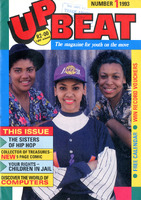 Welcome to Upbeat 1993! A new school year is underway. We all hope that the coming year will bring better things; new friends, an exciting romance, success at school and an end to the violence and uncertain future in our country. We all have it in us to make change to our lives. Listen, learn and ask questions. Don't be left behind because you don't understand. That's the theme of our calendar this year. And it's FREE inside this issue of Upbeat. Our leaders have said that there will be free elections this year. But many people don't know how to vote. Don't be in the dark. Upbeat will be running stories all about voting this year. Don't miss the first article on page 14. For many people the world of computers seems too complicated. In a three part series. Upbeat will tell you all about the exciting world of computers. You could also win a fantastic IBM computer worth R3 000. Discover the world of computers on page 20. And don't miss our great new comic on page 26. Collector of Treasure is a classic African short story by Bessie Flead. It tells the story of Dikeledi, a young woman who lived in a village in Botswana. For many years this story has shocked readers. The comic captures the drama and horror of Dikeledi's remarkable courage. Don't be without Upbeat this year. We've got lots of great new stories lined up. Subscribe or get Upbeat delivered to your school. Find out how to get Upbeat quickly and easily each month, on page 6.
 -
 The two-hour drive from Cape Town to Worcester is long. But it's not boring. You pass green, open farmlands where cattle graze. Every now and then, you cross a river or a stream. In the distance, the purple mountains frame the blue sky. Bree River High School In the valley surrounded by the Hottentots-Holland mountains, you find Worcester. Just outside the town is Bree River High School. Wilfred Zebedezela is a student there. He throws the shotput. He lives on a farm outside Worcester and he travels for an hour everyday to get to and from school. 'At school there isn't a place where I can train with weights, said Wilfred. 'So I build my muscles by doing farm work. I would like to practice shotput at home, but I can't because there is only one shotput at school. I can't practise at school, as there is no teacher to stay behind in the afternoons with me.' Ruduwaan Visagie is a 200 metre sprinter. 'We can't afford things like starting blocks. We ran in the South African Junior Athletics Championships. But some of our athletes almost couldn't take part. We didn't have starting blocks. Fortunately, we managed to borrow some.'
 -
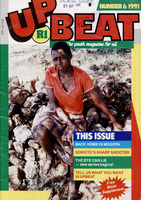 The people of Paballelo in Upingtonhadabig party. They started celebrating on Thursday 30 May and they carried on right through the week-end. They were happy because their friends were home, home from death row in jail. Perhaps some readers will remember reading a story in Upbeat last year about Evelina de Bruin. She was one of the people from Upington on death row. She was also one of the people set free on the 30 May. The first thing that Evelina did when she stepped out of prison was to hug her children that she had missed so much. 'I feel the same now, seeing my children as I did when I saw them for the first time as newborns,' said Evelina. Next Evelina gave her husband, Gideon Madlongwane a big hug. Gideon had also just been freed from death row. Evelina still says she was innocent. 'I heard about the death of the policeman while I was doing my washing,' said Evelina. 'I was shocked when I was arrested. But I was not afraid. I knew Gideon and I had done nothing. I never dreamt that we would spend three and a half years in jail.' Evelina's lawyers are happy and angry. They feel that she shouldn't have gone to jail in the first place. But they are happy that their appeal against the death sentences of the 14 people from Upington has been overturned.
 -
 Richard is in Std 9. He sits in the same row as Thabo and Mike. They are his great friends. Every day at break they sneak out the schoolyard to go and smoke dagga. Richard doesn't like smoking. He wants to say no. But he is scared his friends won't like him if he does. He doesn't want to risk that. These are his chommies! They all watch soccer together and share secrets about girls. Maybe you find yourself in Richard's position. You are also too scared to say no to your friends. Try to be brave and stand up for yourself. Tell your friends that you don't want to smoke, because drugs are harmful. You may be surprised to find that someone else in the group agrees with you. He was just too scared to say so. Or maybe your friends will cut you out. You'll feel lonely for awhile but others will come to respect you. We all look up to people who make a stand. It is hard to go against your friends. But you must learn to do what's right for you. Arm yourself with information. Read, listen and learn. Then make your choice. Upbeat is filled with important information to help you make decisions about your life. In this issue read why Prophets of the City say No to drugs. Don't miss our hot debate on sex education. We've got information on AIDS. So tell your friends about it and help stop the disease spreading. We all love listening to music. But do you know how a record is made? Find out all about the recording industry on page 17. That will really impress your friends! When they look surprised and say 'how do you know all that', just say you read it in Upbeat. You'll be a winner at parties.
 -
 Conflict is OK. Violence is not! You can disagree with someone else's views. But you can't punch them! Conflict is a normal part of life. We are all different and want different things. As a result we often fight with the people around us - our family, friends and neighbours. You like rap but your boyfriend likes disco. You want to go out but your mom says stay at home. Every day Upbeat receives lots of letters from our readers. Many of the letters are about violence. There are stories about violence in the street and poems pleading for peace. There are letters seeking help in solving battles with boyfriends and parents. Readers tell us frightening tales about violence between gangs at school and students who hold different political views. The problem seems too big to solve. You may think our leaders should sort it out. But we can all do something to help build peace in our country. In this issue we start an exciting new series called 'Be a peacemaker'. It is about how to tackle conflict without screaming, blaming or punching the person you are fighting with. Learn to be a peacemaker at home, school and in your community. YOU can make a difference. You can't avoid conflicts in your life. But you can learn to 'fight fair'. Don't forget! If you have ideas that you want to share or a story to tell - write to us. If you need advice on careers or sex education - let us know. Sometimes all it takes is a little bit of advice and information to make you feel better and get you on the move again.
 -
 On the night of the 8 March 1991, a thousand women braved the rain to march through the streets of Johannesburg. They chose this day for their protest march because the 8 March is International Women's Day. The women marched to highlight the problem of violence against women. They said that women are not safe on the streets at night. Many women are not even safe in their own homes! The night they marched about 140 women were raped in South Africa between six and nine o' clock. Many women were beaten and raped in their own homes, some were hurt by their own husbands or boyfriends. 'We want to feel safe in our own homes, at work and in the streets. We demand an end to violence against women,' Monique Marks of the ANC Women's League said. Copies of the demands were sent to the Chief Magistrate of Johannesburg, the City Council and Health Department.
 -
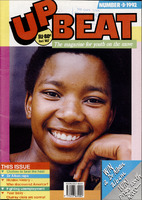 There are two sides to every story. You've surely heard that before. Well, it is true. Sometimes there are even three or four sides to a story. It depends how many people were there to tell the tale. Behind every story there is a writer. Behind a picture there is a photographer. And they are ordinary people, like you and me. They eat, sleep and play like the rest of us. Like us, they have their own ideas and feelings about the world. And these ideas show in their stories, books or photographs. So what you read is not the truth. It is someone's version of it. Always read with an open mind. Be a detective when you read! Ask questions, think, search for clues and weigh up the facts. Then decide for yourself which story comes closest to the truth. You must have learnt about Christopher Columbus at school. Well there's another side to that story in our article called 'Who discovered America?'. Read it and decide what YOU think really happened. Upbeat writes a lot about young peoples' experiences of growing up. There's another side to being a teenager - being the mother of one. Nomasondo Hadebe openly shares with us the pain and joy of having teenage children. We don't only learn from grown-ups or famous people (or both). Upbeat is full of stories about youth, their ideas and feelings about the world. By sharing experiences, problems and ideas we can learn from each other. So don't miss our letters page, advice column and talkshop. Read what young people have to say. You can agree or disagree with their ideas. And when you close the magazine you may feel a little sadder, happier or angrier. But you will always be wiser
 -
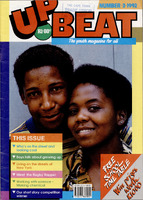 Teenage life is full of challenges.' That's what Ebrahim Abader from Cape Town thinks. He's right. When you are young there is lots to learn and discover about yourself and the big world out there. It's exciting! But it can be a miserable time too. It is not easy to meet a challenge when you are worried about pimples, can't do your maths and are suffering from a broken heart. You are special but you are not alone. Young people all over the world are probably going through what you are. Believe it or not your parents and teachers where once teenagers too. Ask them what it was like. There is a big challenge facing all of us, especially young people in South Africa today. We have to learn to live together; to accept differences and respect one another's feelings and beliefs. It is called tolerance! Your parents, brothers, sisters, comrades, neighbours and friends have their own ideas. Listen to them with an open mind. In this issue you can read about a great school in Tongaat in Natal. Here students have learnt to forget about colour and together are discovering what real learning is all about. Meet Simon Nkoli. He knows what it's like to be treated unfairly and to grow up feeling different and alone. So readers, speak out, listen, read and learn. That's the way to get wise. That's the way to meet the challenge of being a teenager in South Africa today. Some of you may be writing supplementary exams. Go for it - you can do it this time! We are holding thumbs.
 -
 It's tough being a teenager. There's pressure from all sides - your friends, parents and teachers. You've got lots of questions that no-one will answer. If you want to get on top of your world, don't be without Upbeat in 1992. This year Upbeat is bigger, brighter and better than ever. There are more pages, more competitions, music and fashion. And the good news is you can find us everywhere - on the street, in your corner shop or in the CNA. We also have special offers for teachers and students. Subscribe before April and you could win prizes worth R1 000. Upbeat also helps you with your school work. But it's not like learning in school. This is learning with a difference. We open your eyes to the world around you. In this issue we'll take you to a night club in Cape Town where everyone is 'hipping and hopping.' Meet a young girl in a faraway land, most of us know nothing about - Pakistan. For comic lovers there's our action packed comic 'Taxidriver'. Follow the adventures of Kabu a taxidriver from Sekhukhuneland in the Transvaal and learn all about South Africa in the 1950s. It's a great way to learn history! No issue is too hot for us to handle. In this Upbeat young people share secrets about their relationships. Our advice page answers your questions on sex education and careers. We believe young people in this country need a voice. Each issue is packed with poems, stories, news and views of young people around the country. So here's your chance to tell the world what you think, express your true feelings in a poem or ask those questions grown-ups don't like to answer. Write to us, it is your magazine. Upbeat is for teachers too. Lots of teachers around the country use Upbeat to promote a different kind of learning in their classes: learning that gets students thinking, helps them understand their world and most of all that's FUN. Read how Mrs Naylor a teacher from Cape Town uses Upbeat with her students. Finally, did you know you have rights? The right to be heard is just one of them. The Rights of Young People is the theme of our calendar this year. And it's FREE in this issue for you to put up on your classroom or bedroom wall.
 -
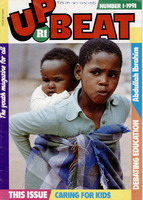 Every day we see adverts in newspapers and magazines encouraging people to smoke cigarettes. But what these adverts don't tell us, is that smoking cigarettes is very dangerous. Today there are 75% more smokers worldwide than there were 20 years ago. Doctors in America are very worried about the damage smoking can do to one's health. They say that smoking is responsible for almost 2.5 million deaths every year. More and more children are starting to smoke cigarettes. Doctors say that millions of children under the age of 20 could die of smoking.
 -
 Where is Maputaland? It is in Northern Kwazulu/Natal. For many years, the government ignored far away places like Maputaland. The roads are terrible and there are few buses. People must walk a very long way to get to a clinic or a shop. The people of Maputaland wanted to solve their transport problem. So they got together with the Khuphuka Skills Training and Employment Programme. Khuphuka is training local people to build drains, roads and bridges. In the Ingwavume and KwaNgwanase districts, 36 young men and women are training to be team leaders. While they work, they are being taught all about how to build roads. When they graduate from the course, they will supervise other trainees. The project is part of the Reconstruction and Development Programme and is co-ordinated by the Department of Public Works.
 -
 Lebogang Tsotetsi is 18 years old. In October last year she wrote us this letter: 'I am a very lonely 18-year-old girl. I am HIV positive.' In response 287 Upbeat readers wrote to her, offering support and friendship. We at Upbeat were impressed and touched by Lebogang's courage and by the warmth and kindness of so many of our readers. Now Lebogang has written an open letter to all Upbeat readers. Read about her experiences and hopes for the future on page 28. What else is there in Upbeat? There is lots to learn about. When lightning flashes across the sky, is it safe to hide in a taxi? Find the answer in our science story. What was it really like to live and work on a Gold mine 100 years ago? Why did some people get rich while others suffered great hardship. Don't miss our history story on page 8. Teachers don't forget our special Teacher's Guide, with each issue of the magazine. Our easy-to-follow lesson plans will bring fresh ideas to your classroom. Enjoy reading and learning with Upbeat!
 -
 School is out! Christmas is around the corner. So put up your feet and enjoy your well-earned holiday break. And don't be without Upbeat. This issue is packed with great holiday reading; quizzes, holiday places to visit, cassettes and books to win. Boys move over! There is a new soccer wizard, to make you tremble in your boots - HER name is Fikile Sithole. Meet her on page 8. There's also lots of great music in this issue. There's a poster of all your local favourites on page 20. But also learn about the golden oldies, who had your grandparents up and jiving. We hope you like our FREE Peace Begins with you' poster. Read it, talk about it and put it up on your wall. We hope the ideas help to bring a little peace, into your neighbourhood and home. Hundreds of readers wrote to us this year. Many letters were about violence; in the street, at home and in school. The terrible violence this year brought pain and suffering to many people. For too long apartheid has destroyed people's hopes and dreams. We want peace and democracy in our land. We want proper schools, were all young people can enjoy learning. Thank you for supporting Upbeat this year and for filling our pages with your wonderful poems, letters, stories and ideas. We wish all our readers a happy and peaceful holiday.
 -
 It's the end of a big year for all South Africans. April saw all of us rejoice and celebrate as Nelson Mandela became the first president of a free South Africa. But it has also been a difficult year. 'What's the use of freedom if our daily lives are ruled by guns?' This issue is explored in our feature 'Guns - what's to be done?' on page 4. But the youth of our country continue to believe in the future. Read about how young people in Wattville, are using their talents to brighten up their own neighbourhood on page 30. Now it's holiday time and Upbeat is packed with fun reading, games and lots of information on great holiday reads. So put up your feet and enjoy your well earned break. We wish all of you a happy and peaceful holiday. Thank- you for your support in 1994.
 -
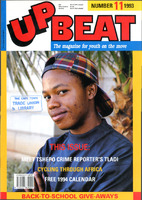 Christmas is around the corner and it's holiday time again. So grab your Upbeat, put up your feet and enjoy your well- earned rest. This issue is packed with great holiday reading. Meet Mignon - the muscle maker, discover Africa's music queens or find out about a great new book to read. In our comic, The Galaxy Arcade Kids, Nomonde finds herself in trouble. Don't miss it. In this issue you will also find your FREE 1994 calendar. It is bright and colourful and its message is for peace and democracy in 1994. Upbeat believes that learning should always be fun. Find out about a great new Upbeat product on page 17. Once you see it, Africa will never be the same again! We wish all our readers a happy and peaceful holiday. During the last week of September, Upbeat together with the Weekly Mail Book Week and Film Festival, ran workshops. We went to Daveyton, Eldorado Park and Othandweni in Soweto. In the workshops students learnt how books are used to make films. Everyone was divided into groups and given a book to dramatise. With help from the Sibikwa Community Theatre Project and Soyikwa Institute for African Theatre, the groups prepared dramas which were filmed. Mrs Simelane, a teacher from one of the schools in Daveyton, said, 'I did not know that my students had such talent. This has truly been an eye- opener for me. I hope that you will run workshops next year so that more of our students can take part.' Students all agreed that the day was great fun. Everyone received a book pack at the end of the day. Now they are waiting to see the final product of their efforts once the film has been edited.
 -
 This month we decided that it is time to turn our attention to the male sex. In Talkshop we discover that boys do worry about their images and their bodies but not always in the same ways that girls do. For some light relief from exams read how Mbaqanga artist, Phuzekhemisi got his unusual name. And for something more serious, Upbeat looks at constructive ideas from unemployed youth groups. Flow can young people gain the skills needed to put their good ideas into action? When you've read the article on unemployed youth, write and tell us about your own ideas for projects in your areas. Upbeat plans publish articles about how our readers are helping with reconstruction and development. December 1 is World AIDS Day. The theme for this year is: AIDS and the family. This is a day for people to remember those who have died of AIDS. It is also a time to support people who have AIDS or who have lost a family member because of the disease. AIDS Day offers families who are supporting AIDS sufferers a chance to plan together. It is a time for them to work out how to support and help brothers, sisters, parents or others who have AIDS. The day is especially important for families who have been separated by migrant labour, violence and poverty. Look out for special events in your area on World AIDS Day.
 -
 Upbeat is on the move. This month we visited the Northern Cape. It is a big, dry province with high unemployment. It is also the place where a group of conservative Afrikaners are trying to keep apartheid alive. But Northern Cape Premier, Manne Dipico, is a tolerant and clever leader. Find out how he handles the right-wingers in his province on page 8. There's been a lot of news lately about conditions in South Africa's jails. Even the Minister of Prisons was shocked when he saw the damp, dirty cells in some jails. Will something be done to improve the situation? Upbeat will keep readers informed. Meanwhile, where can young people who are awaiting trial, be held in safety? We visited Meritum near Krugers- dorp to find out. (page 28) Are you reading Upbeat's business economics articles? In Upbeat No 8, we will publish all the questions that you need, to enter our bumper money competition. And if you follow the Living Trees articles (page 20), you might win Upbeat's biggest-ever prize, a tennis court or soccer field for your school! Good luck!
 -
 On 9 August every year, the people of South Africa celebrate Women's Day. We do this to remind the government that women should enjoy the same rights and opportunities as men. And we celebrate Women's Day on 9 August for a special reason. On 9 August 1956, 20 000 women from all over South Africa gathered at the Union Buildings in Pretoria. Led By Lilian Ngoyi and Helen Joseph, women came to protest. They were angry because the government was trying to force women to carry passes and control their movements. They told the Nationalist Prime Minister, Strijdom, 'You have tampered with the women. You have struck the rock.' The women lost their struggle. But every year we remember their bravery. And every year we pledge ourselves to fight, so that women are treated as equals in our country.
 -
 Stanley ran away from home when he was a little boy. He lived on the streets. He took drugs and ended up in jail. That was two years ago. Today he has a job as a painter. Stanley feels hopeful about the future. Kathleen was 13 when she left home to live on the streets. Today she is doing a cooking course and has moved in with her aunt in Mitchell's Plain. This issue of Upbeat is full of stories of ordinary people who have done extraordinary things. You will meet people like Kathleen and Stanley who are determined to make something of their lives. There's Gary Donnelly who is the youngest player ever to play for the NSL. He says that there is no magic in being a sportsman. It's just practice! Meet Jac Fourie from Pretoria. He was chosen to attend the International Space Camp in Alabama, USA. What an experience! If you live in Phiri in Soweto you have probably heard of Soso's Hair Salon. It is run by the amazing Sonki Nkwane. Five of his hairdressers, are friends who are still at school. All these young people have one thing in common. They are on the move! They want to challenge and change things. They want to learn and search for new opportunities, that will make a difference to their lives. Happy reading!
 -
 In April, the Institute for Multi-party Democracy organised a debate. Young people from the Democratic Party Youth, the ANC Youth League, the IFP Youth and Aisec discussed howto protect youth rights. Neville Naidoo of the ANCYL argued strongly for a youth ministry. He said that, in the past, each government department received money for youth development. The youth had no control how this money was spent because it was spread over so many different departments. Neville said that all money for youth development should go to one Youth Ministry. The Youth Ministry would then make sure that the money was spent where it vtas needed most. The DP youth said that a ministry would cost too much money. They argued for an independent national youth council made up of youth organisations. They said the council must protect youth rights and see to youth development. No agreement was reached but everyone enjoyed themselves. There was lots of laughter and shouting. Hopefully, we will be able to debate many issues in the same, friendly atmosphere.