
Worker Tenant
Item set
- Title
- Worker Tenant
- Description
- A grassroots serial publication/magazine focused on the intersection of labor rights and housing struggles in South Africa. The publication served as an ideological bridge between trade unionism (the "Worker") and community/civic struggles (the "Tenant"). It frequently analysed "Total Strategy," the JMC system, and the necessity of working-class leadership in the national liberation struggle.
- Date Issued
- c. 1984 – 1989
- Language
- English
- Type
- Collection
- Genre
- Periodicals
Items
-
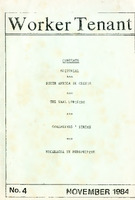 1984 has witnessed an intensification of the world economic crisis which began 10 years ago and with it a heightening of the class struggle world-wide. So extreme has the recession become that banner headlines liken it countless times to the first capitalist crash of 1929. Not even the USA's conjunctural boom can act as any respite to its own working population or to those of the other nations linked inexorably in the Imperialist chain. In America capitalism can boast an increase in profits of up to 50% for 1984 and the truth is that this has been achieved by depressing the value of wages below the inflation rate since 1981. For Latin America, America's boom has brought nothing but greater hardship as she reels under the economic burden of increased indebtedness, exacerbated by the soaring interest rates in the USA. Caring little for traditional blood-ties America intensifies the death throes of her oldest rival - Britain. The buoyant dollar has suppressed confidence in sterling, pushing up the cost of credit and thus discouraging capitalists from investing. The threat of this ruthless business sense has expressed itself in the most tenacious struggles on the part of workers to defend their right to work. In South Africa, hopes of an export-led recovery have been shattered by greatly diminished exports from the drought striken agricultural sector, and the costly importation of heavy machinery from America and Japan where the rand finds very little in exchange. This then is the meaning of America's boom. In a period of rapidly declining capitalism, there can be no talk of a protracted boom which brings about general social upliftment, but only an intensification of the most nationalisic throat-cutting and the immiseration of large sections of the working class.,No. 4
 -
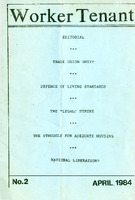 A Marxist-Leninist serial publication analysing the socio-economic crisis in South Africa during the early 1980s. Key topics include the necessity of trade union unity, a critique of "reformist" union leadership, the failure of the "legal strike" mechanism, and an analysis of the state's 1983 housing policy (the "sale of houses" campaign). The magazine argues for a "United Front" of workers and tenants to defend living standards against "Apartheid Capitalism."