
National Union of Metalworkers of South Africa (NUMSA) Collection
Item set
- Title
- National Union of Metalworkers of South Africa (NUMSA) Collection
- Alternative Title
- NUMSA Collection
- Description
- A comprehensive archival collection documenting the history, policy-making, and industrial actions of NUMSA. Formed in 1987 through the merger of several unions (including MAWU and NAAWU), NUMSA represents workers in the auto, motor, metal, and engineering sectors. This collection features National Congress resolutions, industry-level collective bargaining agreements, shop steward training manuals, and gender committee reports, reflecting the union's commitment to a "socialist orientation" and worker control.
- Date Issued
- 1987-
- Language
- English
- Type
- Collection
- Subject
- National Union of Metalworkers of South Africa (NUMSA)
- Labour unions--South Africa
- Metal-workers—South Africa
- Automobile industry workers—South Africa
- Collective bargaining—South Africa
- Industrial relations--South Africa
- Anti-apartheid movements
- Trade unions — South Africa
- Rights Holder
- National Union of Metalworkers of South Africa
Items
-
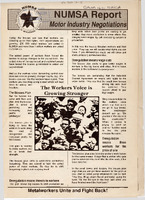 Today the bosses can see that workers are standing up for their rights. Their organisations are growing. 230 000 metal workers are united in NUMSA and more than 1 million workers are united in COSATU. The united power of workers have forced the bosses to accept changes to the vicious LRA. The united voice of the oppressed and exploited people have forced the bosses government to unban our organisations. And so the workers voice demanding control over their own lives is growing stronger day by day. The bosses can see that the workers have a plan. That workers are marching along a road which will lead them to victory and freedom. But the bosses too come with their own plan. And the bosses plan is aimed at protecting and increasing their profits and priviledges. The bosses plan is trying to force the workers to walk along the road of deregulation and increased profits for the bosses. This plan is seeking to divide workers and so to break their strength. The bosses plan aims to undermine centralised bargaining. They are scared to face the united power of motor workers. So they try to shift bargaining to plant and company level.
 -
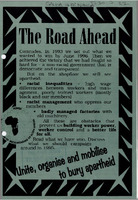 Comrades, in 1993 we set out what we wanted to win by June 1996. Then we achieved the victory that we had fought so hard for - a non-racial government that is democratic and transparent. But on the shopfloor we still see apartheid: racial inequalities - high wage differences between workers and management, poorly trained workers (mostly black and our members) racist management who oppress our members, badly managed factories with S old machinery. All these are obstacles that prevent us building worker power, worker control and a better life for all. Read what we have won. Discuss what we should campaign around in 1995.
 -
 A comprehensive report prepared for the NUMSA National Gender Conference in 1998. It evaluates the union's progress on gender equality since 1993, specifically regarding maternity rights, childcare, and women's leadership. The document identifies major obstacles, including the rejection of a quota system, lack of gender sensitivity among male negotiators, and the absence of disaggregated data on female membership. It proposes a "Gender Analysis" framework and recommends integrating gender into shopsteward training and collective bargaining structures.
 -
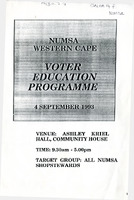 A resolution from the September 1993 Western Cape congress detailing NUMSA's political strategy for the 1994 general elections. Key points include: 1) Formal support for the ANC in the elections; 2) Affirmation of COSATU’s independence from political parties and the post-apartheid state; 3) A demand for restructuring the Tripartite Alliance to ensure a "bottom-up" mandating process and regular report-backs; 4) A commitment to intensify voter education and leadership development to ensure workers' interests influence political negotiations through COSATU.
 -
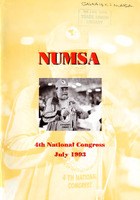 Records of the Fourth National Congress of the National Union of Metalworkers of South Africa (NUMSA), held in Johannesburg from July 1–4, 1993. The congress was attended by 773 delegates representing all 11 NUMSA regions. This congress was a turning point for the union’s political policy, featuring the election of new national office bearers and critical debates regarding the Tripartite Alliance, the "Worker’s Charter," and the union's stance on the upcoming 1994 general elections.