National Union of Metalworkers of South Africa (NUMSA) Collection
Item set
- Title
- National Union of Metalworkers of South Africa (NUMSA) Collection
- Alternative Title
- NUMSA Collection
- Description
- A comprehensive archival collection documenting the history, policy-making, and industrial actions of NUMSA. Formed in 1987 through the merger of several unions (including MAWU and NAAWU), NUMSA represents workers in the auto, motor, metal, and engineering sectors. This collection features National Congress resolutions, industry-level collective bargaining agreements, shop steward training manuals, and gender committee reports, reflecting the union's commitment to a "socialist orientation" and worker control.
- Date Issued
- 1987-
- Language
- English
- Type
- Collection
- Subject
- National Union of Metalworkers of South Africa (NUMSA)
- Labour unions--South Africa
- Metal-workers—South Africa
- Automobile industry workers—South Africa
- Collective bargaining—South Africa
- Industrial relations--South Africa
- Anti-apartheid movements
- Trade unions — South Africa
- Rights Holder
- National Union of Metalworkers of South Africa
Items
-
 The idea of developing Research Groups in NUMSA was agreed to within the Education Programme for 1989. The areas of research emerged from the organising sectors of the union. This link between research, education and organisation was seen to be very important. The experiment has been very successful and could point the way to a successful research method for many other projects. The research groups have effectively combined academic researchers, service organisations and worker leaders. This has proved a powerful combination. The basic idea was that a small group of between 10-15 people from within NUMSA would work with outside researchers on certain key areas. The task of the group was to identify problems and a framework of proposals for how NUMSA could deal with the issues. These recommendations then went to the organisational structures for discussion and endorsement. Once endorsed it became the task of: organisational structures to carry out the implementation of the proposals through collective bargaining and campaigns. Education to educate and train people within the unions on these issues. Education would work with the research groups in doing this. the research groups to continue research if necessary. It is also our aim to link these research groups to study tours to other countries so that we can make comparisons.
 -
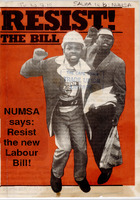
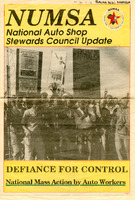 During July and August this year, the united mass action of 25 OOO auto workers forced the bosses to negotiate nationally. Large demonstrations of workers demanding national negotiations marched and toyi-toyied through the plants. But auto workers also gave their bosses another strong message. United and strong, marching with large banners and replica AKs, workers were unbanning the ANC and flying high the red flag. Workers demanded the release of Nelson Mandela and all political prisoners. They said all hangings and political trials must stop. Workers demonstrated against the LRA and all other apartheid laws. Workers wanted their bosses to be clear. The bosses must know that the mass defiance campaign in the factory is part i of the struggle of the oppressed and exploited masses. When we are demanding better working conditions today, when we are unbanning our organisations through mass action today, we are demanding at one and the same time, control over every aspect of our lives in the factory and in the townships where we live. Our struggle for freedom is one struggle.
 -
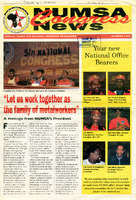 From the 25 to the 29 September, NUMSA held its Fifth National Congress. Seven hundred and sixty-two delegates came from all our locals. They had prepared well. We saw from the debate. I was afraid before the Congress. I was not happy. 80% j of the shop stewards you elected in 1996 were new. I thought the level of debate at the Congress was not going to be high. But I was wrong - the level of debate was high. We must be proud of ourselves. Thank you for mandating your representatives to Congress - that is what we mean by worker control and democracy. We are doing our work under different conditions compared to before April 27, 1994. We have a democratically elected government in place. It is not as hostile as its predecessor. But the reality of the situation is that as workers in the workplace, nothing has changed. Management is coming to us with new ideas like kaizen, team-work, etc. These are all about eliminating waste. They define waste as anything that is not absolutely essential to production. They want to get to the lowest levels of inputs, equipment, material and workers. This means more and more control over workers' time and activities, a faster workplace, longer and more irregular hours. They standardise jobs and make the workplace more regimented. So we have to focus our efforts collectively on our “core business†- to represent our members effectively. We have to fight for job security, training, technical skills and better increases. We have to do all these under difficult conditions, for example, reduction of tariffs to conform with the requirements of the World Trade Organisation. We do not want the country's economy to be cushioned forever but the drastic restructuring results in job loss and factory closures. We must have an alternative in place to ensure that people do not once more swell the swollen ranks of the unemployed. Work organisation is taking place in different forms in different workplaces. We are involved in these processes. I know that when shop stewards give report backs and persuade members to accept certain things in exchange for job security, members tend to regard them as management stooges. We mustn't think like that. It is causing division amongst us. Outside the workplace, the balance of forces is not in favour of the working class for reasons that we all know. We must work together as workers, shop stewards, administrators and organisers to build our Union into a coherent vehicle. Only a strong vehicle can play a leading role in freeing our people economically. Let us work together as the family of metalworkers!
 -
-
-
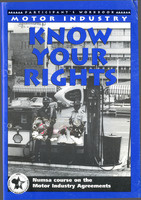 Industrial Councils were established in terms of the 1924 Industrial Conciliation Act (ICA). Even with the ICA giving way to the LRA of 1956, Industrial Councils remained the central forums for collective bargaining. Because African workers were excluded from the definition of an "employee" both in the ICA & LRA of 1956, African workers and their unions did not participate in Industrial Councils. As a result of this the.Councils were then used by white unions to promote the interests of skilled white workers. This situation only partially changed in 1979 when the LRA was changed to give African workers bargaining rights. From then on African workers and their unions could participate in Industrial Councils.
 -
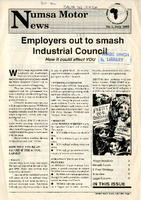 WHILE wage negotiations with employers are deadlocked, there are more serious rumours that some employers are trying to smash the Motor Industrial Council and so break down centralised bargaining. They are acting just like other employers and the government who want to destroy centralised bargaining. They see it as a way to weaken the power of workers. COSATU decided early this year to fight against these moves. NUMS A is committed to centralised bargaining. It bargains centrally in all the industries where it organises - motor, auto, engineering and tyre. The collapse of the IC in the motor sector would encourage employers in other NUMSA industries to smash the other central bargaining forums. This would defeat all the gains we have made over the years. Motor workers must lead the way in squashing employers' wishes.
 -
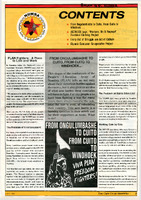 In Namibia today the National Union of Namibian Workers (NUNW) says that the organised labour movement must play an active role in helping PLAN fighters and the war refugees, to find somewhere to live and to find work. They say: "All these people are the relatives of us who remained behind. Together we must look at what our needs are in the communities where we live, and find ways of meeting our needs. " We must use the skills of the combatants to help the community and the community in their turn, must welcome all those people back from the war. The organisations of the people, the trade unions and SWAPO, must help in this process." How can the NUNW help all the people returning from the war to find their place in the community? The NUNW says we need to first understand the strengths and weaknesses of the people and the country.
 -
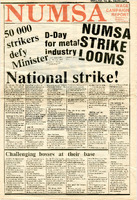 ON 14th July 1987, for the first time in South African history, there was a national strike in the metal industry. About 350 factories stopped work all over the country in support of the NUMSA demand for a living wage. Metalworkers voted overwhelmingly for strike action in the national ballot that was conducted between 6th and 8th July. The strike was set for the 14th July. Workers were ready to fight SEIFSA until they won. The militancy of workers could be seen from the huge attendance at local meetings. During the week of the ballot shop stewards were gathering in huge numbers in the union offices to discuss problems and plan strategy. In the Eastern Cape a general meeting of over 400 workers was held to discuss plans.
 -
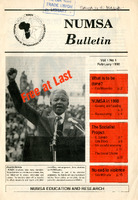 NUMSA structures take many decisions. These decisions are not taken in isolation, they are influenced by events, information and debates. The decisions taken will be found in the official documents and reports of NUMSA committees and congresses. These decisions are NUMSA policy. However, as part of the education programme, the Bulletin will carry background articles. These articles are not policy but are part of the educational resources of NUMSA.
 -
-
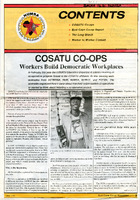 In February this year the COSATU Education Department called a meeting of co-operative projects linked to the COSATU affiliates. At this meeting were comrades from ACTWUSA, NUM, NUMSA, NUWCC, and POTWA. The comrades explained how it came about that their union started co-operatives or started to think about initiating a co-operative project. SAWCO was formed in 1985 after the mass lockout of 960 Sarmcol strikers. 1987 was the year of the miners strike and saw one of the biggest strike waves in the history of the our country. On the mines, the bosses of Anglo fired more than 13 000 workers. More than 3 500 POTWA members were dismissed by the government bosses of the post office. But not all projects started because of mass dismissals through strikes. In 1986 a bulk buying project was formed by union members at the General Motors Engine Plant in Port Elizabeth. They took their initiative back into the union for discussion. Towards the end of 1986 ex-NAAWU was looking at how to use the organised strength of the union to the benefit of members outside the shopfloor. Today, in NUMS A, the union is in the process of establishing a giant consumer co-operative, Siyanda, which means, "we are growing". In 1985 ACTWUSA vowed that it would never accept any retrenchment package from Frame that would result in workers losing jobs. And so in 1988, ACTWUSA negotiated a retrenchment package with the Frame bosses. The agreement said that the Frame company would provide the money to start a factory which would be owned and controlled by the union and which would provide jobs for the retrenched workers.
 -
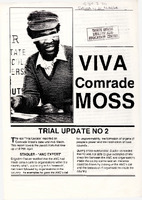 The last 'Trial Update" reported on Comrade Moss's case until mid-March. This report covers the period from that time up until 25th April.STADLER - "ANC EXPERT" Brigadier Stadler testified that the ANC had made certain calls to organisations within the country which, according to his "research", had been followed by organisations in the country. As examples he gave the ANC's call for ungovernability, the formation of organs of people's power and the destruction of town councils. During cross-examination Stadler conceded that he was not able to give examples of any direct link between the ANC and organisations inside the coutry but he said an inference could be drawn by looking at the ANC's call and the behaviour of organisations inside the country.
 -
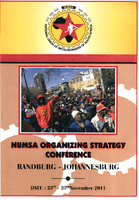 A strategic framework developed for the NUMSA Organising Strategy Conference held in Randburg, Johannesburg, November 23–25, 2011. The document integrates organising, campaigning, and bargaining into a unified "OCCB Strategy." This third draft incorporates feedback from the 2010 National Workshop and the 2011 Central Committee, as well as international benchmarking lessons drawn from a study tour of North American (Canadian) labour movements by the General Secretary and sectoral coordinators.
 -
 Numsa's Special National Congress convened from December 17 to December 20, 2013. It was attended by 1,200 delegates representing 338,000 metalworkers from 50 Locals throughout the provinces of South Africa. Numsa was proud to announce in the Congress that it is the biggest union in the history of the African continent. In the last 17 months, since our 9th Congress in Durban, we have grown from 300,000 members to 338,000 members. We are ahead of schedule in our goal to organise 400,000 workers by the time of our 10th Congress in 2016.
 -
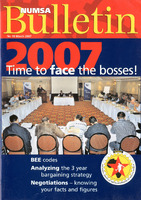 Numsa's National Bargaining Conference is almost upon us. Wage negotiations in all Numsa's sectors will start from May. Bargaining is the focus of this Bulletin (pages 12-28). We give you some basic facts and figures to arm yourselves for centralised bargaining. We also include information on the new black economic empowerment (BEE) codes as well as employee share ownership schemes (esops). You will need this information to negotiate in your own companies. Division rocked the Cosatu congress last year. Woody Aroun summarises a paper of Joel Netshitenzhe on the issue of factions within organisations while Alex Mashilo gives his own views on how to deal with them. Cosatu's recent Central Executive Committee analysed the current political conjuncture. See if you agree with it and prepare yourself for the challenges that face you in a year in which both the SACP and the ANC will be holding key conferences. What do you think of Desai's challenges to Cosatu? Are you up to them? Take yourself through Enver Motala's piece on education. Did your schooling give you these critical skills? Are your children getting these skills from their schools? Are Numsa's education courses helping you to grasp those skills that you didn't get at school? And what about education and training at work - are these filling the gaps in your education?
 -
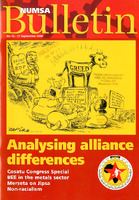 An annual Numsa Bulletin seems to be becoming the norm! However our aim is still to bring them out more often. Cosatu Congress is the focus for this Bulletin (pages 17- 39). We assume that you have Cosatu's resolutions and secretariat report so you will not find them here. We have instead included other background documents and articles that we think will help comrades debate resolutions in the September Congress. read the different understandings of the NDR by the alliance partners (page 18) how should we judge the actions of a developmental state (page 20) how Cosatu's jobs and poverty campaign can learn from Spain (page 23) understand what the Financial Sector Charter is all about (page 26) But there is much more to read - read the contributions from readers (pages 8-15), decide which brand of feminism you support (page 48) and do the test to see how gender sensitive you are. Learn tips from Aubrey ka Saki on how to avoid the VW- type situation (page 51) and absorb the findings of BEE research into Numsa-organised companies (page 55). How does your company compare? Do you have Esops in your company? Should Numsa adopt Esops as a way of going the BBBEE route or is it too risky? Study how the Merseta plans to complement Jipsa and how Bolivia is nationalising its hydrocarbons sector (despite a few hiccoughs!) Look at the glossary for definitions of those long words that always pop up at congresses and add words that are troubling you to it.
 -
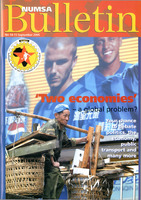 It is a year since the last Numsa Bulletin was published in September 2004. Last year Numsa's educators forum discussed how we could use the Numsa Bulletin more effectively. Included in this Bulletin are a number of topical issues that challenge you to debate issues at your local shop steward councils or your workplaces: If you are violently opposed to GEAR, have your views challenged by Motlanthe (page 14), Get your local to analyse what was agreed in the Alliance Summit earlier this year and give your score on whether you think the Alliance has met its targets (pages 22-23). Debate differences between the ANC's NGC document on two economies and Cosatu's response (pages 24-27). If you are an engineering shop steward in Middelburg, Witbank, Vanderbijlpark, Richards Bay, Pietermaritzburg, Vereeniging, then force a debate on the slow integration of House Agreements into the Main Agreement (pages 40-41). If you are an auto shop steward, then read Dumisa Ntuli's ideas (pages 42-44) on the shortcomings with black economic empowerment initiatives in the auto industry and debate the issues in your local/workplace. When was the last time you briefed members in your workplace? Do the organisational test on page 49 and see if you are up to the job. If you fail, redeem yourself by reading the health and safety, training and education sections and then debating and discussing the contents with your fellow members.
 -
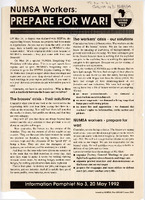 This archival document is an "Information Pamphlet" issued by the NUMSA head office in Johannesburg during a period of intense industrial unrest in South Africa. The record captures the escalation of a labor dispute between NUMSA and the Steel and Engineering Industries Federation of South Africa (SEIFSA), along with employers in the Motor, Auto, and Tyre/Rubber sectors.
 -
 The National Union of Metal Workers of South Africa (Numsa). following Cosatu, has since its foundation argued for a 40 hour week and a ban on overtime to increase employment. The goal of a shorter working week should not. however, limit itself to employment. Metal workers work long, hard hours, an average 49 hour week in 1995. (ILO.1996:334) Shift workers often work longer, with serious health and safety risks, including shorter lives. A poor and inefficient transport system cuts at least another 5 to 10 hours a week from the time urban africans spend away from home, community and leisure. (CSS. 1995)1 Workers too must have the right to a healthy work environment and proper access to leisure time and family. The organisation of working time is also important, impacting on the ability of workers to effectively access education and training.
 -
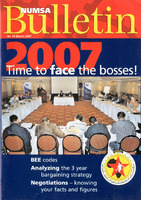 It is often said that it is not enough to be busy in the trade union movement or even in the corporate environment nowadays. The big question is: what is it you are busy with? What to do about countless scheduled or impromptu meetings, political sessions, mass campaigns, workshops, relationship and capacity- building consultations in the regions and nationally, has become another matter of daily debates in our structures. Everyone in the labour movement has a view on why this and that meeting or the other campaign has to be taken up with urgency. Many of us are regarded as experts on labour activities. And this results in time pressures and internal hurly-burly. It is because the organization must achieve its ultimate goals in the end. Ultimate goals inform our major organizational objectives ranked by their highest priority. These include progress on the motor recruitment campaign. the white-collar workers recruitment drive, monitoring major bargaining, food prices, fuel price increases and the latest CPI-X and regional policy workshops, culminating in the National Bargaining Conference in April 2007. Charles Schwab, the world's greatest industrialist. with great ability and perspicacity, is known as a most efficient, fabulously rich steel worker who led and transformed the Bethlehem Steel plant into the largest independent global steel producer. But, that did not immunize him from pressures and time-wasting interruptions. He once issued a challenge to a management consultant to show him the way to get more things done with his time and promised to "pay any fee within reason.†The consultant, without hesitation gave him a pad of blank paper and wrote on it: “Each night write down the things you have to do tomorrow, number them in the order of their importance. Start working on priority item number one and continue until finished. Then start item number two, then three, and do not worry if you have not managed to finish them.†The consultant was paid handsomely within seconds of dispensing this discreet advice. She was probably paid a million dollars or more. Some extremely important considerations arise in relation to this big question, as we intensify our 2007 programme of confronting the class logic of capital through collective bargaining. We have to look at them carefully, if we are to realize the objectives we have set for the giant metalworkers’ union this year.
 -
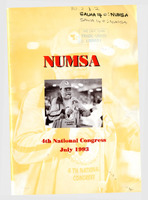 A comprehensive booklet documenting the proceedings of NUMSA's Fourth National Congress held in Johannesburg. It includes the General Secretary's Report, full transcripts of resolutions and debates, and discussion documents regarding the Reconstruction Accord and industry restructuring.
 -
 In the past, the government in many countries provided social welfare benefits to people. These benefits included things like public health care and free education. This is now changing in many countries. Governments today provide fewer services and benefits to people. Instead they hand this job over the private sector. This means that people have to start paying before they get a service. If families can't afford to pay private companies for these services, then someone in the family has to fill the gap. Generally it is women who have to: care for the sick when it is too expensive to take them to hospital, collect firewood because electricity is too expensive, walk miles to collect water from the river because piped water is too expensive. Many governments have been forced to change the role they play in the economy by the structural adjustment programmes (SAPs) that the International Monetary Fund (IMF) imposes on them as one of the conditions for lending them money
 -
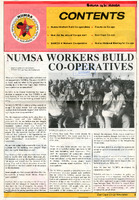 There are two main co-operative activities that are supported by NUMSA. The one is SAWCO in Natal and the other is the project that is starting here in the East Cape. Does NUMSA have a policy on co-operatives? NUMSA in its Central Committee has taken a decision to support co-ops. But NUMSA is still busy thinking of how we can formulate a policy on co-operatives. We are working towards such a policy. So what is NUMSA's aim in giving support to co-ops? In other words, how can organised workers benefit from the support that NUMSA is giving to these co-op activities? Interview with Cde John Gomomo NUMSA East Cape Regional Chairperson We, the organised workers on the shop floor are becoming more and more mobilised and politicised. We do not believe that the struggle should just end on the shop floor. The struggle of organised workers should also benefit the community. Co-operatives is such an activity that can be of interest to all groups of oppressed people. We, the organised workers with all the skills we have gathered in the organisation, we believe that if we take the lead, co-ops could be fully democratised organisations in the community.
 -