
South African Municipal Workers' Union (SAMWU) Collection
Item set
- Title
- South African Municipal Workers' Union (SAMWU) Collection
- Alternative Title
- SAMWU Collection
- Description
- The largest trade union in the South African local government sector. Established in 1987 through the merger of five unions, SAMWU is a COSATU affiliate representing over 160,000 workers in municipalities, water boards, and allied services.
- Date Issued
- 1987-10-24
- Language
- English
- Type
- Collection
Items
-
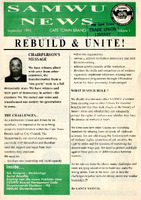 As a democratic Union and driven by its members, it is imperative for us to bring about the transformation within the Cape Town Branch and the City Council. The Shopstewards, our elected representatives, cannot do it by themselves and therefore need the support and input from their members they represent. We need to: develope new leadership and build capacity within the organisation, seriously address workplace democracy and joint decision-making address gender equality at the workplace, develope the skills and competencies of workers, vigorously implement education, training and development programmes through Affirmative Action for those previously disadvantaged. WHAT IS YOUR ROLE ? We should also dissuade other SAMWU members from crossing over to other Unions for material benefits but that they look closely at the history of these Unions and whether they can adequately protect the rights of workers and whether they have the interest of workers at heart. We have seen how other Unions are recruiting members by offering them all kinds of elaborate schemes, but not addressing the fundamental issues of workers' rights, protection of job security, the right to strike and the question of narrowing the discriminate wage gap. We need to protect and fight against these policies of differentiation between workers. As we can see from the above, many challenges and work are lying ahead of us to build and unite the strong union. Now is the time - let us face the challenges together to build strong union and worker leadership.
 -
 One of the biggest threats to RDP delivery in the municipal sector is that of privatisation. The Conference re-affirmed the long standing anti-privatisation position of SAMWU. In order to advance this position, the following proposals are made: That the Union develops a clear campaign to promote our opposition to privatisation and our support for the retention of basic services under public control and ownership through the “turning around†of local government services. That Regions discuss the elements of this campaign and that this is finalised in the next NEC. That for the campaign to succeed, it must be mass based. We should focus on getting worker and community support for our fight to retain services in public hands. An essential element of the campaign would be to ensure implementation of the last COSATU CEC resolution which calls for basic services like water, electricity, housing etc. to remain under public ownership and control. This includes identifying those services which should be brought under public ownership and control(nationalisation). Another important feature of the campaign should be the integration of the research findings(the joint ILRIG/SAMWU Research Project) into the programme. The research should both illustrate international and national consequences of past privatisation experiments as well as illustrating public sector superiority in the delivery of basic services(democratic alternatives to privatisation).
 -
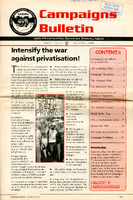 The SAMWU anti-privatisation campaign goes right to the heart of all members in their role as service providers to the community. Any privatisation of municipal services would mean that people in community not have access to basic services. It would also mean a loss of jobs through retrenchment and restructuring. This has already happened in other parts of the world. Internationally, public sector unions are fighting privatisation. For all these reasons, SAMWU calls on all members to intensify the anti-privatisation campaign! Experiences internationally have shown that privatisation results in increase in tariffs and a decline in quality services. Our communities have never received a quality service under apartheid. Now things will even be worse: under privatisation only those who can afford to pay, will get services. A major political responsibility that confronts SAMWU: we must ensure that we win the struggle against privatisation. We are confident that based on the democratic participation of 'our gold', SAMWU workers, COSATU and the community we can be victorious.
 -
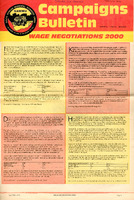 It is sad how the promises of a better life for all made by the government means so little for workers. Cosatu and Samwu mobilised our forces to ensure a victory for the ANC in the national and local government elections. Despite the fact that workers have put MPs into parliament and councillors into local government councils, we have yet to see any real benefit for workers. The 3rd and final round of negotiations delivered a big disappointment for Samwu. Once again we went into negotiations with high hopes of persuading Saiga to implement decent wage increases. Samwu's position of R250 or 10% for workers earning less than R6 700 per month was very reasonable. Because we said that those earning more than R13 700 should get a 7% increase, this meant that the total cost to councils was only 9%, which is very affordable. Saiga moved its position in negotiations by 1%. They also tried to get us to give up our demand for a R250 increase by offering a minimum wage of R1600. As we know, most workers are earning more than that. Workers earning R1600 Saiga's 5% will mean a R80 increase. This is less than councillor's get for attending one meeting! Although the negotiators tried everything to try to reach a settlement, Saiga frustrated us at every turn.
 -
-
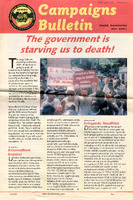 The wage talks are resuming on May 8th 2001. At the time of going to print, all provinces were holding marches all over the country to highlight our demands for a living wage. Currently on the table is a proposal by the conciliator that all parties should agree to accept an 8% across the board increase, and an increase in the minimum wage to R1900. Firstly this proposal has not yet been accepted by the employer. At the conciliation, the employer stuck to 5% only. Secondly this falls short of our demand. It means we will not get the R300 across the board. Any worker earning below R3800 per month is going to get an increase of less than R300. The hardest hit will be workers earning from R1700 - R3000 who will only get R136 - R240. There is nothing more we can get from conciliation or negotiations. It is now up to YOU the workers to decide if you will accept the 8% offer put on the table by the conciliator!
 -
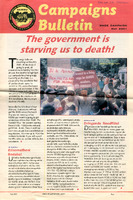 The wage talks are resuming on May 8th 2001. At the time of going to print, all provinces were holding marches all over the country to highlight our demands for a living wage. Currently on the table is a proposal by the conciliator that all parties should agree to accept an 8% across the board increase, and an increase in the minimum wage to R1900. Firstly this proposal has not yet been accepted by the employer. At the conciliation, the employer stuck to 5% only. Secondly this falls short of our demand. It means we will not get the R300 across the board. Any worker earning below R3800 per month is going to get an increase of less than R300. The hardest hit will be workers earning from R1700 - R3000 who will only get R136 - R240. There is nothing more we can get from conciliation or negotiations. It is now up to YOU the workers to decide if you will accept the 8% offer put on the table by the conciliator!
 -
-
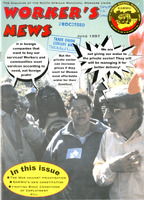 The inaugural issue of the SAMWU Magazine serves as a foundational document for the South African Municipal Workers' Union, following its formation in 1987. Published during a critical period of transition in South African labour history, the issue outlines the union’s militant stance against the privatisation of local government services and highlights its leadership in the National Living Wage Campaign. The content reflects a dual focus on internal organisational building—featuring the new union constitution and the role of service committees—and broader socio-economic advocacy, including critiques of the Employment Standards Bill and the Labour Relations Act (LRA). Notably, the issue integrates technical workplace safety concerns, such as the environmental hazards of municipal sludge, with political education and international worker solidarity. By documenting the early policies of the union and its affiliation with COSATU, this issue captures the emergence of a unified, worker-controlled movement dedicated to transforming municipal service delivery in a post-apartheid South Africa.