
Congress of South African Trade Unions (COSATU) Collection
Item set
- Title
- Congress of South African Trade Unions (COSATU) Collection
- Alternative Title
- COSATU Collection
- Description
- Archival collection of the Congress of South African Trade Unions (COSATU), launched on November 30, 1985. The collection documents the federation's founding principles of non-racialism, worker control, and the concept of "one industry, one union." It includes records of major campaigns such as the Living Wage Campaign, anti-apartheid stayaways, and its participation in the Tripartite Alliance.
- Date Issued
- 1985–
- Type
- Collection
- Subject
- Trade unions — South Africa
- Source
- Originally sourced from COSATU House (Johannesburg) and affiliated regional offices by the Labour Research Service (LRS}
- Spatial Coverage
- South Africa
- Temporal Coverage
- 1985-Present
- Access Rights
- Access provided for research and educational purposes. Copyright held by COSATU unless otherwise noted.
- Rights Holder
- Congress of South African Trade Unions (COSATU)
Items
-
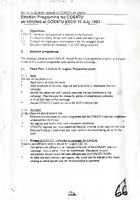 This policy document outlines the strategic mandate of the Congress of South African Trade Unions (COSATU) in the lead-up to the 1994 democratic elections. Adopted by the Executive Committee (EXCO), the programme formalises the federation’s "Three Priorities": Political Mobilisation: Ensuring a decisive electoral victory for the African National Congress (ANC) and securing its legitimacy to govern. Organisational Development: Strengthening the internal structures of COSATU to transition from a resistance movement to a sustainable force in a post-apartheid economy. Advocacy for Worker Interests: Establishing a framework to ensure the ANC-led government prioritises labour rights, specifically through the implementation of the Reconstruction and Development Programme (RDP).
 -
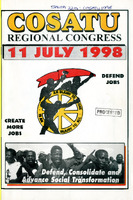 Records of the COSATU Western Cape Regional Congress held on 11 July 1998. The congress focused on mobilizing workers in the Western Cape province under the national theme of "Defend, Consolidate and Advance Social Transformation." Key agenda items included regional strategies for the 1999 General Elections, local government delivery, and addressing job losses in the regional textile and agricultural sectors.
 -
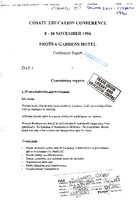 A policy resolution from the COSATU Education Conference focusing on the strategic priority of women's leadership development. Key mandates include: 1) The implementation of a quota system for training course participants; 2) A clear definition of "women development" that targets shop-floor workers to build leadership at all organisational levels; and 3) An inclusive approach designed to reach a broad base of women rather than a select few.
 -
 A comprehensive training manual and workshop guide designed by the COSATU Education Department in September 1999. The pack provides a "baseline" introduction to the Employment Equity Act (EEA), focusing on its application to address discriminatory workplace practices. It uses an activity-based methodology to help shop stewards understand the Act's implications for collective bargaining. The document emphasizes reporting legal loopholes back to the Federation to strengthen future labor campaigns and challenges the employer's demand for "flexibility" by asserting the legacy of apartheid imbalances.
 -
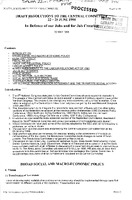 A comprehensive draft resolution delegated by the 6th National Congress to the Central Committee. It serves as a unified policy framework, integrating resolutions from COSATU affiliates and findings from the "September Commission" (The Commission on the Future of the Unions). The document synthesizes a decade of policy conferences (1992–1997) to form the labor movement's formal proposal for the Presidential Jobs Summit. It covers economic policy, health and safety, and living wage mandates, wielding the same authority as a National Congress resolution.
 -
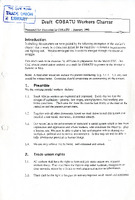 A draft policy document intended as a "dynamic organisational and fighting tool" for the democratic transition. It outlines the core demands of the labour movement regarding constitutional rights, including the right to strike, organisational independence, and gender equality. This version was circulated for affiliate discussion ahead of the March 1992 Central Executive Committee (CEC) and the subsequent Workers' Summit in May 1992.
 -
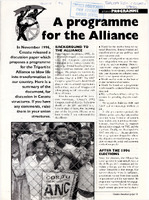 A summary of COSATU's 1996 proposals to revitalise the Tripartite Alliance. It critiques the shift toward neoliberal economic policies (GEAR), discusses the "dual power" situation in post-apartheid SA, and proposes a binding Reconstruction Accord to prioritise the RDP.
 -
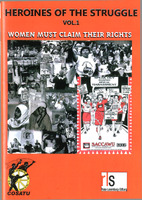 "The booklet serves as a commemoration of the heroines and veterans of the struggle. The brave women of the struggle, women who hold knife from its sharpest edge. Freedom cannot be achieved unless women have been emancipated from all forms of oppression. The booklet is the product of COSATU Archives in partnership with Rosa Luxemburg. The information is compiled by NANDIPAMITI (COSATU Archivist) pictures by William Matlala and COSATU Photo Archive."
 -
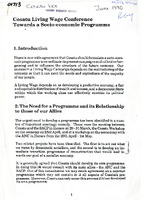 A strategic discussion paper proposing a comprehensive socio-economic framework for COSATU during the transition to democracy. It advocates for a "Growth Path" that moves beyond "bread and butter" issues to address industrial restructuring, human resource development, and the role of the State in a post-apartheid economy. It outlines the establishment of five specific commissions (Macroeconomics, Industrial Restructuring, Human Resources, LRA/Workers Charter, and Social Services) to synthesise labour policy with the ANC and SACP.
 -
 A foundational educational manual and primary source reader compiled for the Workers’ College. It documents the launch and structural framework of the National Economic Development and Labour Council (NEDLAC) in February 1995. The reader includes the "Founding Declaration," the NEDLAC Act and Constitution, and the landmark launch speeches by Tito Mboweni (Government), John Gomomo (Labour/COSATU), and David Brink (Business). It outlines the "quadripartite" structure (Labour, Business, Government, and Community) and the four specific chambers: Public Finance, Labour Market, Trade and Industry, and Development.