
Congress of South African Trade Unions (COSATU) Collection
Item set
- Title
- Congress of South African Trade Unions (COSATU) Collection
- Alternative Title
- COSATU Collection
- Description
- Archival collection of the Congress of South African Trade Unions (COSATU), launched on November 30, 1985. The collection documents the federation's founding principles of non-racialism, worker control, and the concept of "one industry, one union." It includes records of major campaigns such as the Living Wage Campaign, anti-apartheid stayaways, and its participation in the Tripartite Alliance.
- Date Issued
- 1985–
- Type
- Collection
- Subject
- Trade unions — South Africa
- Source
- Originally sourced from COSATU House (Johannesburg) and affiliated regional offices by the Labour Research Service (LRS}
- Spatial Coverage
- South Africa
- Temporal Coverage
- 1985-Present
- Access Rights
- Access provided for research and educational purposes. Copyright held by COSATU unless otherwise noted.
- Rights Holder
- Congress of South African Trade Unions (COSATU)
Items
-
 Cosatu's Sixth National Congress held over four days from 1 6-1 9 September was on the surface a fairly well run operation in which Cosatu, with the involvement of the SACP, effectively drew the battle-lines with respect to its ANC alliance partner on the question of its Growth, Employment and Redistribution macro-economic policy - GEAR. The Congress also laid the groundwork in preparation for the ANC's upcoming December National Conference where socialists are expected to make a determined push in getting elected onto the ANC's National Executive Committee (NEC), as well as influence ANC strategy and tactics to counter the emergent Africanist grouping which threatens to dilute the ANC's working class bias. The Congress further saw Cosatu clearly attempt to reassert its socialist vision. Using its recently released September Commission Report as a basis for policy formulation, a decision was made that Cosatu should play an active part in the economy and the development of the country. This included Cosatu's involvement in areas such as industrial development strategy, changing investment patterns and new forms of management. The Congress, however, also witnessed the humiliating defeat of carefully crafted motions and much unfinished business concerning the finalisation of critical resolutions and debates raised from the floor. Cosatu's senior leaders including John Gomomo (President), Sam Shilowa (General Secretary) and Zwelinzima Vavi (Deputy General Secretary), were often caught wrong-footed by debates from the floor which countermanded positions thought out prior to the conference by the executive committee. The most embarrassing moment came for Cosatu's leadership when a recommendation to implement a gender quota was rejected by most affiliates, including women delegates themselves. Prior to the Congress, it had been recommended by the September Commission that the federation and its affiliates should adopt a quota system for women. A target had been set of 50 percent representation in all structures by the year 2 000. Mindful of the implications this held for the national affirmative action debate, Cosatu's leadership tried to side- track the issue for a later resolution but were rebuffed by the delegates. Similarly, the debate around globalisation took up a considerable amount of time, which led to Gomomo attempting to bring the debate to a speedy resolution. That in turn resulted in his censure from the floor. Earlier, Shilowa had embarrassed himself when he inadvertently seemed to state that he supported globalisation only to be reminded by the delegates that that was not Cosatu's position
 -

-
 The COSATU Central Executive Committee met in its first session of the year over two days (5-6May 1998). The CEC received reports on a variety of issues and tool a number of policy decisions and approaches by on these matters. The CEC was characterised by anger and frustration on the scale of job losses in many industries and the failure of the current macro economic strategies to turn this tide around. Below are some of the issues discussed. The CEC endorsed the proposals submitted by Labour in NEDLAC on job 4^ creation in preparation for the Presidential Job Summit. The proposals will be further discussed in the coming Central Committee of COSATU scheduled for the 23-35 June 1998. COSATU shall use the Central Committee to further expand on the broad framework submitted in NEDLAC and get more proposals in line with how labour has categorised issues for the agenda of the Job Summit, i.e. (i) Measures to create jobs (ii) Measures to stop current job losses (iii) Measures to support the unemployed, (iv) Measures to assist the informal sector to be formal (v) Identification of long term issues to be negotiated beyond the Job Summit. COSATU is extremely concerned by the failure of both government and business to submit their proposals at NEDLAC. It is worth to note that various deadlines for them to submit proposals have passed. A million-dollar question is : Why does the government and business seem reluctant to submit their proposals? Clearly both government and business have abundance of capacity to deal with the proposals in a relatively short space of time. This is a major concern for COSATU. Whilst the delays continue, job losses are continuing unabated and the time bomb continue to click.
 -
-
 The year 1999 is the year of assessing performance and delivery. In the political arena we are reflecting on the accomplishments and shortcomings of our young democracy as we prepare our nation for South Africa's second democratic elections on the 2nd of June 1999. At this time, it is important that we also evaluate the progress we as a united labour movement made subsequent to April 1994, since the involvement of COSATU in our struggle for democracy was and still remains crucial. For women the 2nd of June 1999 presents itself as a challenge, especially women within COSATU. The challenge lies in the need to ensure that women are more represented in all structures of the federation, affiliates, down to local structures. Women make up the majority of citizens in South Africa and have been and remain under represented within the trade union movement. This has been the case since the launch of COSATU in 1985.
 -
 A consolidated policy document containing socio-economic resolutions delegated by the 6th National Congress. It integrates new resolutions from affiliates with established policies from previous conferences (1992–1997) covering Economic Policy, Health and Safety, and the Living Wage. As the inaugural meeting of the Central Committee, this document represents the highest policy-making authority on socio-economic issues between National Congresses.
 -
 COSATU must intervene in affiliates where it has identified problems, where problems have been brought to its attention and / or has been requested to do so. The CEC should draw guidelines on how and under which circumstances the federation and its structures may intervene taking into account clauses 3.9 and 3.10 of the constitution. Such intervention should not undermine affiliates where such problems exist. COSATU leadership must be visible during major disputes between affiliates and employers and co-ordinate solidarity with workers involved in such disputes.
 -
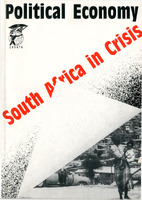 THE Central Executive Committee of COSATU took a decision in 1986 that active discussion and study of the South African economy was a priority. This decision was prompted by the very serious problems of unemployment, retrenchment, inflation and poverty that we now face. It was also prompted by an understanding that organised workers must be able to propose and fight for solutions to these problems. In addition sanctions are now becoming a reality. The need to thoroughly understand the economy is even more urgent. One of the biggest problems for any person trying to understand the South African economy is the question: Through whose eyes do we study it? We can look at the economy through the eyes of the capitalists or we can look at it through the eyes of workers. Depending on which set of eyes we use, we'll see a very different picture. The newspapers, radio, TV and education system all look at the economy through the eyes of the capitalist. They talk of economic laws* which are efficient and benefit everyone. And when the economy goes into a recession* or into a crisis* they argue that the economic laws are being interfered with. They want people to think that the economy is something controlled by laws that workers cannot change. In this booklet on the South African economy we will look at the economy through the eyes of workers. We will see how politics and economics have combined to the benefit of the capitalists. In doing this we will undertake a study of the political economy * of South Africa. The aim of this booklet is to provide a starting point for a study of the South African political economy. We will be looking back into our history to understand the very close link between politics and economics. The purpose of such a political economy study is to allow us to better understand just how serious the present crisis is. Being clearer on this will also allow us to begin discussing the real and effective solutions to the crisis. This is important because many of the solutions being proposed at present will benefit capitalism but will lead to small changes for the mass of the people.
 -
 This discussion paper is being issued seven months after the 7th National Congress. The Central Executive Committee (CEC) of February 12 to 14, 2001 debated it, and felt that with minor changes it should be issued to COSATU structures and members for debates on the current political situation. This paper is presented to the members and structures of COSATU as a political discussion paper for 2001. A further detailed political discussion will take place in the November 2001 CEC. As the last CEC of 2001, it will be expected to take stock of the political situation, taking into account issues raised here. The February CEC took place almost five months after the Seventh National Congress. The Congress was a watershed moment and a turning noint in the life of the organisation. For 'months"before as well as xiuriiig the- Congress itself, our members and the public focused on the Congress deliberations and discussions. In political terms, this process underlined the central role played by COSATU in the post-apartheid political landscape
 -
 The Portfolio Committee on Labour considered amendments to the Employment Equity Bill which were tabled in parliament by the Department of Labour today. Amongst these were amendments in response to COSATU's proposals for closing the apartheid wage gap. COSATU has serious reservations, however, about the tabled amendments on this issue, and believes that the amendments proposed today by the ANC should be supported as they address these defects. Finalisation of the clauses relating to the wage gap has been postponed to next week, when the Bill will be voted on by the Committee. COSATU has consistently maintained the view, both in our submissions to the committee last month, and at NEDLAC, that the Employment Equity Bill must address the issue of the apartheid wage gap, if it is to have meaning for the millions of ordinary workers, who are the worst victims of apartheid discrimination, and who will not be able to reach the upper echelons of the workforce, despite the affirmative action provisions of the legislation. We have supported the philosophy of the legislation that employment equity must benefit everybody, and not just an elite few. We have taken the view that the legislation must address the critical legacy of massive income inequalities, which was a deliberate policy under apartheid, in order to make this philosophical approach a reality, and that in this respect the Draft Bill was seriously defective. We proposed a series of concrete amendments to remedy this defect, within the broad philosophical approach and architecture of the Bill. We also proposed an integrated strategy to address these differentials, which combines measures in the Employment Equity legislation with other legislation and processes. A number of organisations have supported us in this view. Further a concept document tabled by the Department of Labour in the parliamentary committee broadly endorsed this approach.
 -
 The Executive Committee met in its normal session on 18 - 19 August 1998. It received reports on a range of socio-economic and political issues. As is always the case, discussions were conducted in a true tradition of the federation - comradeship, frankness, robust and constructive. A number of decisions were taken by the meeting, some of which are contained in this statement. The meeting received a report on meetings held with Old Mutual and Sanlam respectively. The meeting reaffirmed COSATU's opposition to demutualisation on political and economic grounds and regretted the fact that the portfolio committee had gone ahead to finalise the bills dealing with demutualisation inspite of being informed about discussions currently taking place with the two mutual companies. We remain of the view that it would help the parliamentary process had this process been allowed to proceed to its final conclusion.
 -
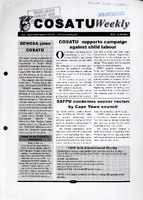 A 2001 issue of the COSATU newsletter reporting on the historic decision by the Democratic Nursing Organisation of South Africa (DENOSA) to join the federation. It highlights the vote of 200 delegates at the Pretoria congress under the theme "Nursing facing challenges: Development and HIV/Aids." The document frames this as a vital consolidation of public sector and white-collar workers, challenging the notion that COSATU only represents lower-ranked labourers.
 -
 The purpose of this booklet is to touch in number of areas, which are important at this point for the recruitment campaign of the federation. It is not meant even by implication to provide details of how to handle the campaign what it does is to highlight issues and areas that we must think in the preparation for this campaign. More importantly is the fact that COSATU remains the biggest federation in South Africa and fastest growing international. Beside a loss of membership from + 2 million to + 1.8 million members. The decrease in membership is mostly because of retrenchments. The well known fact is that only about 40% of the workforce that is unionized. The aim of the recruitment drive is to access this 60% that is not unionized. The mistake must not be committed to think that the 40%, which is unionized, belong to COSATU. There are two other federations plus number of non-affiliated unions. Our commitment to One Country One Federation does not stop us to recruit from other unions as long as we remain under different bodies. This October campaign coincides with Red October campaign of the SACP and Health and Safety month of the federation this must be seen as strength than lack of co-ordination. One area that is link to recruitment is the servicing of membership. It is useless to recruit and fail to service membership because every campaign that we will take around recruitment we may find ourselves had to fight with disgruntled members and obviously it will be difficult to attract new members. This must say to us that members come first.
 -
 COSATU must intervene in affiliates where it has identified problems, where problems have been brought to its attention and / or has been requested to do so. The CEC should draw guidelines on how and under which circumstances the federation and its structures may intervene taking into account clauses 3.9 and 3.10 of the constitution. Such intervention should not undermine affiliates where such problems exist. COSATU leadership must be visible during major disputes between affiliates and employers and co-ordinate solidarity with workers involved in such disputes.
 -
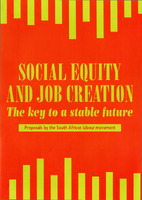 A comprehensive 1996 policy framework and economic vision released by organized labor (COSATU, NACTU, and FEDSAL). It critiques the "jobless growth" of the early transition and the extreme income inequality where the richest 10% earn over half the national income. The document advocates for a "social equity" model involving the redistribution of wealth, a "floor of rights" for workers, and an active role for the state in the economy, explicitly challenging the SA Foundation’s "neo-liberal" prescriptions.
 -
 COSATU must intervene in affiliates where it has identified problems, where problems have been brought to its attention and / or has been requested to do so. The CEC should draw guidelines on how and under which circumstances the federation and its structures may intervene taking into account clauses 3.9 and 3.10 of the constitution. Such intervention should not undermine affiliates where such problems exist. COSATU leadership must be visible during major disputes between affiliates and employers and co-ordinate solidarity with workers involved in such disputes.
 -
 COSATU must intervene in affiliates where it has identified problems, where problems have been brought to its attention and / or has been requested to do so. The CEC should draw guidelines on how and under which circumstances the federation and its structures may intervene taking into account clauses 3.9 and 3.10 of the constitution. Such intervention should not undermine affiliates where such problems exist. COSATU leadership must be visible during major disputes between affiliates and employers and co-ordinate solidarity with workers involved in such disputes.
 -
 COSATU must intervene in affiliates where it has identified problems, where problems have been brought to its attention and / or has been requested to do so. The CEC should draw guidelines on how and under which circumstances the federation and its structures may intervene taking into account clauses 3.9 and 3.10 of the constitution. Such intervention should not undermine affiliates where such problems exist. COSATU leadership must be visible during major disputes between affiliates and employers and co-ordinate solidarity with workers involved in such disputes.
 -
 COSATU must intervene in affiliates where it has identified problems, where problems have been brought to its attention and / or has been requested to do so. The CEC should draw guidelines on how and under which circumstances the federation and its structures may intervene taking into account clauses 3.9 and 3.10 of the constitution. Such intervention should not undermine affiliates where such problems exist. COSATU leadership must be visible during major disputes between affiliates and employers and co-ordinate solidarity with workers involved in such disputes.
 -
 A policy statement outlining COSATU's long-term campaign for the democratisation of mutual insurance companies (Old Mutual and Sanlam). It argues that while these companies manage vast sums of worker provident fund contributions, workers are granted no real ownership or governing rights. The document proposes that organised labour be represented on governing structures through Nedlac and that the resources of these "Mutuals" be leveraged for national economic development.
 -
 A 64-page formal submission to Parliament regarding the Basic Conditions of Employment Bill (BCEB). It tracks the transition from the 1996 Green Paper to intense negotiations in NEDLAC. COSATU argues for a mandatory "floor of rights" for all workers, especially domestic and farm labourers, while critiquing business attempts to maintain "apartheid cheap labour practices" under the guise of international competitiveness.
 -
 A discussion document reflecting on the role of COSATU following the 1994 elections. It acknowledges the sympathetic nature of the new ANC-led government while emphasising the need for COSATU to maintain its "high moral ground" and organisational strength. The paper outlines a "Back to Basics" approach, focusing on the core union functions of collective bargaining, the living wage campaign, and meeting the basic needs of workers.
 -
 A 1998 press statement outlining COSATU’s support for "strict anti-trust legislation." The document rejects business opposition to ministerial discretion in merger regulation and advocates for the forced divestiture (breaking up) of conglomerates that abuse their dominant market position. Key focus areas include the erosion of inherited corporate power, the prevention of excessive pricing, and the inclusion of "public interest" criteria—specifically the protection of jobs—in merger reviews.
 -
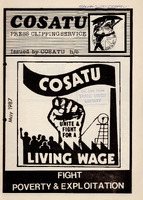 The Congress of SA living wage campaign will be launched towards the end of this month. Already various regions report that police are refusing permission for public launches to be held. Initial plans by some regions to launch the campaign at the end of this week, to coincide with the commemoration of the Sharpeville and Langa massacres, had to be shelved when permission to hold a mass rally was turned down. Cosatu has vowed to make this the "biggest challenge to bosses and their profit system". The struggle is also seen as more than just an economic one. "It is a struggle against apartheid- capitalism which is built on ultra-cheap, ultra- controllable and super-exploitable labour.
 -
 We the Trade Union representatives here present firmiy commit ourselves to a unified democratic South Africa, free of oppression and economic exploitation. We believe that this can only be achieved under the leadership of a united working class. Our history has taught us that to achieve this goal we will have to carry out the following tasks. To organise the unorganised workers and build effective trade unions based on the democratic organisation of workers in the factories, mines, shops, farms and other workplaces. Organise national industrial trade unions, financed and controlled by their worker members through democratically elected committees. Unify these industrial unions into a national worker controlled federation. Combat the divisions amongst the workers of South Africa and unite them into a strong and confident working class. Encourage democratic worker organisation and leadership in all spheres of our society together with other progressive sectors of the community. Reinforce and encourage progressive international worker contact and solidarity so as to assist one another in our struggles.We call on all those who identify with this commitment to join us and the workers whom we represent as comrades in the struggle ahead. We call on all trade unions to strive to unite their members in their ranks without discrimination and prejudice, and therefore resolve that this federation shall determinedly seek to further and protect the interests of all workers and that its guiding motto shall be the universal slogan of working class solidarity: "AN INJURY TO ONE IS AN INJURY TO ALL".