
Food and Allied Workers' Union Collection
Item set
- Alternative Title
- FAWU Collection
- Description
- Records documenting the history, campaigns, and administrative activities of FAWU. Formed in 1986 via the merger of the Food and Canning Workers' Union (FCWU), the Sweet, Food and Allied Workers' Union (SFAWU), and the Retail and Allied Workers' Union (RAWU). Includes minutes, strike posters, and correspondence.
- Date Issued
- 1986–
- Type
- Collection
- Subject
- Labour unions--South Africa
- Food industry and trade--Employees--Labor unions
- Collective bargaining—Food industry—South Africa
- Trade unions—Agricultural laborers—South Africa
- Trade unions — South Africa
- Subject - Occupation
- Labour unions
- Identifier
- Food and Allied Workers' Union
- Temporal Coverage
- 1986–
- Date
- 1986–
- Source
- Records originally held at FAWU Head Office and regional branches
- Access Rights
- Copyright Food and Allied Workers' Union. Access provided for research purposes.
Items
-
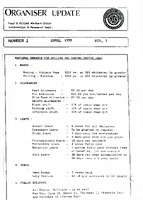 Barlow also has an international links with UK, Europe, USA and Far East. In UK it has a division which operates as J. Bibby 4 Sons and we also read that the group is listed on the Stock Exchanges in Johannesburg, London, Paris, Brussels, Antwerp, Frankfurt, Basel, Geneva and Zurich. Bibby's agricultural division is the UK s third largest producer of animal feeds, emphatically the cattle, pigs and poultry. This might be in line with the group's primary mission which is the creation of wealth for all its stakeholders. It is also said that the company's special focus is in the attainment of effective management of resources, new investment, exports and productivity.
 -
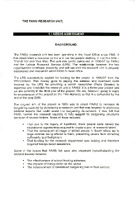 A report or institutional summary of the Food and Allied Workers' Union (FAWU) Research Unit's operations from 1998 to 2000. It details the unit's establishment at the Head Office as a joint venture with the Labour Research Service (LRS), funded by FNV-Holland. Key personnel mentioned include Thandi Yoli, Viva Mtai, and Reza Daniels. The unit's primary objective was to increase FAWU’s bargaining capacity through the production of sectoral reports.
 -
 A progress report detailing the revitalisation of the FAWU Research/Resource Unit, which resumed operations in 1997 after a two-year closure (1995–1997). The report acknowledges a lack of internal research capacity to support bargaining structures and describes the contractual arrangement with the Labour Research Service (LRS) to provide senior-level supervision. It candidly discusses the "hiccups"—including financial constraints, limited staffing, and capacity gaps—that have hindered the unit’s goal of achieving full organizational independence.
 -
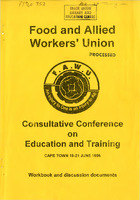 A collection of discussion documents and opening remarks from the 1996 FAWU conference on Education, Training, and Development (ETD). The text highlights the union's shift toward viewing ETD as a tool for economic liberation, moving workers away from low-skilled, low-security labour toward career progression. It specifically addresses the alignment between worker development and industrial productivity through tripartite consultation between labor, the state, and employers.
 -
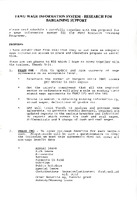 This document outlines a technical strategy from the late 1990s to professionalise the collective bargaining capacity of the Food and Allied Workers' Union (FAWU). It describes a partnership with the Labour Research Service (LRS) to develop a digitised Wage Information System (WIS), enabling the union to transition from anecdotal evidence to data-driven negotiation. This proposal, likely authored by an LRS senior researcher (Reza Daniels), details a two-phase implementation plan for a Wage Information System (WIS) at the FAWU Head Office. Phase One (Wage Data): Focuses on the logistical challenge of centralising signed wage agreements from regional coordinators. It establishes a workflow for analysing "cash vs. real wages," wage differentials, and percentage changes across sectors. Phase Two (Non-Wage Benefits): Addresses the "hidden" part of the social wage. Since formal agreements often omit specifics, the plan involves surveying shop stewards via questionnaires to capture data on sick leave, allowances, medical aid, housing loans, and retrenchment packages.
 -
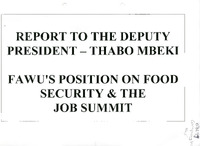 A strategic report outlining FAWU's critique of economic liberalization. It highlights the "dilemma" where lower food prices for consumers come at the cost of local job losses due to the inability of domestic producers to compete with imports. The report calls for a systematic balance between consumer and producer interests, centered on "household food security." It directly critiques the GEAR (Growth, Employment and Redistribution) strategy for failing to meet its targets and perpetuating poverty, while advocating for the establishment of an implementation forum based on the "Poverty and Inequality" report.