Action Notes
Item set
- Title
- Action Notes
- Alternative Title
- HAP Action Notes Series
- Description
-
This collection comprises the Action Notes series, a set of practical training manuals produced by the Human Awareness Programme (HAP) between the 1980s and mid-1990s. Designed as a core resource for the South African democratic movement, the series provided grassroots activists, trade unionists, and civic leaders with the technical and organisational skills necessary to build sustainable, democratic institutions during the struggle against apartheid and the subsequent transition to democracy.
The series is characterized by its "popular education" methodology—utilizing accessible language, clear visual aids, and step-by-step instructions to demystify complex administrative and legal processes. Each manual (or "Action Note") addresses a specific pillar of organisational development, ranging from internal governance and financial accountability to external communication and strategic facilitation.
The series includes foundational guides on:
Organisational Governance: Drafting constitutions, defining legal personality, and establishing democratic structures.
Administrative Skills: Effective meeting management, agenda setting, and minute-taking.
Resource Mobilisation: Fundraising strategies, grant-seeking, and basic bookkeeping for non-profit treasurers.
Advocacy and Communication: Designing low-cost media, producing publicity materials, and engaging in public relations.
Strategic Planning: Methodologies for facilitating workshops, evaluating campaign success, and conducting organisational audits.
As a whole, the Action Notes represent a historical record of the "capacity-building" efforts that underpinned South African civil society. They reflect a commitment to the principle that information and organisational discipline are essential tools for political liberation and social transformation. - Date Issued
- 1980-1994
- Language
- English
- Type
- Collection
- Subject
- Community organization—South Africa—Handbooks, manuals, etc.
- Nonprofit organizations—South Africa—Management
- Political education—South Africa—History—20th century
- Associations, institutions, etc.—South Africa—Law and legislation
- Communication in politics—South Africa
- Format
- Instructional Pamphlets
- Training Manuals

Items
-
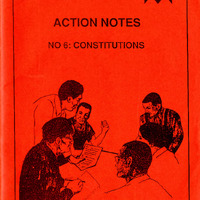
This document, titled "Action Notes: No. 6: Constitutions", is a practical guide for activists in South Africa on the legal and structural formation of organisations. It focuses on the crucial distinction between entities that require formal government registration (such as Close Corporations or Trusts) and grassroots bodies, like civic organisations and advice offices, which operate primarily through a self-authored constitution. The pamphlet explains that for many non-profit and community groups, a well-drafted constitution is sufficient to grant the organisation its own "legal personality." This status allows the group to enter into contracts, incur debt, or be sued as a distinct entity from its individual members—a concept known in South African law as a Voluntary Association. The guide provides a framework for drafting these foundational documents to ensure clear governance and legal protection for members. -
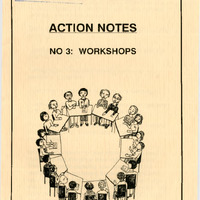
This document, titled "Action Notes: No. 3: Workshops", is a practical instructional pamphlet designed to assist activists and community organisers in the systematic planning of educational and strategic sessions. It serves as a methodology guide for the "popular education" style frequently employed by South African trade unions and political organisations. The text emphasises that the foundation of any successful workshop is a clearly defined objective. It categorises workshops into five primary functions: skill-building (e.g., media production), political analysis (e.g., responding to new legislation), strategic planning, evaluation of past campaigns, and internal conflict resolution. The pamphlet provides a step-by-step framework for managing both the intellectual content and the logistical arrangements once the core aim has been established.