
General Materials
Item set
- Title
- General Materials
- Alternative Title
- LRS General Materials
- Creator
- Labour Research Service (LRS)
Items
-
 Welcome to our new COSATU Negotiations Bulletin. This will be a regular Bulletin giving you information about the different negotiating forums COSATU is involved in. In this Negotiations Bulletin we look at COSATU's internal structures dealing with negotiations, the different forums COSATU is negotiating in, and the National Economic Forum's (NEF) first vary report back on agreements reached.
 -
 THE National Executive Committee (NEC) of NUMSA met on 27-28 June and agreed that strike action is necessary to achieve our demands in these industries: NICISEMI - Iron, Steel, Engineering, Metallurgical Industry, NICMI - Motor, NBF - Auto, TYRE AND RUBBER. The NEC has therefore decided to hold a STRIKE BALLOT for workers in NICISEMI, Auto and Tyre and Rubber from 6-17 July 1992. The workers in NICMI will ballot later because the Agreement only expires on 31 August 1992. The votes will be counted on the 18-19 July. The STRIKE COMMITTEE will meet on 20 July to consider the ballot result and decide on strike action.
 -
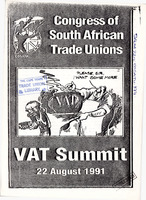 We welcome you to this Summit to discuss VAT. By yesterday afternoon, 22 organisations had indicated that they would be attending. COSATU is very gratified that so many organisations have felt the need to come together to discuss this pressing problem. COSATU has called this summit out of deep concern about the implications of VAT especially for workers and members of lower income groups, that is the vast majority of South Africans. We believe that unless we can reach consensus on this tax, we will be facing a disaster of national proportions. There will be a decline in the standard of living for all, and for those not protected against cost of living increases, starvation will stare them in the face. The Inkathagate scandal and the fact that the majority of the people in South Africa are taxed without representation, already angers our people. If tax changes are introduced without the widest possible consultation and consent, heightened conflict could jeapordise the transition process in its current delicate phase. The government should not underestimate the volatile character of unpopular taxes- this is a lesson which Maggie Thatcher had to learn the hard way! It will only be through the unity of organisations from all walks of life, that we will be able to successfully achieve modifications to the tax system. That is why we called this meeting. We sincerely hope that from this meeting, we will be able to develop a common approach.
 -
-
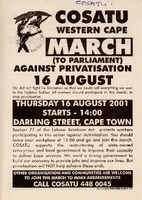 Section 77 of the Labour Relations Act protects workers participating in this action against victimisation. You should leave your workplace at 13:00 and go and join the march. COSATU supports the restructuring of state-owned enterprises and local government to improve their capacity to deliver basic services. We want a strong government to build our economy to provide jobs and improve our lives. But privatisation will NOT help achieve these ends
 -
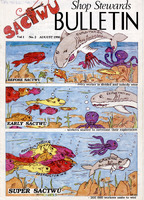 WHAT does the Zulu speaking steward do when the noisiest and nicest songs are sung in Afrikaans? Hum along, of course! And so indeed, through song, debate and elections a new unity was bom at S ACTWU's National Congress. But the congress - the highest policy making body - was about more than songs and elections. It confirmed that workers need a union of energy and life.
 -
-
 One of the central tenets of much current development thinking in southern Africa is that market-oriented strategies and private sector involvement must be the basis for future economic growth. This has underpinned structural adjustment and economic policy reform policies in the region over the last decade or more. It also underlies the argument for encouraging external foreign direct investment (FDI) as a motor for growth. However growing evidence suggests that such a strategy has not paid off. Economic growth rates have been disappointing, private, and particularly foreign, investment has been limited, and employment in the formal sector has fallen dramatically.1 Structural adjustment and market liberalisation have clearly not delivered the developmental benefits claimed of them, and people's livelihood opportunities have, ft seems, declined over the same period and their levels of vulnerability have increased. The increasing recognition that the standard neo-liberal prescriptions were not having the expected benefits, especially for poor people, has resulted in some rethinking about how best to redirect the benefits of globalisation and economic reform towards the poor, and how to offset some of the losses. Thus 'pro-poor growth strategies', 'making markets work for the poor' and 'growth for redistribution' have become well-worn slogans. However, the practical and policy measures required, whereby the benefits of an engagement with a globalised economy, investment by the private sector and liberalisation privatisation measures can result in poverty reduction, remain vague.A number of issues arise. For the sceptics, questions are raised about the degree to which the turn to a 'pro-poor' markets approach is simply rhetorical gloss, added to the discredited neo-liberal paradigm, or actually a genuinely new policy perspective in its own right. It is important to differentiate between broad economic policy reform objectives (which, with some nuances, remain largely in the standard neo-liberal form) and sectoral policies which contain explicitly pro-poor elements. While retaining the argument that market liberalisation and external investment are key, such policies may include some strategic elements of state- directed intervention which boost the access of the poor to new markets and investment opportunities. It is this stance, where the state intervenes to improve access and for particular groups of people, redressing to some extent the imbalances caused by the lack of level playing fields of existing markets, which potentially sets a pro-poor perspective apart.
 -
 These terms and conditions of employment govern the employment of all permanent employees at the South African Democratic Teachers' Union (SADTU). These standard terms and conditions do not apply to temporary, part- time or fixed-term contract employees.
 -
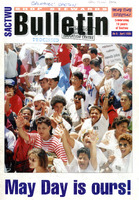 This year's May Day celebrations will take on a special meaning and character. It constitutes an important date in the tripartite alliance's 1999 general elections campaign. This is an important opportunity for workers to pause, and to reflect on our achievements over the last five years of democratic rule. Are workers better off than before? Have our rights been strengthened or weakened? It is also an important moment for workers to deliberate on the future challenges, as we approach the election of our second democratic government. Do we expect workers to become better off? Will our rights be strengthened or attacked? Over the past five years, many new laws have been placed before our first-ever- democratic parliament. All the new laws have been important to cement our democracy, and to bury apartheid. Some laws, like the adoption of the new constitution (with an enshrined right to strike!), the Public Holidays Act, the Basic Conditions of Employment Act, the Labour Relations Act, the Skills Development Act, the Restitution of Land Act, and the Employment Equity Act, have special significance for workers. It has advanced and strengthened our rights. It has given us a good platform of worker rights from which to further our fight for a better life for workers. In parliament, some parties have voted for these new laws - others have voted against them. As we approach the June 2nd general election, there will be many . sweet promises on many issues, by all the different political parties. We must be clear, and judge the parties by their record: have they voted for or against worker rights over the past five years? Strong worker rights strengthen worker power. Strong worker power helps workers in their fight for a better life. We must call on our members to vote for a party which has strengthened worker power. Vote for a party which has voted for worker rights over the last five years!
 -
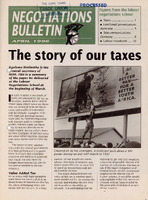 IN SOUTH AFRICA two kinds of taxes are imposed by the tax authorities, namely direct and indirect taxes. Direct taxes are those that are levied directly on the income and wealth of companies and individuals. Examples of direct taxes are personal income taxes paid by salaried employees and taxation paid on company profits. Indirect taxes are those taxes levied not directly on income earned, but on certain transactions. Examples of indirect taxes are value added taxation, customs and excise duties and transfer duties. The power to levy taxation rests with the central government. It is thus government's responsibility to ensure that a taxation structure and balance is achieved that would not only meet its budget requirements but also be fair and acceptable to its constituents.
 -
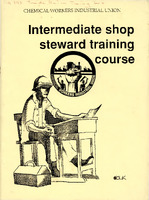 Dismissal is managements main weapon against workers. The union strives for JOB SECURITY for all workers; companies try to create INSECURITY amongst workers. Fighting against dismissals is therefore one of the biggest jobs a shop steward faces. A shop steward must be able to handle individual dismissal cases, without having to call in the organiser. In the old days, foremen / managers could fire workers for any small reason, and get away with it. Since 1973 workers have rebuilt unions to fight for their rights. One of the rights workers have fought for is the right to challenge dismissals. Workers have fought for this right in the factories and in the Industrial Court. Through such struggles, progress has been made, and certain rules have developed about what is " fair " and what is " unfair Management and the government are always trying to find ways to make dismissals easier. For instance the Labour Relations Act was changed in 1988. In the new Act, it was made easier for management to dismiss workers. However, the Unions fought and struggled to take out these changes to the Act. On May 1 1991 the Labour Relations Act was once again changed - this time more in favour of workers. Now, dismissals have to follow certain strict rules.
 -
 THE bosses' system is in crisis. In the auto, tyre, metal and motor sectors, bosses say that they can't make enough profits. So what is their solution? They say we must help them solve their crisis - by sacrificing our jobs and wages. In every sector where NUMSA is organised the bosses are saying the same thing: "There can be no job security or moratorium on retrenchment workers must be retrenched. There can be no decent or living wage - workers must accept wage increases well below inflation (16%)." The bosses say there can be no compromise on these things if the industries are to survive. They are going ahead with their plans to restructure industries. Their aim is for fewer workers, who earn less money, to produce more for them.
 -
 THE bosses' system is in crisis. In the auto, tyre, metal and motor sectors, bosses say that they can't make enough profits. So what is their solution? They say we must help them solve their crisis - by sacrificing our jobs and wages. In every sector where NUMSA is organised the bosses are saying the same thing: "There can be no job security or moratorium on retrenchment workers must be retrenched. There can be no decent or living wage - workers must accept wage increases well below inflation (16%)." The bosses say there can be no compromise on these things if the industries are to survive. They are going ahead with their plans to restructure industries. Their aim is for fewer workers, who earn less money, to produce more for them.
 -
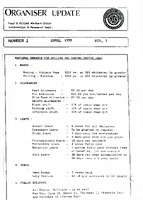 Barlow also has an international links with UK, Europe, USA and Far East. In UK it has a division which operates as J. Bibby 4 Sons and we also read that the group is listed on the Stock Exchanges in Johannesburg, London, Paris, Brussels, Antwerp, Frankfurt, Basel, Geneva and Zurich. Bibby's agricultural division is the UK s third largest producer of animal feeds, emphatically the cattle, pigs and poultry. This might be in line with the group's primary mission which is the creation of wealth for all its stakeholders. It is also said that the company's special focus is in the attainment of effective management of resources, new investment, exports and productivity.
 -
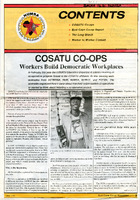 In February this year the COSATU Education Department called a meeting of co-operative projects linked to the COSATU affiliates. At this meeting were comrades from ACTWUSA, NUM, NUMSA, NUWCC, and POTWA. The comrades explained how it came about that their union started co-operatives or started to think about initiating a co-operative project. SAWCO was formed in 1985 after the mass lockout of 960 Sarmcol strikers. 1987 was the year of the miners strike and saw one of the biggest strike waves in the history of the our country. On the mines, the bosses of Anglo fired more than 13 000 workers. More than 3 500 POTWA members were dismissed by the government bosses of the post office. But not all projects started because of mass dismissals through strikes. In 1986 a bulk buying project was formed by union members at the General Motors Engine Plant in Port Elizabeth. They took their initiative back into the union for discussion. Towards the end of 1986 ex-NAAWU was looking at how to use the organised strength of the union to the benefit of members outside the shopfloor. Today, in NUMS A, the union is in the process of establishing a giant consumer co-operative, Siyanda, which means, "we are growing". In 1985 ACTWUSA vowed that it would never accept any retrenchment package from Frame that would result in workers losing jobs. And so in 1988, ACTWUSA negotiated a retrenchment package with the Frame bosses. The agreement said that the Frame company would provide the money to start a factory which would be owned and controlled by the union and which would provide jobs for the retrenched workers.
 -
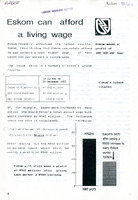 In July 1987, Eskom gave large wage increases, up to 35% for a general worker. General workers suffered a big fall in the buying power of their wages in the late 1970's but now their wages are higher than ever. The graph shows the buying power, also called "real wages", of wages from 1974 to 1987 for grade 1 and grade 5 workers at Eskom in the group 1 non-shift (national) category.
 -
 This booklet gives the minimum period of notice required before either the employer or his employee may terminate his contract of employment as laid down in the various wage regulating measures ie. Wage Determinations, Industrial Council Agreements and Wage Orders. The booklet must be used in conjunction with the: "The complete guide to wage regulation measures" by H. Cheadle and L. Silver to determine the exact area and industrial scope to which each particular measure applies. The notice period given in the booklet is of course the minimum required and it can be varied by employers in determining individual contracts of employment.
 -
 It is sad how the promises of a better life for all made by the government means so little for workers. Cosatu and Samwu mobilised our forces to ensure a victory for the ANC in the national and local government elections. Despite the fact that workers have put MPs into parliament and councillors into local government councils, we have yet to see any real benefit for workers. The 3rd and final round of negotiations delivered a big disappointment for Samwu. Once again we went into negotiations with high hopes of persuading Saiga to implement decent wage increases. Samwu's position of R250 or 10% for workers earning less than R6 700 per month was very reasonable. Because we said that those earning more than R13 700 should get a 7% increase, this meant that the total cost to councils was only 9%, which is very affordable. Saiga moved its position in negotiations by 1%. They also tried to get us to give up our demand for a R250 increase by offering a minimum wage of R1600. As we know, most workers are earning more than that. Workers earning R1600 Saiga's 5% will mean a R80 increase. This is less than councillor's get for attending one meeting! Although the negotiators tried everything to try to reach a settlement, Saiga frustrated us at every turn.
 -
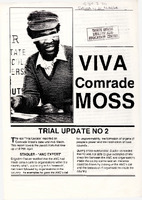 The last 'Trial Update" reported on Comrade Moss's case until mid-March. This report covers the period from that time up until 25th April.STADLER - "ANC EXPERT" Brigadier Stadler testified that the ANC had made certain calls to organisations within the country which, according to his "research", had been followed by organisations in the country. As examples he gave the ANC's call for ungovernability, the formation of organs of people's power and the destruction of town councils. During cross-examination Stadler conceded that he was not able to give examples of any direct link between the ANC and organisations inside the coutry but he said an inference could be drawn by looking at the ANC's call and the behaviour of organisations inside the country.
 -
 This document is informed by the struggles of women in the fight against colonialism and apartheid which were also encapsulated in the Women's Charter of 1954. The discussion is also premised on the charter that women drew up in 1993, prior to the 1994 elections. Our Constitution, in its quest to protect and promote gender equality in South Africa, drew largely from these documents.
 -
 A strategic framework developed for the NUMSA Organising Strategy Conference held in Randburg, Johannesburg, November 23–25, 2011. The document integrates organising, campaigning, and bargaining into a unified "OCCB Strategy." This third draft incorporates feedback from the 2010 National Workshop and the 2011 Central Committee, as well as international benchmarking lessons drawn from a study tour of North American (Canadian) labour movements by the General Secretary and sectoral coordinators.
 -
 A multi-purpose educational flyer and union recruitment tool published in 2011. It outlines the core legal protections for domestic workers in South Africa under the BCEA, LRA, and Wage Act. The pamphlet specifically highlights the 2011 "Domestic Work is Decent Work" campaign at the ILO in Geneva, seeking international recognition for the sector.
 -
 DOMESTIC WORK IS WORK; DOMESTIC WORKERS ARE WORKERS; SADSAWU through our active involvement in the processes leading up to the adoption of the ILO convention on domestic workers, recognises that our country has made huge strides to protect domestic workers in relation to other countries. South Africa and particularly the Department of Labour played a leading role ensuring that the ILO adopted the convention on the 16th June 2011. Our right to organise, to a contract of employment, to participate in processes of setting national minimum wages and conditions of employment has been achieved long before the adoption of the ILO convention But we have to continue to lead and the nexi step is the ratification of the ILO convention on domestic workers by the South African government - let us be the first country to do so in Africa and in the world.
 -
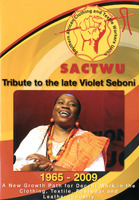 Violet Seboni was born on 18 September 1965. It was to be a turbulent start to life for this young girl who never got to know her father, in a story that started in sadness. And shortly after her birth, it was her mother too that she lost in circumstances that no one should experience. She knew pain and later in life she stood up for those in pain. Young Violet was raised by her grandmother for the first few years of her life, and when her grandmother died, it was her granny's friend - in a culture where ubuntu requires that we reach out to others - who took on the responsibility to rear the young girl and to become her comforter, her provider, her mother. Violet went to primary school and later to Madibane High School in Diepkloof, where she developed a love for netball and a passion for activism. After high school, she became pregnant and her beloved daughter Lesego was born. She looked for work, and like generations of young, working- class women before her, she turned to the clothing industry, to use her hands, her dexterity and her skill to earn a living to feed her young family. The role the industry plays, to give work, bread and life to those in need, is in itself a reason not to let the industry die simply due to the cold, harsh winds of global competition and indifference or inaction from those who have the power to intervene, to use trade measures and to use industrial policy tools to save jobs and absorb our people into decent work opportunities. The industry that young Violet chose is one whose factories in Joburg grew with the discovery of minerals and the rapid growth of an urban population that needed to be clothed. Violet's predecessors in the industry were white women sewing machinists, mainly Afrikaners, often the wives and daughters of the Afrikaner mineworkers who as 'by-woners', were like their black brethren, driven off the land and into the cities hungry for labour. Trade unionism took root among the male mineworkers - Die Mynwerkers Unie was their vehicle - and among female garment workers - through the Garment Workers Union.,A new growth path for decent work in the clothing, textile, footwear and leather industry