
General Materials
Item set
- Title
- General Materials
- Alternative Title
- LRS General Materials
- Creator
- Labour Research Service (LRS)
Items
-
 More than two years of worker struggle, mass action and negotiations resulted last Thursday 14th February in the scrapping of the 1988 amendments to the Labour Relations Act. The State President has to sign the new Act within ten days of it being passed by parliament. Some of the most important changes contained in the new LRA are: The 1988 definition of the "unfair labour practice" is gone, removing strikes and lockouts from this definition. It will now be easier to use the Conciliation Boards and the Industrial Court to help resolve disputes. It will no longer be presumed that a union 0 is responsible for an illegal strike of its members. An employer can't interdict a strike without giving 48 hours notice or, if shorter notice is given, without informing the union. Unions with public and private sector members can now register. COSATU will be organising regional workshops for organisers to look at the implications of the Act, and how to apply the new provisions. COSATU has stated that the scrapping of the amendments are only the first step in the process of creating a workers LRA. Immediately on the agenda, in terms of the agreement reached with employers and the state last year, is our demand for rights to be extended to farm workers, domestic workers, public sector workers, and workers in the bantustans. June is the deadline which has been set for real progress to be made in these areas. COSATU is also calling for the restructuring of the Labour Appeal Court and the National Manpower Commission.
 -
 This discussion paper is being issued seven months after the 7th National Congress. The Central Executive Committee (CEC) of February 12 to 14, 2001 debated it, and felt that with minor changes it should be issued to COSATU structures and members for debates on the current political situation. This paper is presented to the members and structures of COSATU as a political discussion paper for 2001. A further detailed political discussion will take place in the November 2001 CEC. As the last CEC of 2001, it will be expected to take stock of the political situation, taking into account issues raised here. The February CEC took place almost five months after the Seventh National Congress. The Congress was a watershed moment and a turning noint in the life of the organisation. For 'months"before as well as xiuriiig the- Congress itself, our members and the public focused on the Congress deliberations and discussions. In political terms, this process underlined the central role played by COSATU in the post-apartheid political landscape
 -
 The living wage campaign falls under the jurisdiction of the SACCAWU organising and collective bargaining unit. The unit is divided into two sectors, commercial and catering, with co-ordinators for both sectors at national and branch level. The national and branch co-ordinators are responsible for implementing the living wage campaign. Quarterly meetings of all organising and collective bargaining unit co-ordinators are scheduled to be held to monitor and evaluate progress. A national workshop of all negotiators and delegates from the union's negotiating committees was held in January. This workshop carried out planning and formulated strategies on various aspects related to living wage activities and campaigns for this year. Another national workshop is scheduled to be held in November.
 -
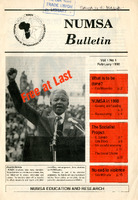 NUMSA structures take many decisions. These decisions are not taken in isolation, they are influenced by events, information and debates. The decisions taken will be found in the official documents and reports of NUMSA committees and congresses. These decisions are NUMSA policy. However, as part of the education programme, the Bulletin will carry background articles. These articles are not policy but are part of the educational resources of NUMSA.
 -
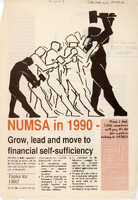 NUMSA is fully committed to playing an active role in the liberation of the working class and ending the oppression of our people. To do this we have set ourselves certain very important tasks in 1990. They are: To strengthen and democratise our union in order to improve conditions for our members, To actively work in our federation COSATU to strengthen it an to greatly improve our working relationship with other affiliates. To contribute to the liberation struggle by using our strength together with the MDM to defeat oppression and exploitation To play an active role in the community struggles in our land particularly in areas such as the Natal violence To actively contribute to developing programmes for a future South Africa based on democracy and socialist planning to improve the lives of all people, To make our organisation administratively efficient and to develop the skills of leadership, organisers and administrators. To become financially self-sufficient.
 -
 South Africa is going through its severest economic crisis ever with millions unemployed, retrenched and without any jobs and with no social security or benefits; the cost of which is measured in the loss of lives, through poverty and starvation, and massive degradation and demoralisation of the workers and all the oppressed people in SA. The economic crisis is part and parcel of a political crisis. The state is incapable of meeting even the minimum democratic demands of the people and has to instead resort to violent measures to stifle all opposition. The present state of emergency with its accompanying arrests of thousands of people, the killing of hundreds and banning of democratic organisations such as COSAS also affects workers.
 -
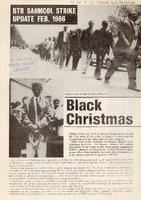 CHRISTMAS Day 1985 in Howick/Mpophomeni marked the 34th week of the strike by Sarmcol workers over the recognition of trade union rights by the Company. While local white residents of HowicK planned their Christmas festivities the Sarmcol strikers still entirely dependant on the small weekly food parcels supplied by MAWU, planned to bring home to local Sanncol management their determination to secure their reinstatement at the factory and the recognition of MAWU. Accordingly on Christmas Day the strikers and their families dressed in black, took buses into the white CBD of Howick to attend the morning Christmas church service at the local Anglican Church — the church of Senior Sarmcol management. Most of the strikers were told to sit in a corner wing of the church while the others stood outside. However at Communion the white Anglicans including Mr. Sampson, the Sarmcol financial director, were joined by the Anglicans amongst the strikers. The morning service was sombre but peaceful. After the service the strikers who rwere unable to afford the transport fares decided to walk back to their homes which in terms of South Africa's grand apartheid plans have been located over 20 kins from Howick. The march which was led by sympathetic priests from the area, was closely followed by the SA Police who waited until the strikers had gone beyond the white residential areas and then broke up the procession and forced the strikers to board buses from the nearby Merrivale bus rank. In order to keep Christmas a peaceful day the strikers did not resist and boarded the buses back to their township. In the township the strikers gathered outside the church for a brief discussion and prayer and reconfirmed their determination to continue their struggle against BTR irrespective of the cost.
 -
-
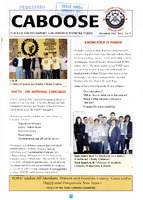 NACTU held its 5th National Congress at Shaft 17 centre in Gauteng from 13 to 16th November 1997. Comrades M Soeker, Joe Sineker, J Braaf, C Lahoo and D Abels were the TOWU delegates. Several constructive resolutions were passed at Congress, notably: Organizational issues Labour market issues Economic issues Social issues Transformation and affirmative action. Discussion and debates ensured that everybody present partook actively because making resolutions and implementing them .are two different things. Message of NACTU President, Comrade James T Madlalose: "We in NACTU need to be more committed and focused. A lot of work lies ahead and it is our responsibility as Congress to execute it with the best interests of our members in mind. NACTU will survive AMANDLA!".
 -
 THE South African Commercial Catering and Allied Workers Union (Saccawu) launched a medical aid fund yesterday which the union said would be used as a springboard for the establishment of its own medical aid scheme. Saccawu assistant general secretary Herbet Mkhize said the fund would operate under Medscheme's Meddent Medical Scheme for about nine months while the union conducted further research into establishing its own medical aid scheme. Mkhize said trade unions were no longer only competing with one another but also with legal firms that were now offering their services to workers. “Now a trade union has to convince potential members that it offers the best services, “Mkhize said. “When you try to recruit a member, they would like to know what they will get out of it. You tell them about getting legal representation when they are unfairly dismissed and they are members of Legalwise. “If you do not offer more than just representation, then you have lost those members,†he said. Mkhize said just as banks were now under threat from retail outlets which were now offering banking facilities, unions were under pressure to improve their benefits for members and also broaden the scope of benefits. The new fund was put together' by Medscheme's Negotiated Benefits Unit (NBU) and follows three years of research by Saccawu. NBU head John Eagles said the fund was unique in that it enabled members to register parents as dependants and that it had a range of benefit options.
 -
 It happened too slowly, not easy to imagine, nonetheless it happened. Minister Tito Mboweni is fairly delighted, the work is done and the new Labour Relations is in place. Is it the same word with workers. Perhaps, what is more important is to observe the provisions of the Act. It certainly brings about balanced playing fields between the business and labour movement. Unions are now allowed to organise and if necessary majority unions are now able to sign for a close shop. The majority union in a given place of employment has overriding rights and workers falling outside organised labour are not free of paying subscriptions, gone are days of labels such as 'umdlwembe' because all will be regarded as organised labour force. Workers have a legal status to strike which should be observed by employers, gone are the days of dismissing workers simply because they participate in the strike. We hope such a provision will stop union bash activities taking place in Kiley Baker, A C Doors and Transvaal Mattress Company.
 -
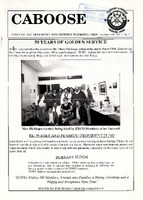 Mr. Adams is a member of TOWU for the past 28 years. From 1976 to 1987 he was a shop steward at the old Klipfontein depot until moving over to Arrowgate. In 1990 he again became a shop steward until 1992 when he was elected as the Vice president. Mr. Adams is married and have three children. His wife Susan is a principal at B ABS Educare. His son Peter is a lawyer and works as an International Financial Consultant in Melbourne, Australia. He has two daughters, Geraldine is a qualified nurse and Hildegarde "the baby" is a 3rd year law student at U.W.C. His hobby is gardening, and he takes pride of his many trophies he has won as a Brigade Drum Major. His keen wit and dry sense of humour makes him a very likeable person. Despite that he is a hard task master at the various forums and committees he serves on.
 -
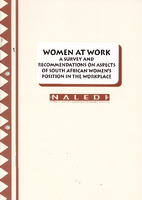 The research report emanates from the NALEDI Women and Work research group. In 1994 COSATU's Congress called for the establishment of a research group at NALEDI to explore the position of women workers. After discussions between COSATU National Women's Sub-Committee and NALEDI, the Women and Work Project was conceived. The project comprises of two research programmes: firstly, an examination of the problems experienced by women at the workplace, and, secondly, an examination of the position of women in the trade unions. This report is the first leg of that project. It is envisaged that the second leg (on women in trade unions), will be completed by the end of 1995. This report is primarily aimed at synthesising existing literature and does not necessarily generate new information. The report identifies key problems experienced by women at the workplace and recommends policy options for unions, employers and the government. However, the report does not consider all problems experienced by women at the workplace. For example, key issues like education, training,' health and safety are not dealt with here.
 -
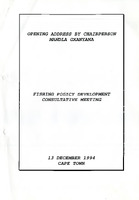 On 27 October 1994 we met at the Good Hope Centre with the purpose of launching a process for developing a fisheries policy. The call of the meeting was driven by the problems and the situation faced by Fisher folk. Communities in the coastal areas are starving and living under bad conditions. These resources are not utilised to address these problems at present as stated in the RDP. The present system creates conflict between individuals and between regions. Since the appointment of Mandla Gxanyana at the Good hope centre meeting lots of things have happened, consultation with regions, forums, organisation and individuals on how to take up this process and the formation of the committee. There was final agreement of bottom up approach. This approach encouraged region like Eastern Cape to take up the process and reported into the siting of the legislature of the Eastern Cape region. In KwaZulu Natal process of creating forum have started which include all the players. I hope this process will create a national Fishing Forum, which shall have committee in the different coastal communities, because RDP outline how our resource should be managed, that our communities are great pillar for the management of our resources.
 -
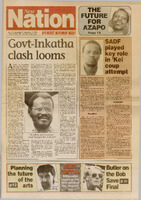 clash is looming between the National Party (NP) government and the Inkatha Freedom Party (IFP) following this week's unveiling by kwaZulu chief minister, Chief Mangosuthu Buthelezi of a constitutional blueprint which envisages a kwaZulu/- Natal state. Following the unveiling of the document this week, state president FW de Klerk, warned that kwaZulu's constitutional initiatives had the potential of escalating violence and of bringing the kwaZulu government into "direct confrontation" with Pretoria. An urgent meeting between De Klerk and Buthelezi is expected within the week. And sources in the government have indicated that senior NP leaders were disillusioned with the IFP and were looking for the "best way to ditch Chief Buthelezi". The sources said that although the NP recognised that Buthelezi was a factor in finding a solution to South Africa's political conflict, the party was disillusioned with the IFP and felt that the government had been misled into believing that the organisation commanded the support it claimed. The NP leadership, as well as their strategists, now believed that the De Klerk government should rather direct all its energy towards striking a deal with the ANC - provided such a deal secured a future for whites. The ANC's newly adopted "Strategic Perspective" document - which envisages powersharing between the ANC and the Nationalists from the transition phase up to the postapartheid era - is viewed as a positive signal which justifies the need for closer ties between the Nats and the ANC. There is also concern within the NP that Buthelezi's latest moves - of steering a conference of right wing parties and this week's constitutional proposals - are "driving" whites away from NP to the Conservative Party (CP). The CP is one of the parties KwaZulu chief minister, Chief Mangosuthu Buthelezi that has welcomed kwaZulu's constitutional blueprint and said it was in line with the CP's vision of the "self-determination of nations in a commonwealth of independent statesâ€. Meanwhile, Democratic Party (DP) Member of Parliament for Umhlanga, Kobus jordaan, who was among those involved in the kwaZulu/Natal Indaba plan in the mid-1980s, said there was no comparison between that initiative and this week's constitutional proposals. "The Buthelezi that was involved in the kwaZulu/Natal Indaba, is not the same Buthelezi that we have today," said Jordaan. "He had a national approach, and never spoke about secession. This proposal smacks of secession ," added Jordaan. Scholars of Natal politics have argued that Buthelezi's undertaking to test his proposals of a kwaZulu/Natal state in a referendum were logisti- cally impossible. The calling of a referendum was also described as "legally impossible", especially now that De Klerk has poured cold water on the initiative. KwaZulu would have no powers to call a referendum for people who live in Natal. Records of the kwaZulu interior department state that only 770 000 people - in a population of 3- million - in the homeland had registered for the 1988 elections. It is suggested that people in the province would either refuse to go to a referendum or Buthelezi would simply lose it. They have pointed out that the Inkatha leader might be over estimating his support. Economists said Natal alone could not be economically viable. The region comprises of about 25 percent of South Africa's population, but it was responsible for only 16 percent of the Gross Domestic Product (GDP)
 -
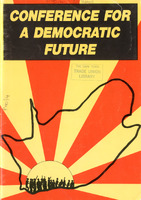 This booklet is intended to serve as a report-back to those organisations which were party to the Conference for a Democratic Future (CDF) and to those who were unable to be present. It is also intended to act as a guide to action for 1990 and beyond. The CDF was a historic gathering of the forces for change represented by 4600 delegates from over 2100 organisations. These range form Bantustan parties on the one end of the political spectrum to ultra leftist groups on the other end. But perhaps the most significant presence was from organisations like Five Freedoms Forum, NAFCOC, the Hindu Seva Samaj, that of traditional leaders and the hundreds of other community organisations which are rapidly becoming an active component of the mass struggle for change. Also significant was the strong worker representation from a range of trade unions, including eight affiliates of NACTU whose leadership had turned down the invitation to be part of the Conference. The Conference for a Democratic Future was a major step in the overall process of building unity in action and maximising the isolation of the regime. It was, in this sense, not an isolated event. The year 1989 had taken unity in action to new heights with the Defiance Campaign and the mass marches. The process leading up to the CDF was intended td be more important then the Conference itself. Likewise, in the post-Conference period, the follow-up process should be given the importance it deserves. At the end of the day, it is this follow-up process which would determine the actual success or failure of the CDF exercise. The Declaration adopted at the Conference represents the strategic orientation of the broad forces for change. It calls for the intensification of the struggle and for the placing of the question of political power on the agenda of our united mass action. The Conference resolutions collectively contain the elements of a programme of action. Without exception, each resolution is a call to action. The task of all participants of the Conference is to translate these resolutions into Mass United Action. The adoption of the Harare Declaration should act as the starting point of a process which takes its content to the masses of our people in all comers of the country. The demand for the Constituent Assembly should become a popular demand of the people. By adopting the resolution on international pressure, the Conference sends an unambiguous signal to the world community on how the people of South Africa view their role in the struggle to end apartheid. The follow-up to the Conference should also be a continuing search for whatever common ground exists between the broad forces for change. This search must take place not only at a national level, but mere importantly at a regional and local level. Let us bear in mind the words of the Declaration: “The moral appeal of the Democratic Movement has never been greaterâ€. by an MDM delegate on the CDF Convening Committee.,Includes the Harare Declaration: declaration of the OAU Ad-hoc Committee on Southern Africa on the Question of South Africa (Harare, Zimbabwe, August 21, 1989)
 -
-
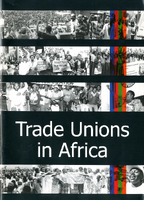 In March 2001, a group of African trade union-based researchers met in Johannesburg, South Africa, to form the African Labour Researchers Network (ALRN). The network initially covered Ghana, Nigeria, Namibia, South Africa, Zimbabwe and Zambia but has since grown and now includes Kenya, Tanzania, Malawi and Angola. One of the network's objectives is to address policy issues that affect African workers and their trade unions by providing relevant research and education materials. The first research project undertaken by the network covered the labour movement in the countries of the founding members. The researchers looked at the legal, economic and political environment in which trade unions operate and identified some of the key challenges that unions face today. This booklet is based on the country case studies that were undertaken by Austin Muneku (Zambia), Anthony yaw Baah (Ghana), Godfrey Kanyenze and Blessing Chiripanhura (Zimbabwe), Salihu Lukman (Nigeria), Herbert Jauch and Barney Karuuombe (Namibia) as well as Ravi Naidoo, Claire Horton, Thobile Yanta, Samuel Denga, Lebo Modise and Wolfe Braude (South Africa). This booklet was compiled by Herbert Jauch and Kishi-Silas Shakumu with assistance from Anthony yaw Baah. We wish to thank the Ford Foundation, the Netherlands Trade Union Federation (FNV), the Finnish Trade Union Solidarity Centre (SASK), and the Belgian Fund for Development Co-operation (FOS) for their support (direct and indirect) of the network's activities, which made the publication of this booklet possible.
 -
 The Portfolio Committee on Labour considered amendments to the Employment Equity Bill which were tabled in parliament by the Department of Labour today. Amongst these were amendments in response to COSATU's proposals for closing the apartheid wage gap. COSATU has serious reservations, however, about the tabled amendments on this issue, and believes that the amendments proposed today by the ANC should be supported as they address these defects. Finalisation of the clauses relating to the wage gap has been postponed to next week, when the Bill will be voted on by the Committee. COSATU has consistently maintained the view, both in our submissions to the committee last month, and at NEDLAC, that the Employment Equity Bill must address the issue of the apartheid wage gap, if it is to have meaning for the millions of ordinary workers, who are the worst victims of apartheid discrimination, and who will not be able to reach the upper echelons of the workforce, despite the affirmative action provisions of the legislation. We have supported the philosophy of the legislation that employment equity must benefit everybody, and not just an elite few. We have taken the view that the legislation must address the critical legacy of massive income inequalities, which was a deliberate policy under apartheid, in order to make this philosophical approach a reality, and that in this respect the Draft Bill was seriously defective. We proposed a series of concrete amendments to remedy this defect, within the broad philosophical approach and architecture of the Bill. We also proposed an integrated strategy to address these differentials, which combines measures in the Employment Equity legislation with other legislation and processes. A number of organisations have supported us in this view. Further a concept document tabled by the Department of Labour in the parliamentary committee broadly endorsed this approach.
 -
 The Executive Committee met in its normal session on 18 - 19 August 1998. It received reports on a range of socio-economic and political issues. As is always the case, discussions were conducted in a true tradition of the federation - comradeship, frankness, robust and constructive. A number of decisions were taken by the meeting, some of which are contained in this statement. The meeting received a report on meetings held with Old Mutual and Sanlam respectively. The meeting reaffirmed COSATU's opposition to demutualisation on political and economic grounds and regretted the fact that the portfolio committee had gone ahead to finalise the bills dealing with demutualisation inspite of being informed about discussions currently taking place with the two mutual companies. We remain of the view that it would help the parliamentary process had this process been allowed to proceed to its final conclusion.
 -
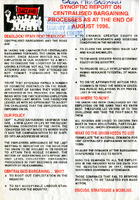 Centralised bargaining and the road ahead.In taking the campaign for centralised bargaining forward, the union, in February, once again invited all the employers in our industry to a meeting to discuss the logistics of establishing a forum. Not all the companies attended and those that attended did not commit themselves to this progress. Those that attended raised a number of cosmetic obstacles on the issue, just short of saying they were not interested in the process. The discussions with the participating employers collapsed last month. This therefore lives us with no option but to accept the challenge that the employers are imposing on us.
 -
-
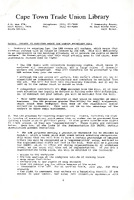 Contrary to existing law, the LRB covers all workers, which means that domestic workers will in future be covered by the LRA. This will definitely be an improvement on the existing situation, as it extends the rights of SADWU workers. On investigating what this would actually mean to the union, some problematic factors come to light: The LRB deals with collective bargaining rights, which means it excludes all unorganised workers, and a large number of domestic workers are unorganised. They will therefore not be protected by the LRA unless they join the union. Although the LRB covers all workers, home workers (domestics) may be classified as independent contractors and therefore be excluded from the act. The bill has been left deliberately flexible, and it may be left up to the labour court to decide on this. Independent contractors are excluded from the bill, so if your work situation can legally be defined as falling under this definition, ie. if contract out your labour, you will be excluded from the bill. Many SADWU members are employed in what would be regarded as small business. The LRB proposes greater flexibility for small businesses, which could mean exemption from some of the regulations and/or collective agreements. This will not be to the advantage of the workers in these small businesses.
 -
 It has been agreed that SAMWU will register under the PSLRA to allow the new union to be able to be registered under the Public and the Private sectors.This is called a piggy bag model. The NEC will be composed of the newly elected NOB's and Heads Of Departments together with one delegate from the. respective regions'..The NOB's will go around launching the regions after the merger congress.
 -
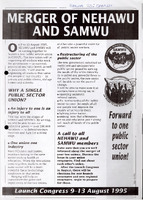 On 9 to 13 August 1995,NEHAWU and SAMWU will be coming together to launch a new public service union in COSATU. The new union will be organising all workers who work for government — at national, provincial and local levels as well as parastatals. It will also be Organising all workers that serve the people of our country — in private and public clinics, old age homes and schools.