
General Materials
Item set
- Title
- General Materials
- Alternative Title
- LRS General Materials
- Creator
- Labour Research Service (LRS)
Items
-
 This department decided to retain the current 1990/1 budget figure of R7bn for curative health and administration costs. A further R2.1bn was proposed for preventative health care. The total health budget is therefore R9.1bn. Primary Health Care (PHC) will be an addition to the health budget. The PHC addition is R1.4bn, which will cover training of PHC workers; the cost of purchasing the ten identified common medicines and drugs that will be mass produced and the cost of setting up informal rural clinics. A further addition to the health budget is the setting up and equiping local Rehabilitation Centres (RC). R0.7bn is allocated for these centres. Speech therapy, physiotherapy and such medical science disciplines will be located at the local RC so as to ease the pressure on hosipitals. The setting up Industrial Hosipitals (IH) which will be located in the industrial areas will be assisted by the health department. The IH must be viewed as an alternative to "medical aid", that workers are increasingly demanding in collective bargaining. Instead IH would be set up in industrial areas serving the factories in those areas. These IH will controlled by workers and management with the health department playing only an advisory and inspectionary role.
 -
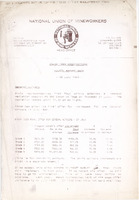 Sixty representatives from four unions attended a mammoth mediation session at the Esxom College on Thursday 27 July. The mediation lasted until 11.30 pm at night. Eskom has given its final offer for increases for the General Workers in July 1989.
 -
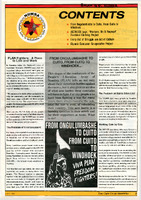 In Namibia today the National Union of Namibian Workers (NUNW) says that the organised labour movement must play an active role in helping PLAN fighters and the war refugees, to find somewhere to live and to find work. They say: "All these people are the relatives of us who remained behind. Together we must look at what our needs are in the communities where we live, and find ways of meeting our needs. " We must use the skills of the combatants to help the community and the community in their turn, must welcome all those people back from the war. The organisations of the people, the trade unions and SWAPO, must help in this process." How can the NUNW help all the people returning from the war to find their place in the community? The NUNW says we need to first understand the strengths and weaknesses of the people and the country.
 -
 Comrade delegates International and local guests Friends and compatriots I wish to welcome you to COSATU's Second National Congress This Congress is taking place at a time when the conflict between the forces trying to maintain the system and the forces of social progress is hotter then ever; when masses of our people are in a state of near permanent upsurge and when nearly everyone is now realising that the apparent iron fortress of the ruling class is breaking down. As we are meeting today, we are doing so united by the deep-seated feeling that victory is certain. Because of that, we must be clear that our Congress is an important milestone in our march towards our total freedom. With unity and clarity of purpose, we must deliberate on all the issues that are put before this Congress and take such decisions as are necessary to take the struggles of the working class in particular, and of the mass democratic movement in general, forward.
 -
-
 THE Central Executive Committee of COSATU took a decision in 1986 that active discussion and study of the South African economy was a priority. This decision was prompted by the very serious problems of unemployment, retrenchment, inflation and poverty that we now face. It was also prompted by an understanding that organised workers must be able to propose and fight for solutions to these problems. In addition sanctions are now becoming a reality. The need to thoroughly understand the economy is even more urgent. One of the biggest problems for any person trying to understand the South African economy is the question: Through whose eyes do we study it? We can look at the economy through the eyes of the capitalists or we can look at it through the eyes of workers. Depending on which set of eyes we use, we'll see a very different picture. The newspapers, radio, TV and education system all look at the economy through the eyes of the capitalist. They talk of economic laws* which are efficient and benefit everyone. And when the economy goes into a recession* or into a crisis* they argue that the economic laws are being interfered with. They want people to think that the economy is something controlled by laws that workers cannot change. In this booklet on the South African economy we will look at the economy through the eyes of workers. We will see how politics and economics have combined to the benefit of the capitalists. In doing this we will undertake a study of the political economy * of South Africa. The aim of this booklet is to provide a starting point for a study of the South African political economy. We will be looking back into our history to understand the very close link between politics and economics. The purpose of such a political economy study is to allow us to better understand just how serious the present crisis is. Being clearer on this will also allow us to begin discussing the real and effective solutions to the crisis. This is important because many of the solutions being proposed at present will benefit capitalism but will lead to small changes for the mass of the people.
 -
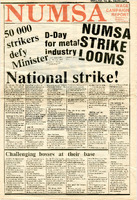 ON 14th July 1987, for the first time in South African history, there was a national strike in the metal industry. About 350 factories stopped work all over the country in support of the NUMSA demand for a living wage. Metalworkers voted overwhelmingly for strike action in the national ballot that was conducted between 6th and 8th July. The strike was set for the 14th July. Workers were ready to fight SEIFSA until they won. The militancy of workers could be seen from the huge attendance at local meetings. During the week of the ballot shop stewards were gathering in huge numbers in the union offices to discuss problems and plan strategy. In the Eastern Cape a general meeting of over 400 workers was held to discuss plans.
 -
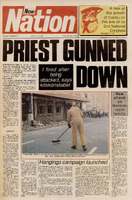 KITSKONSTABELS in the Karoo town of Aberdeen this week shot and beat a priest while he lay handcuffed and dying, accusing him of being a communist. These allegations were made by residents who claim to have witnessed the incident. Police have confirmed that municipal police shot and killed Rev Booi Jantjies (40) of the Zion Church in Africa, but deny the residents' version. Residents say Sergeant James Ndunjane described Rev Jantjies as a "communist suspect" after the latter was shot. A witness who asked not to be named said nine kitskonstabels had gone to Jantjies' house between 9 and IOpm on Tuesday, but.-, had not found him. "They took away his son, whom they said was suspected of dealing in dagga," said the eye-witness. "Jantjies1 son was told he was being taken to the house of Ndu- njeni's brother Mbu- leni, also a kitskon- stabel. "When Rev Jantjies arrived home, he heard the news and went to look for his son in Ndunjane's house," he said.
 -
 The University of the Witwatersrand has a long established relationship with the mining industry. Indeed, its origins go back to the South African School of Mines established in Kimberley in 1896. (1). Since 1917, the Chamber of Mines has given direct grants to the University and its predecessors. In fact, the Chamber remains our largest private donor. Murray has shown in his authoritative study of the early years of the University that there have been occasions in our history when the Chamber has felt that it has not received a satisfactory return upon its massive investment in the University (2). On balance, however, the University can rightly claim to have served the Chamber well over the years. In recent years, the other side of the industry's history and social structure has been a focus of systematic investigation in this University. Here, van Onselen's Chibaro stands out : a pioneering attempt to create historically the social world of the compound in the early years of the mining industry in Southern Rhodesia. In our own Department, Moodie, Bozzoli, and Innes have all contributed to our knowledge of the social structure of mining.
 -
 The COSATU Central Executive Committee Lekgotla endorsed this document in May 2000. It aims to initiate a discussion in COSATU and the democratic movement as a whole on the state of the transformation and our progress in taking forward the National Democratic Revolution (NDR). This process should inform the development of resolutions for COSATU's Seventh National Congress. The years since the transition to democracy in 1994 have seen fundamental shifts in the political economy of South Africa. These shifts present new challenges for COSATU and the democratic movement as a whole. To address them requires reflection on the basic trends in society and our strategies for pursuing the National Democratic Revolution (NDR). This document first reviews progress and setbacks in achieving these goals since the transition to democracy in 1994. In that context, it explores current attempts to rewrite the aims of the NDR. Above all, some groups want to redefine the NDR merely to provide equal opportunities for all, irrespective of race. This tendency would stop the NDR before it achieves more fundamental reconstruction and development toward a non-racial, nonsexist society on the basis of democ- ratisation of the state and the economy. After considering these issues, the document explores changes in the balance of power, in terms of the political arena, the nature of capital, international developments, the state and the Alliance. Finally, it points to some implications for the development of transformatory programmes by COSATU and the Alliance.
 -
 Sedert 1992, toe die politieke regskikking van die land begin gebeur het (Goddank), het die rooilig-tyd by ons verbygegaan en, met die verkiesing in 1994, het 'n wonderlike groenlig*tydvak vir ons almal aangebreek. Politiek, en veral party-politiek hierby uitgesluit, sal geen regdenkende mens horn weer wil terugbegeef in die tyd toe demokrasie 'n hoi woord was en die land effektief regeer is deur een magtige kabaal met hordes gedienstige rade, geheime komitees en baantjies-vir-boeties- organisasies nie. Suid-Afrika het destyds, sedert die verkiesing in 1948, progressief 'n minder lekker plek begin raak om in te bly - veral vir party van die groeperings. Dit het hoofsaaklik gebeur, soos dit in Engels gestel word, weens "power corrupts, absolute power corrupts absolutely". Ek sluit nie by hierdie stelling enige spesifieke persone in nie; ek maak slegs in die bree die stelling oor dit waar is van enige situasie. Oor mens maar altyd mens bly en versoekings vo
 -
 Local Economic Development (LED) is one of the primary building blocks in terms of the economic growth and development equation for the Province. The primary challenges LED has the potential to address include the following: Job creation, the building of an enabling environment that will encourage economic engagement by a larger number of local entrepreneurs, drawing together a number of critical partners and mobilising their energies and resources towards local economic growth and development, facilitating access to finance, markets, capacity building and business support services, creating the environment which will effect economic viability of local communities and their Local Authorities, linking local product development to provincial, national and international markets. There are many other fundamental challenges. The key issue though is whether people in their communities, especially rural and peripheral environments, are benefiting in real terms regarding the quality of their lives. The LED programme will also give effect to the “Growth, Employment and Redistribution: A Macro Economic Strategy†framework that outlines the strategy for rebuilding and restructuring the South African economy. The document confirms Government's commitment: “It is Government's conviction that we have to mobilise all our energy in a new burst of economic activity. This will need to break current constraints and catapult the economy to higher levels of growth, development and employment needed to provide a better life for all South Africans.†(1996:2)
 -
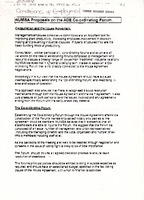 Managament/employee consultative committees are an important tool for improving plant productivity, increasing employee involvement In decision making and preventing Industrial disputes. Properly structured they are the basic building block of productivity. Consultation, worker participation, co-ordinating forums and so on are ail variations on the Idea of establishing forums composed of management and labour to discuss a broader range of issues than "traditional" industrial relations. NUMSA believes that it is^neither side long term interest to establish a Coordinating Forum that is not directly connected to the House Agreement negotiations.
 -
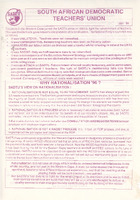 Teachers in the Western Cape joined the SADTU strike in 1993 to fight the retrenchment of teachers. This was the De Klerk government's interpretation of rationalisation. The National Party's approach was as follows : It was UNILATERAL. Teachers were not consulted. It was UNIMAGINATIVE. Retrenching teachers was seen as the only option. It BRANDED our labour action as immoral and unlawful whilst refusing to extend the LRA3 to teachers. It was RACIST. Only ex-HoR teachers were to be retrenched. It was a consequence of the Education Renewal Strategy and designed to anticipate an ANC take over and it was seen a last ditched attempt to maintain and protect the privileges of the white ruling class. It was an ATTACK on SADTU. Retrenchment affected mostly temporary, and in some cases, permanent post-level 1 teachers. The bulk of SADTU's membership falls into these categories. What added insult to injury, was that more promotion posts were created. Senior heads of departments became deputy principals, and more Heads of Department posts were created. Consequently, millions of rands were wasted.
 -
-
-
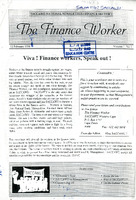 Workers in the finance sector's struggle against low wages, unfair labour practice, racial and gender discrimination by their wealthy bosses have been ignored for too long. We are seen as pencil pushers and white collar workers who earn big salaries. Now, the time has come for the truth, to put the record straight and speak as one voice through. The Finance Worker, our own mouthpiece, spearheaded by our union SACCAWU. SACCAWU is the only union that recognises the struggle of the comrades in the finance sector, therefore those workers who are not yet members of our union should organise and join SACCAWU to become a strong force in the finance sector. Workers at Sanlam, Fust National Bank, Metropolitan, Standard Bank, African Bank, Price Forbes &. .Alexander and others have already joined SACCAWU. The time to sit and watch our wealthy bosses (fat cats ) in their flashy cars and huge palaces, whilst we go home with a starting wage, is over. We must organise, unite and support each other to fight for a liting wage, better working conditions, and basic trade union rights. This newsletter will give all the workers in the finance sector the opportunity to have their say on worker issues. It will be up to you the workers, to make this newsletter a success and a pain in the (SjSSS of the bosses. We plan to publish an issue every month, depending on contributions from vou, the workers. The names of workers who'll be sending, in articles and other contributions will remain anonymous if the}- so wish, to prevent them from bemg victimised and intimidated by Management. SACCAWU accept full editorial responsibility for the newsletter and the production thereof.
 -
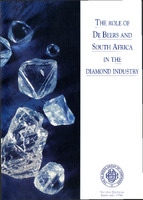 This memorandum outlines the role of De Beers and its leading position in the international diamond industry. It is designed to give a brief overview of the “diamond pipeline†that leads from prospecting and mining of diamonds in remote parts of Africa and elsewhere to glamorous jewellers' shops the world oven It looks particularly at the unique and important role South Africa plays in the diamond pipeline.
 -
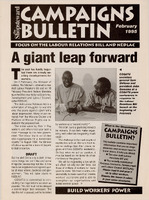 The year has hardly begun but there are already exciting developments for workers. On 2 February, the Minister of Labour, Tito Mboweni, unveiled a new draft Labour Relations Bill and on 18 February President Nelson Mandela launched the new National Economic, Development and Labour Council, called NEDLAC. The draft Labour Relations Act is a culmination of struggles by workers over the years against apartheid's labour dispensation. Many of our demands from the Workers Charter and Platform of Worker Rights are included in the proposed law. The strike wave by Pick 'n Pay workers and others last year sent a clear message to the new government: “Our labour law is out of date and inappropriate for a democratic country.†In August 1994, the Minister of Labour appointed a team of lawyers to draft a new law.
 -
 In July 1994 the Cabinet approved the appointment of a Ministerial Legal Task Team to overhaul the laws regulating labour relations and to prepare a negotiating document-in draft Bill form to initiate a process of public discussion and negotiation by organized labour and business and other interested parties. Its brief was to draft a Labour Relations Bill which would give effect to government policy as reflected in the Reconstruction and Development Programme (RDP);. give effect to public statements and decisions of the President and the Minister of Labour, which commit the government to International Labour Organisation (ILO) Conventions 87, 98 and 111, among others, and the findings of the ILO's Fact Finding and Conciliation Commission (FFCC); comply with the Constitution; be simple and, wherever possible, written in a language that the users of the legislation, namely workers and employers, could ^understand, and provide procedures that workers and employers were able to use themselves; be certain and, wherever possible, spell out the rights and obligations of workers, trade unions, employers, and employers' organizations so as to avoid a case-by-case determination of what constitutes fair labour practices; contain a recognition of fundamental organizational rights of trade unions; provide a simple procedure for the certification of trade .unions and employers' organizations and for the regulation of specific aspects of these organizations in order to ensure democratic practices and proper financial control; promote and facilitate collective bargaining in the workplace; promote and facilitate collective bargaining at industry level.
 -
 The year 1993 was a year of test and struggle for SADTU. As President of SADTU I believe that we have passed the gruesome test and successfully concluded our struggle against the Apartheid regime. I want to commend and congratulate our regions, branches and the entire membership for remaining vigilant against apartheid education and its bureaucratic structures in order to defend the rights of teachers. You must remember that your success is most vital because SADTU is the only teachers' union that had the ability and the capacity to fight against 19 education departments. Various issues faced us in 1993. At the beginning of 1993 F.W. de Klerk closed salary negotiations. Because of our campaigns these negotiations were re-opened. We opened the door for all teachers irrespective of membership. All other teachers' organisations had accepted the closure by the State President of negotiations and the meagre offer of 5% as a reality. Rationalisation programmes went ahead in the HOR/HOD/HOA, again because of the insistence of the leader of the NP, F.W. de Klerk, that all departments must rationalise and cut back. This unfortunately was effected by retrenching thousands of teachers. Although our campaigns were unsuccessful in as far as stopping these programmes, we have succeeded in developing alternative strategies in this regard for a Post Apartheid government.
 -
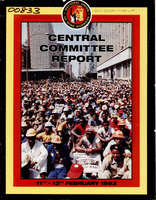 The National Union of Mineworkers (NUM) held a successful 1993 Central Committee (CC) meeting from 11-13 February at CSIR Centre in Pretoria. The CC attended by 300 delegates from the 16 regions of the union representing 280 000 members deliberated key issues affecting workers in mining and energy sectors. With the opening session, the 11th, being the third anniversary of the release of NUM honorary president, Nelson Mandela, the stage was set for tough decisions to be taken on the current political developments in South Africa. NUM president, James Motlatsi outlined general guidelines on major issues affecting workers in his keynote address. Major issues for discussion were: Retrenchments, NUM's role in the forthcoming national democratic elections, Wages and conditions of employment demands for 1993, Assessment of the state of the NUM. It took delegates three days of serious discussions to come out with decisions which will guide the union in this dynamic period in the history of our country. NUM was honoured to have ANC secretary general, Cyril Ramaphosa as a guest speaker on the current political developments. COSATU general secretary, Jay Naidoo also gave us the honour by giving an invaluable input on the challenges faced by the labour movement today. The CC culminated with a mass rally in Klerksdorp on the 14th February for report back. The CC was held under the theme: Save jobs and protect standards. Forward to democratic elections. Details of CC decisions are given in this report. Please note that this report is not the official record of the CC proceedings but is a summary guide prepared by the NUM media department for the information of members. We suggest you keep it for future reference.
 -
 It is one year since our last Central Committee.During this period much has happened on the international and domestic front. Yugoslavia remains at war, the United States of America has the first democratic President since Carter and millions of people are starving. It is not only in Somalia that people are starving.Right here at home over two million people are fed by poverty relief programmes. Although we thought that democracy was at hand, it has still eluded us in 1992. The Apartheid government still remains firmly entrenched although the negotiations with the African National Congress show some glimmer that the multilateral negotiations will resume shortly, the establishmant of a transitional government and the holding of the first non-racial national democratic elections by the end of 1993 or early 1994. With the violence still not under control we continue to see our people under siege, families broken up and property destroyed. For peace there must be democracy. Apartheid has left incalculable damage and a legacy that will have to be addressed. As the National Union of Mineworkers we have made and will have to continue to make many sacrifices. 1993 heralds important challenges for our union and the democratic movement as a whole. Central Committee will have to deliberate on these matters and decide the way forward for the coming months.
 -
 This is a booklet to explain why M A W U has decided to join the Industrial Council for the Iron, Steel Engineering and Metallurgical Industry. In South Africa at present there are 104 Industrial Councils. However, the one for the Iron, Steel, Engineering and Metallurgical Industries is the largest and most important covering nearly 500 000 workers. But only about 100 000 of these workers belong to trade unions. At the Industrial Council the employers and trade unions negotiate an agreement that covers all 500 000 workers. At present on the union side there are 14 trade unions - M A W U will make it 15. But most of these unions are racial unions and what are called craft unions - that is their members only do certain kinds of jobs e.g. boilermakers or electricians etc. On the employer side nearly all the 8400 factories in the industry are members of the employer association SEIFSA. It is SEIFSA - which is the largest and most powerful employer association in South Africa - that negotiates for employers on the Industrial Council.
 -
 More than two years of worker struggle, mass action and negotiations resulted last Thursday 14th February in the scrapping of ^ the 1988 amendments to the Labour Relations Act. The State President has to sign the new Act within ten days of it being passed by parliament. Some of the most important changes contained in the new LRA are: The 1988 definition of the "unfair labour practice" is gone, removing strikes and lockouts from this definition. It will now be easier to use the Conciliation Boards and the Industrial Court to help resolve disputes. It will no longer be presumed that a union 0 is responsible for an illegal strike of its members. An employer can't interdict a strike without giving 48 hours notice or, if shorter notice is given, without informing the union. Unions with public and private sector members can now register. COSATU will be organising regional workshops for organisers to look at the implications of the Act, and how to apply the new provisions.