General Materials
Item set
- Title
- General Materials
- Alternative Title
- LRS General Materials
- Creator
- Labour Research Service (LRS)
Items
-
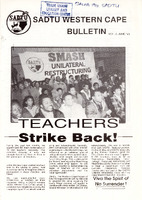 During the past few months, we experienced the mass mobilisation of 70 000 teachers, nationally. This collective showing of unity and strength forced the State to listen to the grievances of teachers. In the Western Cape, militant teachers took to the streets to picket, held successful sit-ins at Regional Offices, participated in mass marches and rallies. We saw unprecedented mass mobilisation of teachers on three occasions. Firstly, a SADTU meeting at the Athlone Civic Centre where a resolution was adopted to intensify ttie campaign against unilateral restructuring and retrenchments. Secondly, after consultations with other teacher organisations in the Western Cape, we embarked on an 'ambitious' plan of uniting all organisations against rationalisation, merit awards and our fight for a Living Wage. This culminated in the historic meeting at the Good Hope Centre which drew approx. 10 000 teachers together to demonstrate the anger of teachers at the racist education departments and the intransigent State. Thirdly, The Western Cape Region of SADTU supported the call by National to suspend the strike regarding the Living Wage demand but agreed to continue with strike action, 24 25 May, around the issue of rationalisation and retrenchments. This was in accordance with SADTU National position. On the 26 May, at a SADTU mass rally at the Athlone Stadium, (psst! the Civic Centre was too small !) approx. 9 000 teachers, from as far as Bredasdorp, Swellendam, Ceres, Tulbagh, Vredendal, Malmesbury and Atlantis braved the inclement weather to hear a report-back from our comrade chairperson, Vivienne Carelse who was part of the SADTU National Negotiating Team with the Department of National Education
 -
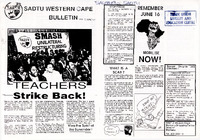 During the past few months, we experienced the mass mobilisation of 70 000 teachers, nationally. This collective showing of unity and strength forced the State to listen to the grievances of teachers. In the Western Cape, militant teachers took to the streets to picket, held successful sit-ins at Regional Offices, participated in mass marches and rallies. We saw unprecedented mass mobilisation of teachers on three occasions. Firstly, a SADTU meeting at the Athlone Civic Centre where a resolution was adopted to intensify the campaign against unilateral restructuring and retrenchment. Secondly after consultations with other teacher organisations in the Western Cape, we embarked on an 'ambitious' plan of uniting all organisations against rationalisation, merit awards and our fight for a Living Wage, This culminated in the historic meeting at the Good Hope Centre which drew approx. 10 000 teachers together to demonstrate the anger of teachers* at the racist education departments and the intransigent State.
 -
 The National Union of Mineworkers has asked for a meeting with the Minister to highlight the severe social and economic effects that are caused by the low rand gold price and the consequent rationalisation measures that are being implemented by the gold mines. The severity of the crisis is well illustrated by the case of the Harmony Gold Mine in the Orange Free State. This is the largest of the so-called "marginal" gold mines and last week it retrenched over 6 000 workers. The gold mines have cut back over 130 000 jobs over the last five years. The job cuts have speeded up again in 1992 as the gold price has continued at low levels. The NUM expressed its deep concern at this contraction in the gold industry most strongly at the Summit on the Future of the Mining Industry in June 1992. This meeting was attended by mining houses, the trade unions and several state departments. The NUM made a plea for a national plan and a national policy to regulate and manage the process of down-scaling. Despite the formation of a Summit Steering Committee to consider this and other proposals, and a whole series of working-group meetings involving all parties, nothing practical has come out of the process to address the issue of down-scaling.
 -
 The NUM's objectives for the mining industry are simple and straightforward. They include the following: The elimination of racism in the mining industry, The payment of fair wages to all mineworkers, The establishment of decent living conditions for workers and an end to the evils of the migrant labour system, Improved health and safety and other working conditions, Proper, broad-based training for mineworkers, Care for workers downscaling of mining and the development of an economically viable mining sector that is run in a humane and participatory manner. It is plain under the system, both of which are profoundly oppressive a That is why the NUM has always taken a strong political stance. Our belief is that there needs to be a thorough-going RESTRUCTURING and re-organisation of the mining sector before the goals of our union can be met. The burning issue that threatens progress towards our objectives, however, is the economic crisis in the gold industry.
 -
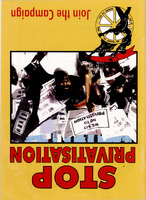 Privatisation is when government hands over the management or assets of government services to private interests. Privatised services don't provide well for the poor, who can't pay, because private interests must make profits. Government says it will ensure the poor get good services through contracts and regulations - but it doesn't have capacity to enforce them. Privatisation makes it harder to maintain cross subsidies. Cross subsidies mean rich communities or industry pay more, so that poor households can pay less. Getting rid of cross-subsidies tends to make the prices for services for the poor go up. Privatised companies don't take the broader economic needs of the country into account, for instance by buying goods locally as a way to create jobs, and providing affordable services in remote regions.
 -
 Industrial and mining group Barlow Rand was again selected the SA's top company in the annual Financial Mail Top 100 companies survey. Barlows received top position in rating in the rankings of total assets, sales, profit and market capital at the Johannesburg Stock Exchange. Barlows Received net profit of Rl,06 billion in the year to September 1989 from the sales of R26,4 billion. Ranked by sales CG Smith received the second position, SAB came third and CG Smith Food on the fourth position. Following is the ranking of the too ten companies on the JSE, ranked by sales, net profit and assets.
 -
 On 12 June 1986, at a joint sitting of the three houses of Parliament, the State President declared a National State of Emergency. In his speech he said: “. . .the sporadic instances of violence have once again begun to increase and have taken on such proportions that I am of the opinion that the ordinary laws of the land at present on the statute book are inadequate to enable the Government to ensure the security of the public and to maintain public order.†What were the State President's reasons for declaring the State of Emergency? Was the Government's action justified? What of the rule of law? Has the National State of Emergency achieved its objectives? When will the National State of Emergency be lifted?
 -
 The formation of FOSATU is part of a long history of struggle to organise the Black workers of South Africa into independent, non-racial trade unions. Black worker resistance in South Africa is as old as the introduction of wage labour but the first effective recorded trade union organising black workers was started in 1917 to be followed by the more famous ICU (Industrial and Commercial Workers Union) in 1919. Ever since then unions have fought against State and employer hostility to the unionisation of black workers. Other federations rose and fell. The 1950's marked a great rise in political and worker organisation with the emergence of the South African Congress of Trade Unions (SACTU) as part of the Congress Alliance. Severe State repression led to the 1960's being a low point of worker organisation. However, growing economic problems of inflation, unemployment and poverty plus a very much larger industrial working class led to an upsurge of worker militancy in the early 1970's. This gave rise to new union organisation in Natal, Transvaal and Port Elizabeth. By 1974 new coordinating bodies had emerged in Natal and the Transvaal. The need for greater unity was clear in the face of hostility from the State, employers and established unions - both the racist white unions and those in the Trade Union Council of South Africa (TUCSA).
 -
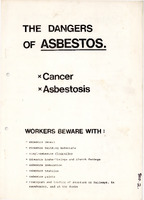 This is a health education booklet for organised workers. It is about asbestos - one of the most dangerous dusts that workers can be exposed to. The aim of the booklet is to provide asbestos workers with the information they need in the struggle for better working conditions. The booklet is divided into three parts. The first part describes the problem of asbestos - who works with asbestos and how it can affect their health. The second part describes how workers can find out how bad the asbestos problem is in their workplace. This is done either by checking the air in the workplace or by having themselves properly examined by doctors. In the final section, ways of solving the problem are described. Workers cannot be sure that they are. safe until they fully understand the problems facing them. This booklet aims to provide the information that workers need.
 -
 South Africa is a land of extraordinary beauty, ecological diversity and abundance. However, the land that God has entrusted to us is crying for justice. During the years of struggle against apartheid several ecumenical documents addressed the issues of the day. The Letter to the People of South Africa (1968), the Kairos Document (1985), the Evangelical Witness in South Africa (1986), the Road to Damascus (1989) and the Rustenburg Declaration (1990) may be mentioned in this regard. In the same ecumenical and prophetic spirit, this document seeks to address the escalating destruction of our environment that results in immense suffering for people, for other living species and for our land as a whole. In responding to this challenge Christians in South Africa may recognise, acknowledge and learn from the many voices and contributions on environmental concerns coming from all over the world — from churches and ecumenical movements, from the Earth Charter movement, from other religious traditions and from environmental organisations. The World Summit on Sustainable Development (WSSD) - 26 August to 4 September 2002, Johannesburg - also challenges the churches in South Africa to respond to these concerns.,1st ed,Ecumenical Foundation of Southern Africa (EFSA)
 -
 Despite the massive contribution women make around the world, they still fall into the category of the poorest and the most oppressed. Women have borne the brunt of the social costs of the changes in the world economy such as globalisation, increased international competition, structural adjustment and the deregulation of labour legislation. Massive technological advances have done little to benefit women around the world. In fact, in many instances it has actually increased their hardships. Multinational companies search the globe for areas that offer cheap labour and poor working conditions. Globally, women make up the bulk of the army of so-called “flexibleâ€, cheap workers sought after by employers anxious to increase their profits. It is women who are mostly to be found in sweatshops and who are least likely to be organised. In South Africa, there is already a significant trend of homeworking in the clothing sector and casuahsation in the retail and other sectors. And when they are organised into unions, women struggle to be recognised as leaders in those movements. With massive retrenchments in the South African economy, more and more women are being pushed out of the labour market. Women's unemployment rate is higher than men's world-wide. The spate of retrenchments and job losses in the last few years have been described as a “job loss bloodbathâ€. According to recent statistics 1 million jobs have been lost since 1994 - what does this say about GEAR'S employment record? The mining and construction industries have suffered the largest job losses in the South African economy. While the workforce in these industries is predominantly male, and mostly migrant labour, the impact on women and families in rural areas is high, given the extreme rates of unemployment and poverty and their reliance on remittances. The clothing, textile, leather and footwear industry, which is female-dominated, has also been hard hit by retrenchments - approximately 76 000 jobs have been lost since 1995.
 -
 Industrial Councils were established in terms of the 1924 Industrial Conciliation Act (ICA). Even with the ICA giving way to the LRA of 1956, Industrial Councils remained the central forums for collective bargaining. Because African workers were excluded from the definition of an "employee" both in the ICA & LRA of 1956, African workers and their unions did not participate in Industrial Councils. As a result of this the.Councils were then used by white unions to promote the interests of skilled white workers. This situation only partially changed in 1979 when the LRA was changed to give African workers bargaining rights. From then on African workers and their unions could participate in Industrial Councils.
 -
 Comrade President, Honorary President, General Secretary and delegates, I present this report on behalf of the National Executive Committee (NEC). Since the last Conference the Union has faced many challenges and difficulties, but has despite this managed to play its rightfull role as a social partner by entering into the national debate of socio-economic transformation. This Conference has to further this advances by debating the crucial issues that underpin our advance to the total socio-economic transformation of our country. We also need to revisit and re-assess the pillars on which our Union rest, and strenghten them through policy formulation - and here I specifically want to isolate the areas of finance and administration. Later in this report I will attempt to highlight some of the crucial areas. Comrade President, allow me to express the NEC's appreciation to the staff for their dedication, loyalty and commitment, to FAWU over the past two years. We want to give them the assurance that their loyalty does not go by unnoticed, and that we will attempt to reward them for this excellent service. May I furthermore use this opportunity to thank the comrades in the National Executive Committee (NEC) and the National Office Bearers for their support and commitment over the past few months. It is through this commitment and dedication that we are able to present this Conference with a report. Comrades, the Annual Audited Financial Statements for the financial year will be tabled tommorrow. To the best of my knowledge this statements represents the financial position of the Union for the year ended 31 March 1997.
 -
 Comrade, General Secretary : Mandla Gxanyana , the acting Office Bearers Lucky Nsizwana , Thomas Basson and Christopher Plaatjies . Leaders of COSATU , SACP , ANC and the present Ministries , Distinguished Guests fraternal forces in the labour movement. I will start by saying we have come a long way as FAWU and we have survived through thick and thin. This was only because of our political understanding and ideological belief on the interconnection of economic struggles with the broad national question. The national liberation has been in the heart of this organisation from its inception in 1941 in the form of African Food and Food and Canning Workers Union. It is both a pleasure and an honour to share the same platform once again with so many leadership of FAWU from all the provinces of our country . Furthermore one feels especially fortunate to be part of this Bi-annual conference . Two years ago in 1995 , we came together in Bloemfontein for a week long Bi-annual Conference . A programme was produced and adopted by the conference and furthermore a action plan to implement the Programme was discussed by the NEC and also endorsed . If we have to be honest not all the aims and objectives we set for ourselves we have manage to achieve them as expected per the mandate of our last Conference , there are number of reasons for that, the G .S report will deal with some of them . Nevertheless we manage to implement some of the areas e.g. setting the tone for Super Bargaining Council which has to put a process of standardise wages in the Food and Beverage Sector and come up with clear industrial policy on the following areas training and grading , industrial provident fund and other benefits. We have reached this date not without problems internally as leaders of the organisation and as the broad membership . Let us lead this organisation and the masses of workers in theory but also in practice. The prospects of achieving a revolutionary break through in South Africa are greater today than ever before in our history. The 27th of April was just a confirmation of the long standing vision of transforming the country from the ashes of Apartheid monopoly Capitalism to Apartheid free South Africa. We owe the workers of this country an answer, the landless rural masses, students , women and all peace loving people. Because it is through the mobilisation , organisation and unity in action of this large front of forces who made it possible from every corner of our country Apartheid to be unworkable.
 -
 What is globilisation The definite answer may not be forthcoming but the process of globilisation may be defined and contextualised Generally 1 will loosely refer to this process [globilisation] as an expression of imperialism of the powerful rich north countries and their multinational companies [MNC or TNC] that undermine the economic borders and powers of the poor developing and underdeveloped south countries in terms of trade relations and economic interactions, i.e., I speak here of a kind of recolonialisation. It is recolonialisation in that the smaller, poor countries of the South are stripped of powers to virtually nothing regarding the scope to shape their economic policies in terms of the WTO trade system of the world This state of affairs also allows free movement of capital and goods from rich countries to poor countries at the benefit of the former and the detriment of the latter. This globilisation, as signed by the WTO, gained momentum and was given impetus by the collapse of the Eastern Socialist Block and Soviet union in particular This is because trade arrangements and economic relations within the socialist block and between socialist countries and developing countries collapsed.
 -
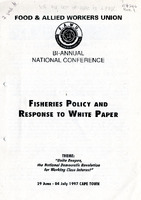 This paper is intended to serve as an aid to discussion in the Commission dealing with Sea Fisheries. Accordingly, its various sections provide an overview of the key issues which can inform discussion. Historically, access to marine resources was unrestricted. In order to facilitate the monopolisation of the fishing resource by a few white companies, a system of quotas was ( introduced. In this way many black fisher folk lost the access rights they had had for generations. At the present time, the fishing industry is completely biased in favour of a few large and medium sized white companies. This is illustrated by the fact that just three (3) companies hold; 72% of the hake quota ; 75% of the abalone quota , and 71% of the sole quota. Overall , across all species, approximately nine tenths (9/10) of the resource is controlled by a hand-full of companies. Since 1994, some of these companies have attempted to blacken their faces. They have also sold minority shares to some black business consortia. Further, a few members of the black elite have been given quotas. None of the above amounts to any kind of restructuring. None of the historic imbalances have been addressed. The above have merely been attempts to confuse the issue and to frustrate any process that attempts to restructure the industry. Prior to, and after the 1994 election, there were various initiatives by Alliance members to outline an equitable and just policy of reconstruction and development for the fishing industry.
 -
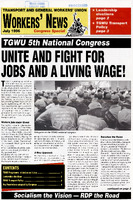 TGWU is gearing up to influence and shape future transport policy with our Transport for the People policy document. A fresh perspective and preparedness to actively assert our vision for transport emerged at our 5th National Congress held in May at the Holiday Inn Garden Court in Johannesburg. More than 700 delegates representing 60 000 members countrywide gave concrete expression to our congress theme by adopting a call for a 24-hour general strike on 2 July in support of our demands around public transport policy. The call to action is a demonstration of our rejection of the Minister of Transport's intention to restructure the public transport industry (buses and Rail) through privatisation, thereby placing the future employment of workers under direct threat.
 -
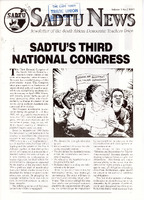 The Third Biennial Congress of the South African Democratic Teachers Union (Sadtu) is one of the most important national events in the short but eventful history of this giant teacher union. This Congress takes place against the backround of unprecedented political transformation which was ushered in by the dawn of a new democracy in April 1994. History will proudly record Sadtu as one of those pioneering allies who fought resiliently to liberate the masses of our people and to eradicate Apartheid education and all its vestiges. This Congress, scheduled to be convened during the period 11-13 July 1995, will be graced by the presence of more that 700 accredited Sadtu delegates, 100 national observers and 20 international guests. This, in fact, will be the largest assembly of delegates at a Sadtu Congress since inception. Since its inception in 1990 Sadtu has been steadfast and persistent in its resolve to transform the education system in our country. The early 1990's were an era of heightened levels of teacher consciousness which highlighted the plight of the South African teacher. It was during this period and thereafter that thousands of teachers swelled the ranks of Sadtu as it was viewed as a champion of teacher rights and an ideal vehicle for transformative changes as espoused by the teacher at the grassroots level. This significant shift of membership from established teacher associations disturbed the balance of power in the education terrain. In grasping the strategic initiative Sadtu was able to earn an enviable position in educational struggles.
 -
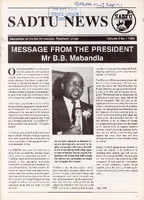 On behalf of SADTU I wish to thank teachers generally and members of the Union in particular, for their valuable contribution to the success of the recent elections, The Union's stated commitment to educate the masses on voting was demonstrated by the large numbers of our members who were involved in voter education in their respective communities. In spite of the high rate of illiteracy, there was a negligible number of spoilt papers. I also wish to congratulate Professor S .M.E. Bengu on being appointed National Minister of Education. We assure him and his colleagues in the provinces of the Union's support as long as their dealings with teachers is democratic and not patronising. To all our Comrades who made it to parliament - both regionally and nationally - Congratulations! It is with a sense of pride and achievement that we South Africans of all persuasions, were able to pull off this remarkable feat that has ushered in, what appeared to some, an unattainable dream.
 -
-
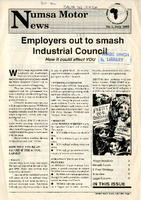 WHILE wage negotiations with employers are deadlocked, there are more serious rumours that some employers are trying to smash the Motor Industrial Council and so break down centralised bargaining. They are acting just like other employers and the government who want to destroy centralised bargaining. They see it as a way to weaken the power of workers. COSATU decided early this year to fight against these moves. NUMS A is committed to centralised bargaining. It bargains centrally in all the industries where it organises - motor, auto, engineering and tyre. The collapse of the IC in the motor sector would encourage employers in other NUMSA industries to smash the other central bargaining forums. This would defeat all the gains we have made over the years. Motor workers must lead the way in squashing employers' wishes.
 -
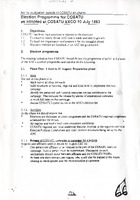 COSATU must intervene in affiliates where it has identified problems, where problems have been brought to its attention and / or has been requested to do so. The CEC should draw guidelines on how and under which circumstances the federation and its structures may intervene taking into account clauses 3.9 and 3.10 of the constitution. Such intervention should not undermine affiliates where such problems exist. COSATU leadership must be visible during major disputes between affiliates and employers and co-ordinate solidarity with workers involved in such disputes.
 -
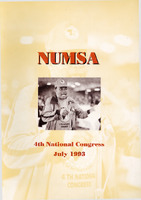 Our National Congress is the highest decision making body of the Union. Its main task is to adopt resolutions that become the policies of NUMSA. These policies guide the union on how to act until the next Congress. After previous Congresses, we have only published the adopted resolutions. But this has meant that our members have lost out on the lively debates that have taken place during the Congress. In this booklet, we try and bring the Congress alive for you. We give you the full text of the General Secretary's report, the debates as they took place, word for word. What was decided on the Alliance? Why do we want “nationalisation without compensation� What was the decision on the Working Class Party? The final resolutions that were adopted are there for you to see. Extracts from speeches of various speakers are also given. Two key issues - the contents of the Reconstruction Accord and Restructuring Industry - will continue to be discussed in the Union. (The documents are included; see pages 65-82) Congress mandated the next Central Committee in October 1993 to take decisions on these issues. Use the booklet to find out for yourself what was said. You will be able to see what were the reasons given for the different positions. This will help you explain to members why NUMSA has adopted these resolutions. You will also see how democracy takes place. In some cases, compromises were reached, in other cases there was no compromise and the motion had to be put to the vote. Comrades, as our new President, Cde Tom, said in the Congress. “Our primary duty is to serve the interests of our members and those who have elected us to represent them It is therefore necessary for us to be accountable to them in shaping the policies of the union. Most of the time we do not consult our members when we debate issues - even on minor issues we leave them behind It is very dangerous for us to create a distance between ourselves and our members. The members must not follow but must be there with us. We must remember our base is the factory floor." Use this booklet as a tool to get rid of that distance between you and the members. Use it to help you understand the positions that NUMSA has adopted as its policies. The General Secretary's Report also gives a full picture of how NUMSA functions and gives useful background information to many of the discussions. The Tables mentioned are at the back of the book; see page 83 to the end. In this first section the debates and the speeches have been put into shaded boxes so it is easier for you to read. Use the booklet to build, strengthen and consolidate our Union in these difficult times.
 -
 This Special Report attempts to capture, in a very readable journalistic style, the fundamental complexity of the conflict in the Weenen District. It is an honest attempt to look beyond the comfortable stereotypes. Hopefully, it will contribute to a clearer understanding of attitudes to land and the conflict around land. There are no easy solutions to this problem. But, hopefully, this report will assist in the process of finding workable solutions to land struggles in Weenen and other neglected parts of South Africa.,Special Report no. 8
 -